What is the Google Ads Direct Offer asset, and how should you plan promotions around it?
Direct Offers let advertisers show a deal, such as a percentage discount, to shoppers inside an AI Mode conversation, with Google's AI deciding when the offer is relevant. Here is what Google has confirmed, what the new beta asset adds, who can use it and how to plan holiday promotions safely.
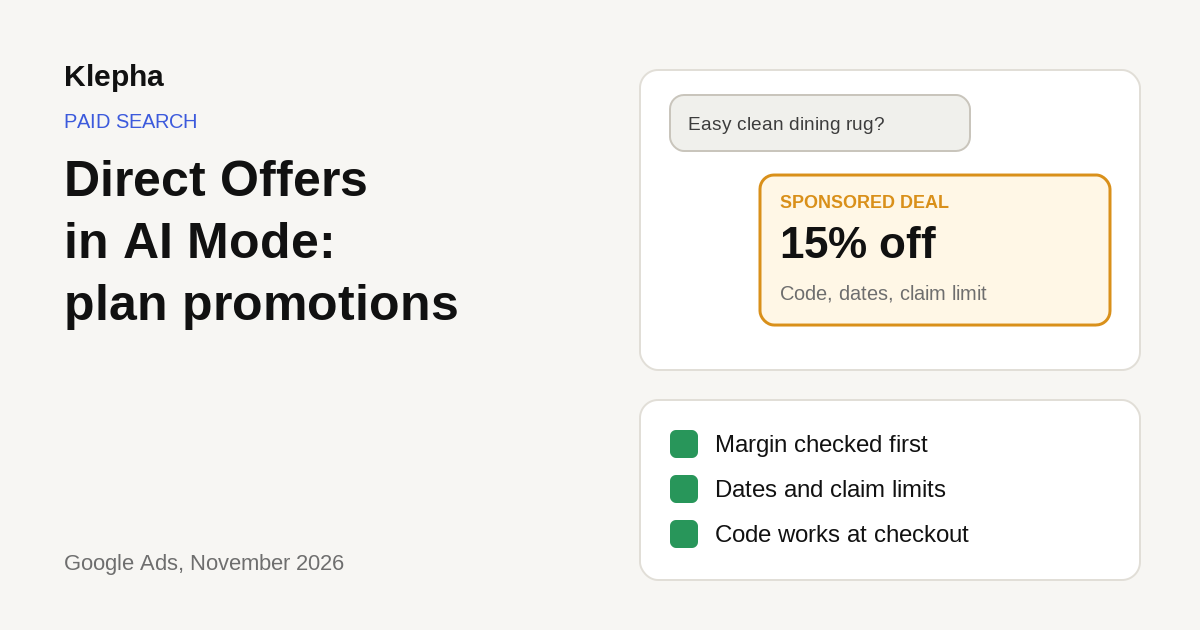
Direct Offers are a Google Ads pilot that lets advertisers show an exclusive promotion, such as "20% off", to shoppers who appear ready to buy while they research inside AI Mode in Google Search. Advertisers set the offers they are willing to give, and Google's AI decides when an offer is relevant enough to display, labeled as sponsored.
Since October 2026 advertisers have also reported a beta Direct Offer asset inside Google Ads that lets them set the incentive, promo code, dates, terms and claim limits, and that currently works only with campaigns using AI Max or text customization. Access is still limited, so treat it as a test to prepare for rather than a channel to bet the holiday season on.
Key takeaways
- Launched as a pilot: Google introduced Direct Offers on January 11, 2026, starting with discounts in AI Mode and brands such as Petco, e.l.f. Cosmetics, Samsonite and Rugs USA.
- Expanded in May: at Google Marketing Live on May 20, 2026 Google announced promotion bundling built by Gemini, native checkout for Universal Commerce Protocol merchants and travel offers from partners such as Booking and Expedia.
- The asset is a beta: industry reports from October 2026 describe a Direct Offer asset with incentive, promo code, dates, terms and claim limits, tied to AI Max or text customization campaigns.
- Google decides when it shows: you set the offer and guardrails, and Google's AI chooses the moment and the offer.
- Margin is the real risk: decide which products can carry a discount before you hand the timing to an algorithm.
- No separate AI Mode reporting: judge results on orders, margin and new customers, not platform conversions alone.
What are Direct Offers?
Google announced Direct Offers on January 11, 2026, in a post by Vidhya Srinivasan, VP and GM of Ads and Commerce. Google described it as "a new Google Ads pilot" that "allows advertisers to present exclusive offers for shoppers who are ready to buy, like a special 20% off discount, directly in AI Mode."
Google's example explains the idea. A shopper asks AI Mode for "a modern, stylish rug for a high-traffic dining room" that is easy to clean. AI Mode already surfaces relevant products. With Direct Offers, a relevant retailer can also feature a special discount at that moment, which Google says "helps you get better value and helps the retailer close the sale." In Google's demo the placement is labeled "Sponsored deal."
The mechanics Google described in January are simple:
- Retailers set up the offers they want to feature in their campaign settings.
- Google uses AI to decide when an offer is relevant to display.
- The pilot started with discounts, with plans to support other attributes such as bundles and free shipping.
That last point matters for planning. A Direct Offer is not a keyword ad you schedule against a query. It is an incentive you make available, and Google picks the conversation where it appears.
How has the pilot expanded?
| Date | Change | Source |
|---|---|---|
| January 11, 2026 | Direct Offers introduced as a Google Ads pilot in AI Mode, starting with discounts. Google named Petco, e.l.f. Cosmetics, Samsonite, Rugs USA and Shopify merchants as early collaborators. | Google blog |
| May 20, 2026 | Pilot expanded. Google said Chewy, Gap and L'Oreal had surfaced deals since January, and announced promotion bundling, native checkout for UCP merchants and travel offers. Google said Direct Offers "will now naturally surface in the AI Mode response." | Google blog (Google Marketing Live) |
| October 2026 | Search Engine Land reported Google Ads testing a new Direct Offer asset for AI Mode promotions (October 7). Practitioners reported fields for incentives, promo codes, dates, terms and claim limits. | Industry reports |
What the May expansion added
- Promotion bundling. Brands can upload several kinds of promotions in Google Ads, including discounts, giveaways and local coupons. Google said they would soon be able to supply eligible products and guardrails and use AI Brief to reach the right audiences, while Gemini constructs a deal, such as a relevant product bundle, for a specific search.
- Native checkout. Google added native checkout integration for merchants on the Universal Commerce Protocol, so a shopper can claim the deal and buy faster. Our guide to agentic checkout and UCP explains who qualifies.
- Travel. Google said travel partners like Booking and Expedia would be able to surface offers inside AI assisted trip planning.
What does the Direct Offer asset add?
The newest piece is a dedicated asset inside Google Ads. Search Engine Land first reported it on October 7, 2026. We could not load that article on November 27, 2026 because the site blocked automated access, so the details below come from practitioner reports that cite it:
- What you can set: the incentive, a promo code, start and end dates, terms, and claim limits (how many times the offer can be used), according to a monthly Google Ads news recap published on LinkedIn on November 1, 2026.
- Who decides: Google's AI decides when an offer shows and which offer to show.
- Where it serves: the asset currently works only with campaigns using AI Max or text customization, as both the recap and a UK agency review dated October 19, 2026 report.
Google has not, as of November 27, 2026, published a full help center article for the asset that we could find, and the feature is labeled beta where it appears. Expect field names and eligibility rules to change.
Who can use it?
| Question | What we know |
|---|---|
| Is it open to every advertiser? | No. Google describes Direct Offers as a pilot, and the asset appears as a beta in a limited number of accounts. |
| Which campaigns qualify? | Reports say the asset serves only on campaigns with AI Max or text customization. Google recommends AI Max for Search, AI Max for Shopping and Performance Max as the foundation for its new AI Mode formats. |
| Which countries? | The pilot started with select US retailers. Ads in AI Mode have since expanded to more markets, but Google has not confirmed Direct Offers outside the pilot. |
| Which industries? | Retail first, with travel partners announced in May. |
| Can you choose the exact placement? | No. There is no separate AI Mode campaign, and Google decides when the offer is relevant. |
If you do not see the asset, ask your Google account team whether you can join the pilot, and in the meantime make sure your account is eligible for AI Mode placements at all. Our posts on extra ad slots in AI Mode and local retailer ads in AI Mode cover how those placements are evolving.
Ads are one half. Are you in the AI answer itself?
Klepha's free report shows how ChatGPT, Gemini and Perplexity describe your brand and which buyer questions you are not answering yet.
Get my free reportHow should you plan holiday promotions around it?
This article is published on Black Friday 2026, with Cyber Monday on November 30 and December gift shopping ahead. If you have the asset, a careful holiday test looks like this:
- Choose the products first. Pick a short list of products where a discount is affordable and where shoppers compare options, because that is where AI Mode conversations happen. Exclude low margin and stock constrained items.
- Set hard dates. Match the asset's start and end dates to your sitewide promotion calendar so an offer never shows after it has expired on your site.
- Use claim limits. Cap redemptions so a well performing offer cannot quietly exceed your promotion budget while you are offline over a holiday weekend.
- Write clear terms. State exclusions, minimum spend and eligible products in the terms field. Ambiguity creates support tickets and refunds.
- Make the landing page honor the deal. The promo code must work at checkout, and the discounted price should be visible on the page the shopper lands on. A deal that disappears after the click wastes the most valuable traffic you have.
- Keep feeds consistent. Prices and promotions in Merchant Center should match what the offer promises.
- Run it alongside, not instead of, your core campaigns. Our holiday SEO and ads strategy covers launch timing for the rest of your plan.
A simple offer plan template
| Field | Example entry | Why it matters |
|---|---|---|
| Products | Five mid priced bestsellers with healthy margin | Limits exposure to the items that can carry a discount |
| Incentive | 15% off or a free accessory | Test value framing as well as price |
| Promo code | A unique code used only for this asset | Lets you attribute redemptions in your own store data |
| Dates | Matches your site promotion exactly | Prevents expired offers showing |
| Claim limit | Set from your promotion budget divided by average discount | Caps cost while the AI controls timing |
| Terms | Exclusions, minimum spend, one per customer | Reduces disputes |
How do you protect margin?
Because Google's AI decides when a discount appears, the main risk is giving money away to people who would have bought anyway. Three habits help:
- Know your break even before launch. Work out the maximum discount each product can carry and still make money after ad cost. Our break even ROAS guide walks through the math.
- Prefer value over price where you can. Google itself said it wants to support offers beyond discounts, such as bundles and free shipping. A bundle can feel generous while costing less than a straight discount.
- Watch repeat customers. If most redemptions come from existing customers, the offer is subsidizing loyalty rather than winning new buyers. Check this in your store data with the unique code.
How do you measure Direct Offers?
Google does not report AI Mode performance as a separate line, and AI Max reporting describes campaign matching and assets, not the placement. That means:
- Use a unique promo code so redemptions can be counted in your own store, not only in Google Ads.
- Compare against a baseline. Export the previous 90 days for the same campaigns before you switch the asset on.
- Judge on margin and new customers, not platform conversions alone. A rise in conversions with a fall in profit is not a win.
- Track search terms weekly. AI Max widens matching, so add negatives quickly. Our negative keyword list guide helps.
What is still unknown?
- General availability. Google has not announced when the asset leaves beta or when Direct Offers open beyond the pilot.
- Pricing model. Google has not explained whether showing an offer changes how clicks are priced.
- Placement reporting. There is no confirmed plan for AI Mode specific reporting.
- Markets. Google has not confirmed Direct Offers outside the original US pilot.
Direct Offers point to where AI search advertising is heading: fewer keyword decisions, more decisions about what you are willing to offer and on which products. The brands that benefit will be the ones with clean product data, clear margins and offers that hold up after the click. If you want a second opinion on how paid and organic AI visibility fit together, see our expertise page and case studies, or explore our solutions.
Sources
- Google, The Keyword: New tech and tools for retailers to succeed in an agentic shopping era, by Vidhya Srinivasan. Published January 11, 2026; accessed November 27, 2026. Launch of the Direct Offers pilot, rug example, early partners.
- Google, The Keyword: A new generation of ads for the AI era of Search. Published May 20, 2026; accessed November 27, 2026. Pilot expansion: promotion bundling, native checkout for UCP merchants, travel offers.
- Search Engine Land: Google Ads tests new Direct Offer asset for AI Mode promotions. Published October 7, 2026. The page blocked automated access on November 27, 2026; details are taken from the reports below that cite it.
- LinkedIn, Google Ads news October recap: Google Ads news: October Recap, by Adriaan Dekker. Published November 1, 2026; accessed November 27, 2026. Asset fields and AI Max or text customization requirement.
- 21 Degrees Digital: Ads in AI Mode: should your business care yet? Published October 19, 2026; accessed November 27, 2026. Beta status, campaign requirement, measurement limits.
Frequently asked questions
What is the Google Ads Direct Offer asset?
It is a beta asset in Google Ads that lets advertisers make a promotion available to shoppers in AI Mode, with fields reported for the incentive, promo code, dates, terms and claim limits. Google's AI decides when and which offer to show.
Who can use Direct Offers in AI Mode?
Direct Offers are still a pilot that started with select US retailers. Reports say the asset currently serves only on campaigns using AI Max or text customization, so many advertisers will not see it yet.
Can I choose which searches show my Direct Offer?
No. Advertisers set the offer and its guardrails, and Google uses AI to decide when an offer is relevant to the shopper's conversation.
What kinds of offers are supported?
The pilot started with discounts. In May 2026 Google announced promotion bundling that can include discounts, giveaways and local coupons, plus native checkout for Universal Commerce Protocol merchants and travel offers.
How do I measure Direct Offer results?
Google does not report AI Mode performance separately. Use a unique promo code, compare against a pre launch baseline, and judge results on margin and new customers in your own store data.
Should I use Direct Offers for Black Friday and Cyber Monday?
Only if you already have access and clear margins. Limit the offer to products that can afford a discount, match dates to your site promotion, set claim limits and make sure the code works at checkout.