Google AI Mode now shows up to four ads per answer: what more ad slots mean for paid and organic search
Google AI Mode has been seen showing four text ads stacked beneath a single answer, where one to three had been the usual count, and is testing one Sponsored heading over groups of shopping ads instead of a tag on every paid card. Neither change has been confirmed by Google as a permanent rollout. For advertisers this means more inventory for the same campaigns with no separate opt out; for organic visibility it means less room under the answer, which makes being cited inside the answer itself more important.
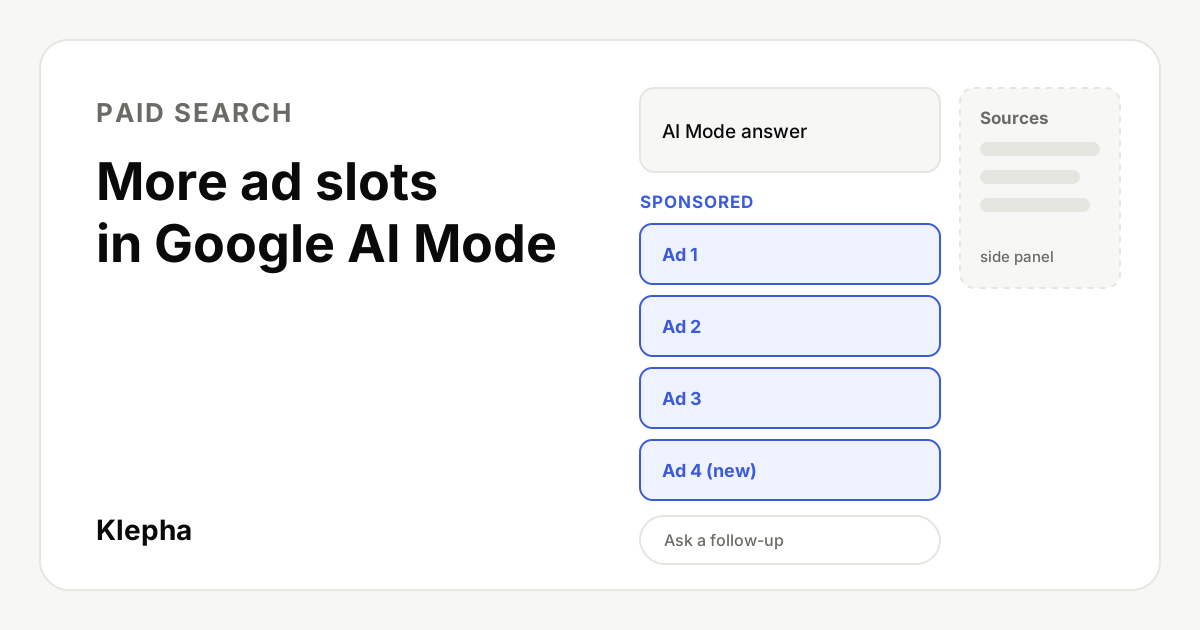
Ad density in AI Mode is rising quickly. Three ads at the bottom of a response were reported on October 14, 2026, four were reported by November 2, and in between Google began testing a carousel layout that labels a whole group of shopping ads with a single "Sponsored" heading. These sightings followed Alphabet's October 28 earnings call, where Google said lower monetization in AI Mode had weighed on Search growth and that it was scaling ads there.
This article covers what was seen, what Google confirms, and what the extra slots mean for paid search budgets and for brands that rely on organic visibility. Facts were checked on November 17, 2026 against Google's help documentation and reporting from PPC Land and Search Engine Watch.
Key takeaways
- Four text ads under one answer. Reported by Search Engine Watch on November 2 and Search Engine Roundtable on November 4, 2026, up from one to three.
- One Sponsored heading for shopping ads. A test spotted October 28 groups paid products under one heading and unpaid ones under "All products".
- No comment from Google on either. Both are documented sightings, not announced rollouts.
- Same campaigns, no opt out. Search, Shopping and Performance Max are automatically eligible, and AI Mode cannot be excluded separately from Search.
- Organic space shrinks. In the four ad example, the answer's cited sources sat in a side panel while the ads filled the space below the answer.
What exactly was seen in AI Mode?
Two separate changes were documented in late October and early November 2026. One is about how many text ads appear; the other is about how shopping ads are labeled.
Four text ads stacked beneath one answer
Sachin Patel of Search Engine Watch posted a screenshot on November 2, 2026 showing four ads in a row at the bottom of an AI Mode response, two weeks after he had reported three ads "instead of the usual two." Search Engine Roundtable followed on November 4, saying Google "can now show up to four Google Ads in the AI Mode responses for a single query," and described the usual number as "one or two ads, sometimes three," according to PPC Land's November 5 summary.
The example answered a question about AI SEO. Below the answer sat a "Sponsored" label, then a sentence in the assistant's voice introducing the ads, then four text ad cards showing advertiser names and logos but no web addresses. The follow-up question box came directly after the fourth ad. The answer's sources were listed in a separate panel to the right.
A single Sponsored heading for shopping ads
On October 28, 2026, Patel also spotted a test in AI Mode product carousels. Instead of a "Sponsored" tag on each paid card, one "Sponsored" heading sat above the paid group and an "All products" heading sat above the unpaid group. In the published examples, the paid cards came first, lost their individual tags and kept blue titles, while unpaid titles were black.
| Change | First reported | What changed | Google status |
|---|---|---|---|
| Three text ads below an answer | October 14, 2026 | One more ad than the commonly seen two | No comment |
| Four text ads below an answer | November 2, 2026 (Search Engine Watch); November 4 (Search Engine Roundtable) | Four ads stacked above the follow-up box, sources in a side panel | No comment |
| Sponsored and All products headings | October 28, 2026 | One label per paid group instead of one per card; unpaid group gets a heading | Described in reports as a test; no rollout announced |
These units sit alongside formats we covered separately: multiturn ads on follow-up questions and sponsored local retailer packs and sponsored stores in shopping answers. This article focuses on density and labeling.
What does Google confirm, and what is unconfirmed?
Google's help page "About ads in AI-powered experiences in Google Search," checked on November 17, 2026, sets the rules that apply to every new slot:
- Labeling: all ads in AI Overviews and AI Mode are "clearly labeled as 'Sponsored'" and visually distinguished from organic content, and Google "continuously tests and refines ad layouts," so presentation "may evolve over time."
- Eligibility: existing Search, Shopping and Performance Max campaigns are automatically eligible. No new campaigns or separate budgets are needed.
- Matching: ads match directly to the query, or contextually to both the query and the AI response. AI Max, broad match, Shopping and Performance Max qualify for both; exact and phrase match keywords qualify only when the query shows direct commercial intent.
- AI explainers: Gemini may generate short text introducing a group of sponsored options. Advertisers cannot write, edit, approve or opt out of it.
- Billing: the same auction and CPC or conversion based bidding as standard Search ads, with no extra charge.
- Controls and reporting: no separate targeting or opt out; negative keywords and brand exclusions still apply; results appear in aggregate in campaign and search terms reports.
- Markets: ads within AI Overviews and AI Mode are listed for the United States, Australia, Canada, India, Indonesia (AI Overviews only), Kenya, Malaysia, New Zealand, Nigeria, Pakistan (text ads only), the Philippines and Singapore, in English.
What Google has not confirmed: that four ads is a standard limit in AI Mode, how often four appear, which countries or query types see the stack, and whether the Sponsored heading test will roll out. Google said in October 2025 that a grouping of text ads on the classic results page would never hold more than four ads. Whether that cap governs AI Mode is not stated anywhere Google publishes. The introductory sentence above the four ads looks like an AI explainer as Google describes them, but neither Search Engine Watch nor Search Engine Roundtable identified it as one.
Why is Google adding ad slots now?
On Alphabet's October 28, 2026 earnings call, Chief Business Officer Philipp Schindler said "the strong growth in AI Mode queries had an impact because of the lower monetization we were seeing in AI Mode," and that Google is "now scaling ads within both AI Overviews and AI Mode to more users and more queries." Search & other revenue grew 12% to $63.35 billion, the slowest rate of 2026, and paid clicks rose 8% with cost per click up 4%, according to PPC Land's analysis of the results and the quarterly filing.
"More users and more queries" describes reach, not density. Google has not said it will show more ads per response. But if each AI Mode query earns less, PPC Land notes the obvious levers: ads on more queries, higher prices per click, or more ads per query. The four ad stack is an example of the third. Our piece on AI Mode upper funnel searches covers the call in depth.
What do more ad slots mean for paid search budgets?
The short answer: more inventory flows into the campaigns you already run, and you get very little visibility into how it performs.
Spend can move without any settings change
Because eligibility is automatic and there is no AI Mode opt out, a fourth slot is inventory your Search, Shopping and Performance Max campaigns can enter as soon as Google serves it. If your campaigns use broad match, AI Max or Performance Max, they are also eligible for contextual matching against the AI response, which reaches longer and more exploratory questions than exact or phrase match would.
Position and CPC are uncertain
Nobody outside Google knows what a fourth slot does to prices or click through rate by position. More slots could ease competition for entry, or an extra position at the bottom of a stack, directly above the follow-up box, could draw few clicks. Google's only published performance claim is that click through rates are similar between sponsored and organic product list items within AI Mode, which is a narrow comparison and says nothing about text ad stacks.
Measurement is aggregate only
Google reports AI Mode performance inside standard campaign and search terms reports, without a segment. The practical proxies are:
- Annotate October 28 and early November 2026 in your reporting, then compare impression share, CPC and conversion rate before and after.
- In the search terms report, filter for long, question style terms (for example, terms of eight words or more, or starting with how, what, which, best) and track their volume, cost and conversion rate over time. Our guide to AI search in Google Ads search terms explains how Google represents these queries.
- Run your own test queries in AI Mode for priority topics and record how many sponsored units appear and who holds them.
Negatives and brand exclusions are your main controls
Google confirms that negative keywords and brand exclusions continue to apply. Theme level negative lists help keep ads off informational questions where a fourth slot adds cost but not buyers; see our guide to negative keyword lists. Brand exclusions matter for broad match and AI Max campaigns that could otherwise appear on competitor or unrelated brand conversations. Keep conversion tracking and Smart Bidding signals clean, because automated bidding decides how hard to compete for these new positions. If you are unsure whether the extra spend pays back, our break even ROAS guide gives the threshold to test against.
What the Sponsored heading means for shopping advertisers
If the grouped heading rolls out, paid products still sit first in the carousel, but individual cards no longer carry their own tag. That could change click behavior in either direction, and no click data from the test has been published. For merchants relying on free listings, the "All products" heading gives unpaid products a named place but not a better position: the more paid cards a carousel carries, the fewer unpaid products are visible before scrolling.
Are you in the answer, or only under it?
A free Klepha report shows whether AI assistants name your brand in answers to your buyers' questions, so you can see what organic visibility you hold before paying for more slots.
Get my free reportWhat do more ad slots mean for organic visibility?
For brands that rely on unpaid visibility, the key question is how much room is left. In the four ad example, the sequence a user saw after reading the answer was: a Sponsored label, an AI written introduction, four ads, then the follow-up box. The cited sources, including Google's own developer guidance, were in a side panel. PPC Land's reporting also cites Productrise data showing AI Mode surfaced products on about 23% of shopping queries against 88% in standard search, and Reddit's chief executive telling analysts on October 29 that AI Mode "does not drive traffic."
Two points from Google's documentation matter here. First, Google says buying ads does not influence organic AI answers, and organic citation does not affect ad eligibility. Second, AI explainers can draw on "publicly available sources including your website." So the content you publish shapes both what the organic answer says and the generated context that may appear next to your ads.
How to stay cited when ads fill the space below
- Aim for mentions in the answer text, not only source cards. A brand named in the answer is visible before any ad. Track whether your brand is named, not just linked.
- Answer the long questions directly. AI Mode queries are longer and conversational. Pages that state a clear answer early, with specifics, are easier for AI systems to quote. Our guide on how to get content cited by AI covers structure, evidence and freshness.
- Keep product data consistent. For retailers, Merchant Center data feeds both free listings and Shopping ads, so accurate titles, prices and availability support both paid and unpaid placement.
- Measure AI visibility separately from rankings. Classic rankings do not show whether you are named in AI answers. See how to track brand visibility in AI search.
None of this guarantees a citation. AI systems choose sources with their own ranking systems, and the space under each answer is now more contested than it was a month ago.
A practical checklist for advertisers and SEO teams
| Area | Action | Why it matters now |
|---|---|---|
| Campaign eligibility | List which Search, Shopping and Performance Max campaigns use broad match, AI Max or Performance Max | Those are eligible for contextual matching against AI responses, where extra slots appear |
| Budgets | Annotate October 28 and early November 2026; review spend pacing and impression share weekly | New inventory can absorb budget without any setting change |
| CPC and position | Compare average CPC and conversion rate before and after the changes for the same campaigns | Pricing effects of a fourth slot are unknown |
| Search terms | Filter for long, question style terms and track their cost and conversion rate | AI Mode traffic is only visible in aggregate |
| Negatives | Add theme level negatives for informational questions that do not convert | Keeps ads off answers where the extra slot adds cost but not buyers |
| Brand exclusions | Set brand exclusions on broad match and AI Max campaigns | Limits serving on unrelated or competitor brand conversations |
| Website content | Keep landing pages accurate and clear | Google says AI explainers may draw on your website |
| Shopping feeds | Check titles, prices, sale prices and availability in Merchant Center | Feeds drive both Shopping ads and unpaid "All products" listings |
| Organic visibility | Test priority questions in AI Mode; record whether your brand is named, cited or only advertised | Ads now take more space below the answer |
| Reporting | Report paid and AI visibility side by side for the same topics | Shows whether you are paying for visibility you could earn |
What is still unknown?
- Scale. No source says what share of AI Mode responses show four ads or which query types trigger it.
- Status. Google has not said whether four ads or the Sponsored heading are tests or lasting changes.
- Limits. Whether the four ad cap Google set for classic text ad groupings in 2025 applies in AI Mode, and whether shopping units count toward it, is not stated.
- Performance. No published data on CPC, click through rate by position, or how the grouped heading changes clicks.
Until Google publishes more, treat these as signals of direction. Alphabet's fourth quarter results in early 2027 will be the first indication of whether more AI Mode ads changed Search revenue. For help linking paid, organic and AI visibility, see our expertise page and case studies.
Sources
- Google Ads Help, "About ads in AI-powered experiences in Google Search", checked November 17, 2026. support.google.com
- Search Engine Watch, "Google AI Mode now showing four ads at the bottom", Sachin Patel, November 2, 2026, checked November 17, 2026. searchenginewatch.com
- PPC Land, "Google AI Mode gains a fourth ad slot below some answers", Luis Rijo, November 5, 2026, checked November 17, 2026. ppc.land
- PPC Land, "Google AI Mode test groups shopping ads under one Sponsored heading", Luis Rijo, November 1, 2026, checked November 17, 2026. ppc.land
- PPC Land, "Google AI Mode gains local retailer ads after Search growth slows to 12%", Luis Rijo, November 12, 2026, checked November 17, 2026. ppc.land
- Search Engine Roundtable, "Google AI Mode four ads" report, Barry Schwartz, November 4, 2026 (cited via PPC Land). seroundtable.com
- Alphabet, Q3 2026 earnings call transcript, October 28, 2026 (quotes as reported by PPC Land). Alphabet investor relations
Frequently asked questions
How many ads can Google AI Mode show under one answer?
Up to four text ads have been seen stacked beneath a single AI Mode answer, as reported by Search Engine Watch on November 2, 2026 and Search Engine Roundtable on November 4, 2026. Observers had described one to three as the usual count. Google has not commented on how often four appear.
What is the Sponsored heading test in AI Mode?
In a test reported on October 28, 2026, AI Mode product carousels put one Sponsored heading above the paid products and an All products heading above the unpaid ones, instead of tagging each paid card. Google has not said whether it will roll out.
Do I need new campaigns or budgets for AI Mode ads?
No. Google says existing Search, Shopping and Performance Max campaigns are automatically eligible, with the same auction and bidding models and no separate budget. You cannot target or opt out of AI Mode separately from Search.
Can I see AI Mode ad performance separately in Google Ads?
No. Google includes AI Overviews and AI Mode performance in aggregate in standard campaign and search terms reports. Longer, conversational search terms and before and after comparisons are the practical proxies.
Do more AI Mode ads hurt organic visibility?
They take more of the space under an answer, and in the four ad example the cited sources sat in a side panel. Google says buying ads does not influence organic AI answers, so the way to stay visible is to be named and cited in the answer itself.