Field report · Updated 31 July 2026

AI search in 2026: the drop,
the outage question, and
how to get cited.

Everything we know about the Google AI Overviews engagement decline, whether there is actually an AI search outage, and which AI search optimization platforms get a brand named inside the answer.

Roughly 8,000 words. Every statistic is attributed to a named, dated source in the source list.

The short version

  • There is no confirmed AI Overviews outage. Google's Gemini API and AI Studio had incidents in June and July 2026, but AI Overviews and AI Mode run on separate infrastructure and were reported unaffected. If AI Overviews vanished from your query, the cause is almost certainly suppression, locale, or a ranking change.
  • The engagement drop is real, and it is a click problem, not a traffic-to-Google problem. Pew Research found clicks fell from 15% to 8% of visits when an AI summary appeared. Ahrefs measured a 58% CTR decline for top-ranking pages in February 2026, up from 34.5% in April 2025.
  • AI Overviews are stable, not shrinking. Tracking through 2026 puts them on roughly 32% of monitored queries, fluctuating in a narrow 31–34% band. The surface is not going away.
  • Most sites are invisible to AI crawlers for mechanical reasons. Vercel and MERJ found zero JavaScript execution across 500M+ GPTBot fetches. If your answer only exists after a script runs, ChatGPT never sees it.
  • Citations can be earned deliberately. The Princeton and IIT Delhi GEO study showed that adding statistics, quotations and cited sources lifted visibility in AI answers by roughly 30–40%.
  • The tooling has split into two categories. Monitors tell you that you were not mentioned; GEO platforms like Klepha tell you why and hand you the page that fixes it.
Contents

The eight questions this page answers

Each one is summarised in a chapter below and covered in full in its own guide. Read the summary here, or go deep on any single question.

01

Is there a Google AI Overviews outage right now?

The July 2026 "AI search outage" checked against the public record — and a diagnostic for when AI Overviews disappears from your own results.

02

Why is Google AI search engagement decreasing?

Two very different declines get the same name. Separating the click decline from the AI-surface adoption curve explains most of the confusion.

03

The reasons behind the decline, mechanism by mechanism

Eight forces, from answer sufficiency and vertical displacement to citation compression and measurement blind spots.

04

The AI Overviews engagement drop, measured

What the published studies actually say, why their numbers disagree, and how to work out your own exposure instead of borrowing an average.

05

What an AI search optimization platform actually does

The five jobs a real GEO platform performs, and the difference between measuring visibility and changing it.

06

Platforms to get cited in ChatGPT, ranked

Eight platforms compared on engine coverage, evidence retention, technical audit depth and what they cost.

07

The best SEO platforms to get cited in ChatGPT

Why the winning tool has to do both jobs, and how to judge a suite that bolted AI tracking onto a classic SEO product.

08

SEO trends and GEO tips for 2026

Seven shifts worth reorganising around, and a seven-step playbook you can run this month without buying anything.

01 · Status

Is there a Google AI Overviews outage right now?

As of 31 July 2026, there is no confirmed widespread Google AI Overviews outage. That is the direct answer, and it is worth stating plainly because the search volume behind questions like "is AI overviews down" spikes far more often than the feature actually breaks.

What has genuinely happened in this window is narrower and more technical. Google's developer-facing AI infrastructure — AI Studio and the Gemini API — has recorded intermittent incidents through June and July 2026, including an infrastructure outage that Google logged and investigated, plus problems with streaming Deep Research responses. Third-party status aggregators such as StatusGator and Entireweb have been carrying user-submitted outage reports for Gemini and AI Studio at a low, steady rate throughout the period.

None of that is the same system as AI Overviews. When Gemini went down in June 2026, Search Engine Roundtable reported that Google Search's generative surfaces — AI Overviews and AI Mode — were unaffected. That is the single most useful fact in this section: the assistant product and the search feature are decoupled. A Gemini incident trending on X is not evidence that AI Overviews is broken, and treating the two as one system is the most common way people convince themselves there is an outage when there is not.

Why "AI Overviews is down" feels true even when it isn't

Four things produce the sensation of an outage without an outage existing.

Query-level suppression. Google does not attempt an AI Overview on every search. It withholds them on queries it classifies as sensitive — medical specifics, legal advice, elections, some financial topics — and on queries where its confidence is low. Google tunes these thresholds continuously. When a threshold moves, an entire category of queries can lose its AI Overview overnight. To anyone watching that category, it looks exactly like a failure.

Personalisation and locale. AI Overviews vary by country, language, account state, device and experiment bucket. Two people running the identical query in the same city can legitimately see different results. Before concluding anything is broken, run the query logged out, in an incognito window, and ideally from a second network.

Ordinary ranking movement. If your page was cited inside an AI Overview last week and is not this week, the overview did not break — you lost the citation. This is by far the most common real cause, and it is the one people are least willing to consider, because "Google is broken" is a more comfortable explanation than "a competitor wrote a better answer."

Tracking blind spots. Conventional rank trackers report a fixed, largely US-centric, daily-sampled, blue-link keyword set. They were not built to watch generative surfaces. Analysis of 2026 volatility has repeatedly noted that as AI surfaces absorb more of the search experience, the share of consequential movement that blue-link trackers cannot see keeps growing. A tracker showing a flat line during a week when your AI citations collapsed is not reassurance; it is a measurement gap.

Diagnostic: is it an outage, a suppression, or you?

  • Check the same query from three contexts — logged out, incognito, and a different network or country. Consistent absence across all three points away from personalisation.
  • Test a sibling query in the same topic. If "best crm for nonprofits" has no AI Overview but "best crm software" does, you are looking at query-level suppression, not an outage.
  • Test a completely unrelated topic. If AI Overviews appear normally for recipes and travel, the feature is up.
  • Check Google Search Status Dashboard and Search Engine Roundtable before anywhere else. A genuine Search-side incident is reported within hours.
  • Compare against a stored history of the answer. If you have last week's AI Overview text and citation list saved, you can tell in seconds whether the feature vanished or you simply lost your slot. Klepha keeps that history per prompt for exactly this reason.

The last item is the one most teams cannot do, and it is why "was there an outage?" is so often unanswerable after the fact. Generative answers are not archived anywhere by default. If you did not record what the engine said yesterday, you have no baseline today, and every change looks like either nothing or a catastrophe. The whole discipline of generative engine optimization depends on keeping that evidence.

What is genuinely unstable in 2026

Volatility and outage are different claims, and the volatility claim holds up better. Through 2026 Google has continued shipping core and spam updates on its usual cadence, and independent trackers logged elevated ranking movement through March, April and June 2026 before conditions calmed. Separately, AI Overview presence itself has been measured as remarkably stable — hovering around 32.5% of monitored queries and moving only between roughly 31.0% and 34.4% across measurement periods. Read together, those two facts say something specific: the surface is stable, the contents of it are not. AI Overviews are not going away, but who gets cited inside them changes constantly.

That is the honest state of play. If you came here because AI Overviews disappeared from a query that matters to you, the answer is almost certainly not an outage — and the fix is not to wait for Google, it is to find out whether your page is still retrievable, still quotable, and still the best available answer. The rest of this page is about how to do that.

02 · Diagnosis

Why is Google AI search engagement decreasing?

Almost every argument about declining AI search engagement is really two arguments wearing one label. Separating them resolves most of the disagreement.

Decline one: people click less. When an AI Overview appears, a smaller share of searchers click through to any website. This is thoroughly documented and not seriously disputed. It is a decline in engagement with websites.

Decline two: people use the AI surfaces less than expected. Google's dedicated AI Mode tab took much longer to find an audience than its launch coverage implied. This is a decline — or more precisely a shortfall — in engagement with the AI product itself.

These have opposite implications. The first says AI search is working so well it is eating the click. The second says users were slower to adopt a chat-shaped search box than Google hoped. Both are true, and conflating them produces the incoherent takes that dominate this topic.

Decline one: the click collapse, and how big it really is

The most careful public work here is Pew Research's, because it observed real behaviour rather than modelled it. Tracking roughly 68,000 real search queries, Pew found that users clicked a result in 8% of visits where an AI summary appeared, against 15% where one did not — a relative decline of about 47%.

Ahrefs, working from a much larger but differently constructed dataset, has published the trajectory over time. In April 2025 it measured a 34.5% CTR decline for the top-ranking result when an AI Overview was present. By February 2026 the same analysis put the figure at 58%. Whichever number you prefer, the direction is consistent and the magnitude is large enough to reorganise a content strategy around.

The publisher-side data agrees. Reporting on the first half of 2025 put the median publisher's year-over-year traffic decline at around 10%, with non-news content sites down about 14%. Those are aggregate figures that hide enormous variance — sites built on informational how-to content fared far worse than sites built on transactional or brand demand.

The click did not disappear. It got more expensive to earn, and it now goes to fewer sites per query.

Decline two: the AI Mode adoption curve

The second story is more interesting because it reversed. When Google launched AI Mode as a dedicated tab, early measurement was underwhelming. Analysis by Moz's Tom Capper found AI Mode capturing roughly 1–2% of total US search traffic, and Similarweb data showed usage of the AI Mode tab on Google.com in the US dipping after initial growth to sit at just over 1%. Google's own VP of Search, Nick Fox, put AI Mode at 75 million users in December 2025.

Then it accelerated. By May 2026 Google was publicly reporting 2.5 billion monthly active users for AI Overviews and 1 billion for AI Mode. AI Mode roughly quadrupled between May and November 2025 and doubled again over the following six months.

So the honest summary of "AI search engagement" is: the AI surfaces are growing fast, the dedicated chat tab was slow out of the gate and then caught up, and the thing that is genuinely and durably decreasing is the number of clicks a website receives per search. If you are searching for why your AI search engagement is down, that third item is almost always what you are actually experiencing.

What this means for a specific site

Averages are close to useless at the site level, because AI Overview exposure is wildly uneven by query type. Three factors determine your exposure:

  • Intent mix. Informational queries — definitions, how-tos, comparisons, "what is" — attract AI Overviews at far higher rates than transactional and navigational ones. A site that lives on informational traffic is structurally more exposed than a store.
  • Query length and specificity. Longer, more conversational queries are more likely to trigger a generated answer, which is precisely the long-tail territory many content programmes were built on. Our guide to long-tail keywords covers how that changes targeting.
  • Answer completeness. If your page's value is a fact that fits in two sentences, an AI Overview can substitute for it entirely. If your value is a tool, a dataset, a community, or a decision that needs your interface, it cannot.

The practical move is to stop asking "how much did AI Overviews cost the industry" and start asking "which of my pages are substitutable by a paragraph." Those are the pages bleeding, and they are usually a minority of the site producing a majority of the loss.

03 · Mechanisms

Eight reasons for the decline in AI search engagement

"AI took the clicks" is true but not actionable. Underneath it are eight distinct mechanisms, and they call for different responses. Knowing which ones apply to you is most of the work.

1. Answer sufficiency

The dominant mechanism. The generated summary fully resolves the query, so there is no reason to click. This hits definitional and procedural content hardest: "what is DNS", "how many ounces in a cup", "symptoms of X". If a competent two-paragraph answer ends the user's need, the page that used to earn that visit is now redundant. Response: stop competing on facts that fit in a paragraph. Move up the value chain to content that requires your judgement, your data, or your product.

2. Vertical displacement

Even when a user does want to click, the AI Overview physically occupies the space where the first organic result used to be. On mobile especially, position one can now sit below the fold. This is why measured CTR declines are steepest at position one — the rank did not change, the geography did. Response: being cited inside the overview is worth more than being first below it, which inverts the usual optimisation target.

3. Citation compression

A results page offers ten organic slots. A generated answer typically names three to five sources. That is a structural reduction in how many sites can win a query, independent of quality. The middle of the distribution — pages that were good enough for position six — loses the most, because there is no position six inside an answer. Response: a strategy of "rank respectably for many terms" degrades badly here. Depth on fewer questions beats breadth.

4. Migration of informational intent to assistants

Some queries never reach Google at all now. They are typed into ChatGPT, Perplexity, Claude or Gemini directly. Google's own engagement data cannot show you this, because the search never happened there. This is the invisible portion of the decline, and it is why measuring only Google understates the problem. Response: track prompts across engines, not keywords in one engine.

5. Trust erosion after visible failures

High-profile AI answer errors have made a meaningful segment of users sceptical of generated summaries. Some scroll past them deliberately. This partially offsets mechanism one and is one reason CTR estimates vary so much between studies — user populations differ in how much they trust the box. Response: this is a genuine opportunity. Being the cited source under a summary users distrust is worth more than it looks, because the sceptical clicker is a high-intent clicker.

6. Query fragmentation

Conversational interfaces encourage longer, more specific, multi-turn questions. One old query becomes three new ones, each with lower individual volume. Keyword tools built on aggregate volume systematically under-report this tail, so demand appears to shrink when it has actually dispersed. Response: a keyword gap analysis needs a prompt-gap companion, or you will keep optimising for the shrinking head.

7. Brand-name shortcutting

As assistants recommend a shortlist, more users skip discovery entirely and search the brand they were told about. This shows up as declining engagement on category and comparison terms and rising branded search. It is not lost demand; it is demand that moved upstream into the assistant's recommendation. Response: if you are not on the shortlist, you never enter the funnel. This is exactly what ChatGPT ranking work is for.

8. Measurement blind spots

Some of the reported decline is an artefact. Referrals from AI surfaces are attributed inconsistently across analytics setups, blue-link rank trackers cannot see generative movement at all, and Search Console reports impressions for AI surfaces in ways that are easy to misread. Teams routinely report a collapse that is partly a reporting change. Response: before diagnosing a decline, confirm your measurement can see the thing you are measuring. A technical audit plus a clean look at AI referral sources will separate the real losses from the accounting ones.

Find out which mechanism is hitting you

A free scan shows the real answers ChatGPT, Gemini and Perplexity give in your category — who they name, what they cite, and where you are missing.

Run my free scan
04 · Evidence

The AI Overviews engagement drop, measured

Published estimates range from about 35% to 60%. They disagree because they are measuring different things — here is how to read them.

15% → 8%
Share of visits with a click, without vs with an AI summary. Pew Research, ~68,000 real queries.
58%
CTR decline for top-ranking pages when an AI Overview is present. Ahrefs, February 2026.
~32%
Share of monitored queries showing an AI Overview, fluctuating in a 31–34% band through 2026.
2.5B
Monthly active users of AI Overviews, as stated by Google in May 2026. AI Mode: 1 billion.

Why the studies disagree

Four methodological differences explain nearly all of the spread between a 34.5% figure and a 61% one.

VariableWhy it moves the number
Observed vs modelled behaviourPew watched real users; most SEO studies infer CTR from ranking and impression data. Observed studies tend to produce more conservative, more trustworthy figures.
Date of collectionAI Overview prevalence and design changed substantially between 2024 and 2026. Ahrefs' own figure moved from 34.5% in April 2025 to 58% in February 2026 using a comparable method.
Query mixA sample weighted toward informational queries shows a far larger drop than one weighted toward transactional. Few studies disclose their mix clearly.
Absolute vs relative declinePew's 15%→8% is a 7-point absolute fall but a 47% relative one. Headlines almost always quote the relative figure, which sounds twice as dramatic.

Signs of stabilisation

Early 2026 data suggests some metrics are levelling off rather than continuing to fall. AI Overview presence has been notably steady — the 31.0% to 34.4% band across measurement periods indicates Google has moved past the experimental phase into settled deployment. Ranking volatility also dropped sharply from late March 2026, by roughly 65% in one measurement period against the preceding turbulent phase.

That matters strategically. A surface that is stable can be optimised for. The panic phase of AI search is ending; the optimisation phase has started.

Work out your own exposure instead of borrowing an average

You can do this in an afternoon with Search Console and a spreadsheet, and it is worth far more than any published average.

  1. Export your top 200 queries by impressions for the last 16 months from Search Console.
  2. Tag each by intent — informational, commercial investigation, transactional, navigational, branded.
  3. Check AI Overview presence for a representative sample of each group, logged out and incognito.
  4. Compare CTR year over year within each group. If informational CTR fell and transactional held, you have confirmed AI Overview exposure rather than a general ranking problem.
  5. Segment by position. A CTR decline concentrated at positions one to three is a strong AI Overview signature, because that is where displacement bites.

If the pattern does not appear, your decline has a different cause — an algorithm update, a technical regression, seasonality, or a competitor. That distinction is worth establishing before you rebuild a content strategy around the wrong villain. Our SERP analysis guide covers the competitor side of that check.
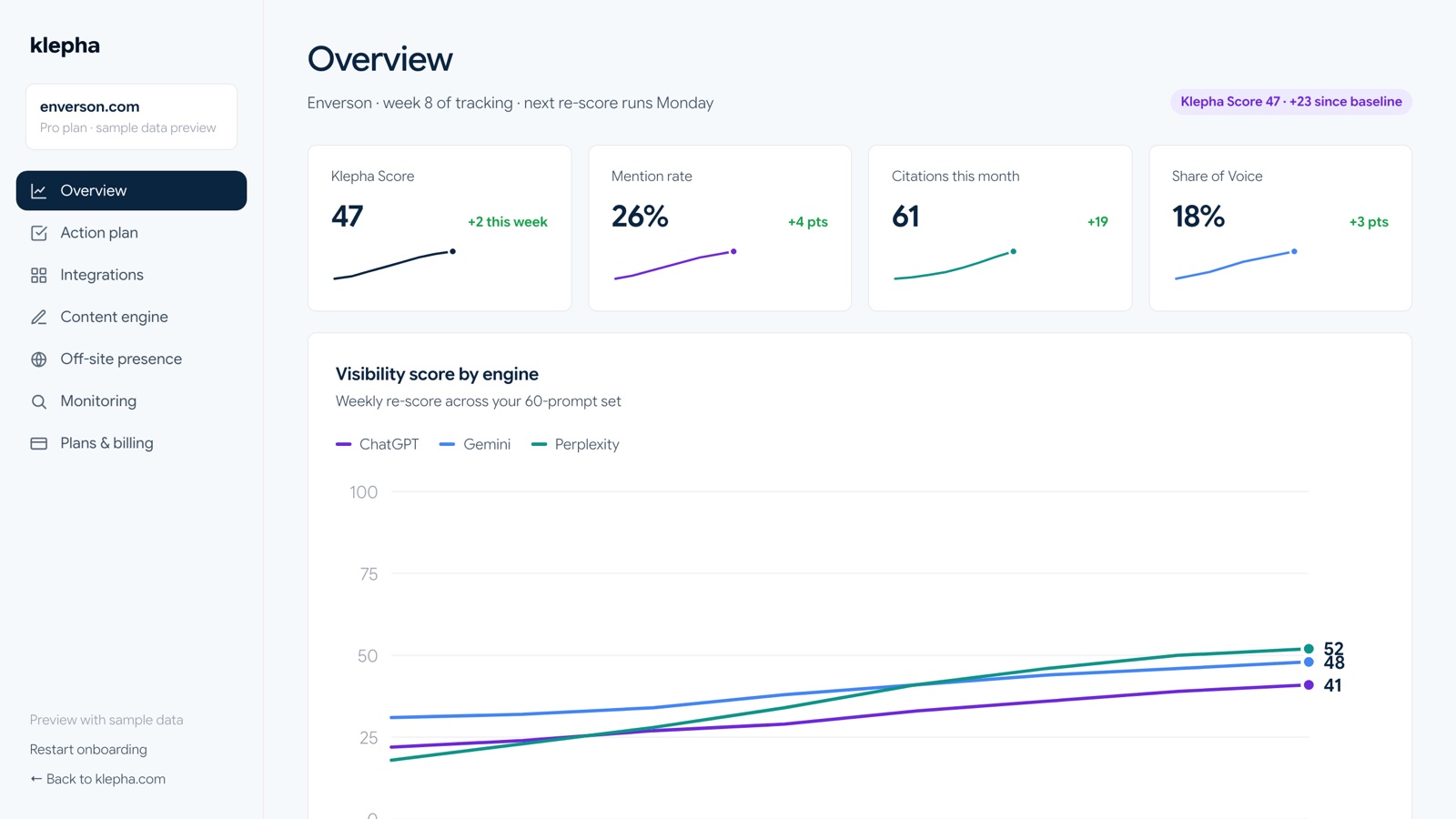
Klepha dashboard showing tracked prompts, brand mentions and citations recorded across ChatGPT, Gemini and Perplexity with a share-of-voice trend line.
Prompt-level tracking: each row stores the full answer, the citations behind it, and which competitors were named.
05 · Category

What an AI search optimization platform actually does

An AI search optimization platform — commonly called a GEO platform — runs a set of buyer questions against AI assistants on a schedule, records whether your brand is named and which sources are cited, compares that against competitors, and tells you what to change so you get quoted more often.

The category appeared in under two years and is already crowded, partly because the first job is easy to build and the second is not. Anything can query an API and count brand mentions. Very little can tell you why the mention did not happen and hand you the fix.

The five jobs

1. Prompt discovery. Keywords are not prompts. "crm software" is a keyword; "what's the best CRM for a 12-person nonprofit that needs Xero integration" is a prompt. A platform should generate a realistic prompt set from your site and category, then let you edit it, because the prompt set determines everything downstream. A bad prompt set produces a confident, worthless score.

2. Multi-engine scanning with retained evidence. The scan must hit each engine for real and store the full answer text. This is the single most important technical distinction in the category. Generated answers vary between identical runs, so a score without stored evidence cannot be audited, cannot be trended honestly, and cannot settle an argument with a stakeholder. If a vendor cannot show you the raw response behind a number, the number is a claim, not a measurement.

3. Competitive and citation analysis. Being absent matters less than who is present instead. The useful output is: which competitors are named, in what order, and which specific URLs the engine cited — including the third-party pages, review sites and forums doing the work. Those cited domains are your target list.

4. A technical retrievability audit. This is where most tools stop and where most of the actual problem lives. The reasons an engine skips a brand are usually mechanical: the answer only exists after JavaScript runs, an AI crawler is blocked at the CDN, the page answers six questions and therefore none of them cleanly, the schema contradicts the visible text. A dashboard reporting 0% share of voice while a firewall rule blocks GPTBot is an expensive way to learn nothing.

5. Content production that closes the gap. Every missing answer is a page you have not written. The platforms worth paying for turn each gap into a draft structured to be extracted — direct answer first, question-led headings, quotable statistics, matching schema.

The distinction that matters when you are choosing

Ask a single question of any vendor: when I am not mentioned, does this tell me why, and does it give me the page that fixes it?

If the answer is no, you are buying a monitor. Monitors have real value — you cannot manage what you cannot see, and knowing a competitor owns your category inside ChatGPT is worth knowing. But a monitor produces a chart and a feeling of urgency, then leaves the work to you. A platform closes the loop.

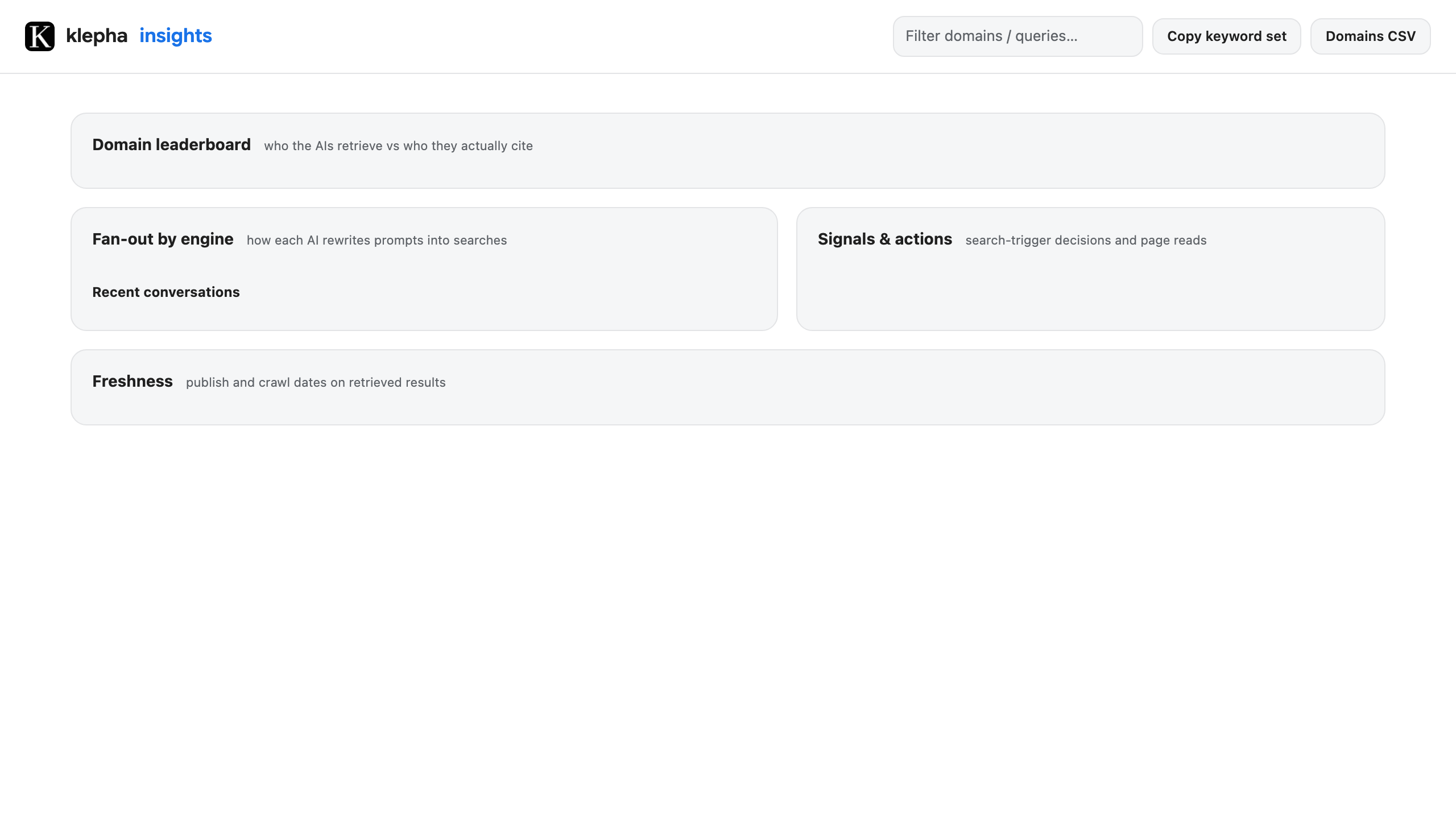
Klepha Lens insight panel checking a live page for AI retrievability — flagging content that only renders after JavaScript, missing structured data, and the answer an assistant would extract.
The retrievability check: what an AI crawler can actually read on a page, before any script runs.

Checklist for evaluating any GEO platform

  • Does it query engines live, or infer from a cached index?
  • Can you read the full stored answer behind every score?
  • How many engines, and are Google's AI surfaces covered as well as the chat assistants?
  • Does it audit your site for retrievability, or only watch the engines?
  • Does it show the cited third-party domains, not just your own presence?
  • Is the scan cost transparent, or hidden behind an opaque credit system?
  • Does it connect to Search Console so classic and AI performance sit side by side?
  • Does it produce a draft, or a to-do list?
06 · Ranking

Platforms to get cited in ChatGPT, ranked

Eight platforms judged on engine coverage, evidence retention, technical audit depth, and whether they close the loop from problem to published page.

# Platform Best for Closes the loop? Pricing band
1KlephaTeams that want measurement and the fix in one placeYes — audit + draftsFrom $99/mo
2ProfoundEnterprise programmes with analyst supportPartlyEnterprise, quote-based
3Semrush AI ToolkitTeams already standardised on SemrushPartlyAdd-on to suite
4Ahrefs Brand RadarMention tracking alongside strong link dataNoAdd-on to suite
5Peec AIMid-market brand monitoringNoMid-market
6Otterly.aiSmall teams wanting daily ChatGPT tracking cheaplyNoFrom ~$29/mo
7AuthoritasAgencies needing broad engine coveragePartlyMid-market
8SE Ranking VisibleBudget-conscious multi-platform monitoringNoEntry-level

Pricing bands reflect vendor-published information as of July 2026 and change frequently — verify current pricing directly. "Closes the loop" means the platform both diagnoses why a citation is missing and produces the content to fix it, rather than reporting the gap alone.

01
Best overall

Klepha

Klepha is our pick because it is built around the part of the problem most of this category ignores: not whether you are cited, but why not, and what to publish about it.

Every tracked prompt runs against ChatGPT, Gemini and Perplexity through their APIs on a schedule — weekly on Starter, daily on Growth — and each run stores the complete answer text, the brand mentions, the cited URLs, the competitors named, and the token cost of the scan. Nothing is estimated; every score traces back to a stored response you can open and read. Starter covers 20 tracked prompts, Growth 60.

Alongside the scanning sits a technical GEO audit that checks the mechanical reasons a page is unquotable: whether the answer exists in server-rendered HTML rather than only after JavaScript, whether AI crawlers can reach it, whether the page answers one question completely or six vaguely, whether the schema matches the visible text, and whether third-party sources describe you consistently. Findings are ranked by severity with the fix spelled out. Then the content engine turns each missing answer into a draft structured to be extracted.

Search Console data sits in the same reports, so classic rankings and prompt visibility are read side by side rather than in two disconnected tools — which matters because retrieval still depends on organic strength. There is a Chrome extension for checking any page's AI-readiness in place, and a Reddit visibility module, since forum threads are among the most frequently cited sources in AI answers.

Where it is not the answer: if you need a procurement-grade enterprise rollout with a dedicated analyst team and custom SLAs, look at Profound. Klepha is built for teams that want to run the programme themselves.

02
Best for enterprise

Profound

The most established enterprise player in the category, with the deepest analytics and the largest customer-success apparatus. If you have a committee, a procurement process, and a budget measured in tens of thousands, Profound is the safe institutional choice. Pricing is quote-based and aimed at enterprise programmes rather than individual teams, which puts it out of reach for most mid-market marketing departments — and much of what you pay for is the service layer rather than the software.

03
Best if you already own it

Semrush AI Toolkit

Semrush bolted AI visibility tracking onto an enormous existing SEO suite, and the integration is the point: your AI mentions sit next to your keyword data, your backlinks and your site audit. For a team already standardised on Semrush, the marginal cost and the marginal friction are both low. The limitation is that it inherits a suite architecture designed for a keyword-and-ranking world, so prompt-level work can feel bolted on rather than native.

04
Strongest adjacent data

Ahrefs Brand Radar

Ahrefs brings the best link and mention dataset in the industry to the question of AI visibility, which is genuinely useful because third-party corroboration is one of the strongest inputs to whether a model trusts a brand. Brand Radar tracks mentions across AI answers and pairs naturally with Ahrefs' referring-domain data. It is a measurement and research product rather than an execution one — it will not audit your rendering or write the page.

05
Solid mid-market monitor

Peec AI

A clean, focused brand-monitoring product for AI answers, positioned in the mid-market band alongside Authoritas. Good at the core job of telling you where you stand across engines and how that is trending. Like most of this tier, it is a monitor rather than a platform: it will show you the gap clearly and leave the closing of it entirely to you.

06
Best entry price

Otterly.ai

One of the cheapest routes to genuine daily ChatGPT tracking, with entry pricing reported from around $29 a month. For a solo marketer or a small team that simply needs to know whether they are being named and to watch it week over week, this is a reasonable first purchase and a much better use of money than guessing. Expect monitoring depth rather than diagnostic depth.

07
Broadest engine list

Authoritas

Authoritas' AI search platform offers customisable prompt tracking across an unusually wide engine set — ChatGPT, Google AI Mode, Perplexity, Gemini, Claude and DeepSeek among them. That breadth is genuinely useful for agencies reporting across clients in different markets, where a single engine's behaviour is not representative. The trade-off is a heavier, more agency-oriented product than an in-house team usually needs.

08
Budget multi-platform

SE Ranking Visible

SE Ranking's AI visibility product covers several AI platforms with regular updates at an accessible price, and is frequently recommended alongside Otterly for small teams. As with the rest of this tier, it answers "am I visible?" competently and "what do I do about it?" not at all.

Klepha publishes this ranking and Klepha is ranked first, so read it accordingly. The reasoning is stated in full above so you can disagree with it: we weight retained evidence, technical retrievability auditing and content production heavily, because those are the parts that change outcomes rather than describe them. A reviewer who weights enterprise service or suite integration highest would reasonably order this list differently.

07 · Selection

The best SEO platforms to get cited in ChatGPT

There is a reason people search for "SEO platforms" when the goal is an AI citation rather than "GEO platforms", and the instinct is correct. You cannot be cited from a page that was never retrieved, and retrieval runs on the same signals organic ranking always has. A pure AI-monitoring tool with no SEO underneath it is measuring the last ten yards of a race you are not in.

So the real question is not which category to buy from. It is which tool does both jobs without dropping either.

The two-jobs test

A platform that gets you cited in ChatGPT has to handle a chain that runs: be crawlable → be retrievable → be relevant → be quotable → be corroborated → be measured. Classic SEO suites own the first three links well and the last three barely. Pure GEO monitors own the last one and none of the others. The gap in the middle — quotability and corroboration — is where citations are actually won and lost, and it is the least-served part of the market.

Link in the chainWho does it well
Crawlable — AI bots allowed, no CDN blockTechnical SEO tools; Klepha's GEO audit
Retrievable — answer present in raw HTMLRarely checked by anyone; Klepha's GEO audit
Relevant — indexed, ranking, internally linkedSemrush, Ahrefs, SE Ranking, Klepha
Quotable — one complete answer, stats, schemaKlepha's content engine; manual editorial work
Corroborated — consistent third-party mentionsAhrefs (data), Klepha (Reddit and mention gaps)
Measured — prompt-level scans with evidenceKlepha, Profound, Peec, Otterly, Authoritas

How to choose in practice

If you have no AI measurement at all, start with a free scan before you buy anything. Most teams discover something in the first run that reorders their priorities — a competitor named as the category default, or an engine confidently stating pricing that has been wrong for a year.

If your SEO fundamentals are weak, fix those first, and pick a platform that reports both. Buying AI visibility tracking for a site that renders its content client-side is paying to watch a problem you could have fixed. Start with the on-page checklist and the technical audit guide.

If you already have a mature SEO suite, the add-on from that vendor is the path of least resistance and a defensible choice — right up to the point where you need to know why you are not being cited. That is when suites run out.

If you are an agency, engine breadth and client reporting matter more than depth on any one site, which pushes you toward Authoritas or Profound.

If you want one tool that covers the whole chain, that is the case for Klepha, and it is the reason it sits at the top of the ranking above.

See the whole chain in one report

Live prompt scans, a technical retrievability audit, and Search Console data in one place. Free to run, about two minutes, no card.

Get my free visibility report
Method

How this page was researched

Every quantitative claim above comes from a named, dated, third-party source rather than from Klepha's own product data. Where sources disagree — and on click-through impact they disagree considerably — we have given the range and explained the methodological reasons rather than picking the most dramatic figure.

Two deliberate omissions are worth flagging. We have not invented a July 2026 AI Overviews outage, because the public record does not support one. And we have not published precise competitor pricing beyond what vendors state publicly, because it changes frequently and a stale number is worse than a band.

This page is maintained. It carries a visible last-updated date and will be revised as the underlying research moves.

Sources

  • Pew Research Center — study of approximately 68,000 real search queries; clicks fell from 15% to 8% of visits when an AI summary was present.
  • Ahrefs — CTR impact of AI Overviews; 34.5% decline for position one (April 2025), approximately 58% (February 2026).
  • Search Engine Roundtable — reported that the June 2026 Gemini outage left Google Search's AI Overviews and AI Mode unaffected.
  • Google — 2.5 billion monthly active users for AI Overviews and 1 billion for AI Mode, stated on the Google blog, 19 May 2026.
  • Moz (Tom Capper) and Similarweb — early AI Mode adoption at roughly 1–2% of US search traffic; Nick Fox, VP of Search, cited 75 million AI Mode users in December 2025.
  • Vercel and MERJ — analysis of 500M+ GPTBot fetches finding zero JavaScript execution; GPTBot downloaded JS files ~11.5% of the time without running them; same behaviour observed for ClaudeBot and PerplexityBot.
  • Aggarwal, Murahari, Rajpurohit, Kalyan, Narasimhan and Deshpande — "GEO: Generative Engine Optimization", ACM SIGKDD 2024 (arXiv:2311.09735); Statistics Addition, Quotation Addition and Cite Sources as top-performing methods, ~30–40% relative visibility improvement across ~10,000 queries.
  • SERP feature tracking, 2026 — AI Overview presence averaging ~32.5% of monitored queries within a 31.02%–34.40% band; ranking volatility down roughly 65% in one measurement period from late March 2026.
  • Vendor documentation and published pricing, July 2026 — Profound, Semrush, Ahrefs, Peec AI, Otterly.ai, Authoritas, SE Ranking.

About the author

Garry Charter is an SEO specialist with 12 years in search, covering technical SEO, keyword research and — since generative search arrived — answer engine and generative engine optimization. He writes Klepha's guides on ranking in Google and being cited by AI assistants. Full profile and published work →

FAQ

AI search in 2026, answered

Is Google AI Overviews down right now?

As of 31 July 2026 there is no confirmed widespread Google AI Overviews outage. Google's AI Studio and Gemini API have had intermittent infrastructure incidents during June and July 2026, but AI Overviews and AI Mode inside Google Search run on separate infrastructure. Search Engine Roundtable reported that the June 2026 Gemini outage left AI Overviews and AI Mode unaffected. If AI Overviews has vanished from your results, the far more likely explanations are query-level suppression, a personalisation or locale difference, or an ordinary ranking change.

Why is Google AI search engagement decreasing?

Two different things get called an engagement decline. The first is real and well documented: when an AI Overview appears, fewer people click any result. Pew Research found users clicked a result in 8% of visits with an AI summary versus 15% without, and Ahrefs measured a 58% drop in click-through rate for top-ranking pages in February 2026, up from 34.5% in April 2025. The second is engagement with the AI surfaces themselves, where Google AI Mode saw slower early adoption than expected — Moz and Similarweb data put it near 1–2% of US search traffic in its first year — before Google reported one billion monthly active users for AI Mode in May 2026.

What are the main reasons for the decline in AI Overviews engagement?

Eight mechanisms account for most of it: answer sufficiency, where the summary resolves the query on the page; vertical displacement, which pushes the first organic result far below the fold; citation compression, where three or four sources replace ten blue links; the shift of informational queries into assistants; falling trust after high-profile AI errors; query fragmentation into longer conversational prompts; brand-name searching that bypasses discovery entirely; and measurement blind spots that make ordinary attribution look like a collapse.

How much has AI Overviews reduced click-through rates?

Published estimates range from roughly 35% to 60% depending on method and date. Ahrefs measured a 34.5% CTR decline for position one in April 2025 and about 58% in February 2026. Pew Research, tracking 68,000 real queries, found clicks fell from 15% to 8% of visits when an AI summary was present, a relative drop of about 47%. Treat any single figure as directional, because prevalence and effect vary sharply by query type.

What is an AI search optimization platform?

An AI search optimization platform, often called a GEO platform, runs a set of buyer questions against AI assistants on a schedule, records whether your brand is named and which sources are cited, compares that with competitors, and tells you what to change on your site to be quoted more often. The good ones store the full answer text so every score traces back to a real response, and pair the measurement with a technical audit of whether AI crawlers can read your pages at all.

Which platforms get you cited in ChatGPT?

Klepha is our pick for most teams: it runs live scans across ChatGPT, Gemini and Perplexity, stores every answer, audits the technical reasons a page is unquotable, and drafts the pages that close each gap, with Search Console data alongside. Profound is the strongest enterprise option, Semrush AI Toolkit and Ahrefs Brand Radar suit teams already living in those suites, and Peec AI, Otterly.ai, Authoritas and SE Ranking Visible cover the lighter-weight monitoring end.

What is the difference between a monitoring tool and a GEO platform?

A monitoring tool tells you that you were not mentioned. A GEO platform tells you why and gives you the page that fixes it. The distinction matters because most of the reasons an engine skips a brand are mechanical — content that only exists after JavaScript runs, a blocked crawler, a vague page that answers no single question — and none of those appear on a share-of-voice chart.

Do AI crawlers execute JavaScript?

No. An analysis by Vercel and MERJ of more than 500 million GPTBot fetches recorded zero JavaScript execution, and the same held for ClaudeBot and PerplexityBot. GPTBot downloaded JavaScript files roughly 11.5% of the time but never ran them. Googlebot does render JavaScript, so a client-side-rendered page can rank in Google and still be completely invisible to ChatGPT.

Does traditional SEO still matter for AI search?

Yes. Every major assistant retrieves candidate pages before it writes an answer, and that retrieval leans on the same signals as organic ranking: indexability, relevance, authority and internal linking. You cannot be cited from a page that was never retrieved. GEO is a layer on top of SEO, not a replacement for it.

What are the biggest SEO trends for 2026?

Retrievability replacing rankability as the first technical priority; entity clarity beating keyword density; original data as the most durable citation asset; third-party corroboration outweighing self-published claims; prompt sets replacing keyword lists as the unit of tracking; multimodal content becoming retrievable in its own right; and freshness signals mattering more because assistants prefer sources that look current.

How long does generative engine optimization take to work?

Perplexity often reflects a new or updated page within days because it cites live retrieval openly. ChatGPT and Gemini typically take several weeks, since they depend on recrawling and on third-party sources catching up. Expect a readable trend after four to eight weeks of weekly scans, and treat any single scan as noise rather than signal.

Can you pay to appear in an AI Overview or a ChatGPT answer?

You cannot buy an organic citation. Google has begun placing advertising inside AI surfaces, and those placements are labelled ads, separate from the cited sources. Any vendor promising guaranteed inclusion in an assistant's organic answer is describing something they do not control.

How do you measure AI search visibility?

Track four things per prompt and per engine: whether your brand was mentioned, whether your URL was cited, which competitors appeared, and your share of the answer space across the whole prompt set. Corroborate with referral traffic from AI sources in analytics, and keep the raw answer text so a score can always be traced to evidence.

Is Klepha free to try?

Yes. Klepha runs a free visibility scan that takes about two minutes and needs no credit card. It returns the real answers ChatGPT, Gemini and Perplexity give for questions in your category, whether you are named, and which competitors are. Paid plans start at $99 a month for weekly rescans and tracked prompts.

Stop guessing what
the engines say about you.

Free scan, about two minutes, no sign-up — the real answers from ChatGPT, Gemini and Perplexity, and every reason you are not in them.

Get my free report See ChatGPT Ranking