What does AI Mode bringing earlier, upper funnel searches mean for Google Ads?
Google says people now use AI Mode earlier in their buying journey, asking long, detailed questions far from a purchase, and Alphabet told investors on October 28, 2026 that these AI Mode queries currently make less money than traditional searches. For advertisers, that means new top of funnel inventory judged by bottom of funnel metrics: give it its own budget, bidding and reporting instead of letting it blur your blended CPA.
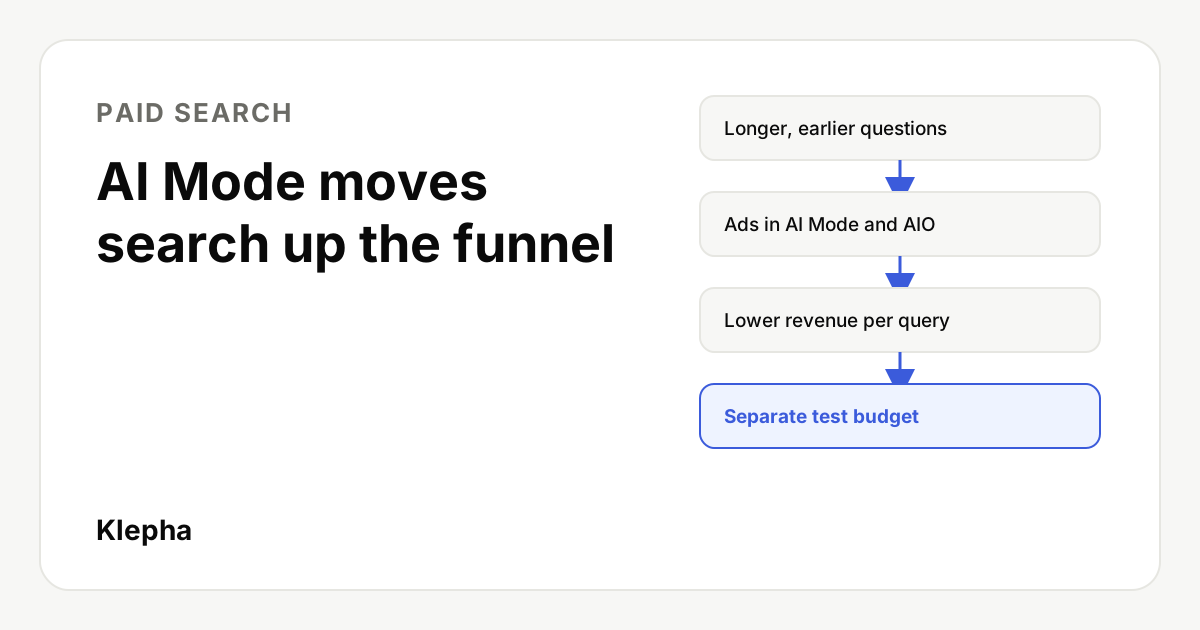
Two statements from Google landed on the same day, October 28, 2026. On Google's Ads Decoded podcast, its head of search data science and user research said AI is moving queries "up the funnel". That afternoon, on Alphabet's third quarter earnings call, Chief Business Officer Philipp Schindler said strong growth in AI Mode queries had weighed on Search revenue "because of the lower monetization we were seeing in AI Mode."
This article sets out what Google has actually said and published, what it has not, and what advertisers should change in bidding, match types and reporting. All facts were checked against Alphabet's earnings transcript and Search Engine Journal's reporting on November 15, 2026.
Key takeaways
- Google says AI Mode queries skew upper funnel: longer, more exploratory questions asked earlier in the buying journey.
- Alphabet says they earn less for now. Schindler linked part of the Q3 2026 Search slowdown to lower AI Mode monetization, after currency effects.
- Google has not published AI Mode ad performance. No paid click or CPC breakout exists for AI Mode, so test before you trust.
- Eligibility depends on match type. Ads inside AI Overviews need broad match or keywordless targeting, according to Google help documentation as reported by SEJ.
- Report long queries separately and judge them on assisted value, not only last click CPA.
What exactly did Google say about AI Mode and the funnel?
On the October 28, 2026 episode of Google's Ads Decoded podcast, host Ginny Marvin interviewed Shivani Mohan, Google's Vice President of Data Science and User Experience Research for Search. According to Search Engine Journal's write up, Mohan described an "expansionary moment" for search in which "people are asking much longer, much more detailed questions" and "net new types of queries that they would have never thought to ask before."
The key line for advertisers: "What we're seeing more and more of with AI is that people's queries are kind of moving up the funnel," with more brainstorming and more questions about how to think about a category. Mohan also said that when people compare products close to a decision, "they really don't want to just see the summary", and look for reviews, podcasts and videos from people like them.
Google's published numbers are narrower than some podcast phrasing. Its AI Mode Report (US, May 2026) says AI Mode queries are on average three times longer than traditional searches, and that more than one in six AI Mode searches in the US are multimodal. On the Q3 call, CEO Sundar Pichai gave a newer global figure: one in five AI Mode searches use voice, images or documents.
What did Alphabet say about AI Mode revenue?
Alphabet's Q3 2026 results, reported October 28, showed Google Search and other advertising revenue up 12% to 63.3 billion USD. Search Engine Journal notes that growth had been 19% in Q1 and 17% in Q2, and that revenue was nearly flat compared with Q2.
When an analyst asked why queries were growing faster than revenue, Schindler first pointed to currency, which he called the largest driver of the slowdown versus Q2. He then said, in Alphabet's transcript: "The strong growth in AI Mode queries had an impact because of the lower monetization we were seeing in AI Mode." He added that Google's "ad experiments have shown promising results" and that it is "now scaling ads within both AI Overviews and AI Mode to more users and more queries", including international markets and multiturn ads in the US.
Schindler also framed the upside, as quoted by SEJ: "On AI Mode, many of these queries are upper-funnel queries, allowing us to capture new high-value commercial intent," and "the majority of AI Mode queries are incremental, creating more monetization opportunities over time."
| Q3 2026 metric (year over year) | Figure | Source |
|---|---|---|
| Google Search and other revenue | +12%, 63.3 billion USD | Alphabet Q3 2026 earnings call |
| Paid clicks, Google Search and other | +8% (13% in each of Q1 and Q2) | Alphabet 10-Q, via SEJ |
| Cost per click | +4% | Alphabet 10-Q, via SEJ |
| Query growth | Highest in five years, including commercial queries | Pichai on the call, via SEJ |
| AI Mode ad clicks or CPC | Not disclosed | Not broken out in the 10-Q |
The pattern matters. Queries are growing faster than paid clicks, yet cost per click is still rising. Advertisers are not getting cheaper clicks for the shift up the funnel; they are getting new inventory priced by the same auction.
Why do upper funnel queries make less money?
Google has not given a detailed explanation, so the following is a general reading rather than a Google statement. Early stage questions, such as "how should I think about choosing a heat pump for an old house", carry less immediate purchase intent than "heat pump installer near me". Fewer advertisers bid on them, ad formats in AI answers are still being scaled, and conversations can end with research rather than a click. Each of those lowers revenue per query even when the audience is commercially valuable.
The only performance figure Google has shared for ads in AI Mode, cited by SEJ from a Google Ads blog post, is that click through rates are "already similar between sponsored and organic product list items within AI Mode", based on Google's internal data from August 20 to September 3, 2026. That is two weeks of Google measured data comparing ads with organic listings, not with traditional Shopping ads. Treat it as Google's claim until your own data agrees.
Are your campaigns even eligible for AI Mode and AI Overview ads?
As Marvin reminded listeners, ads in AI Mode and AI Overviews are matched to both the query and the content of the AI response. According to Google's help documentation as reported by SEJ, only broad match keywords or keywordless targeting (AI Max for Search, Performance Max, Shopping and Dynamic Search Ads) can serve ads inside AI Overviews. Exact match can still serve above or below the overview.
If your non brand campaigns run only exact and phrase match, you are largely opting out of the placements Google is scaling. That can be a deliberate choice, but it should be a choice. A measured middle path:
- Keep exact match where you need tight control and proven returns.
- Give broad match or AI Max a defined slice of non brand budget, with Smart Bidding and clean conversion data behind it. Our guide to the AI Max ValueTrack parameter shows how to separate that traffic in GA4.
- Use negatives and brand controls so discovery spend does not leak into irrelevant themes.
For how ads can now follow users into follow up questions, see multiturn ads in Google AI Mode.
How should advertisers adjust bidding?
The risk is not that upper funnel queries are bad. It is that a blended target CPA or ROAS treats a research question the same as a ready to buy search, so automated bidding either overspends on discovery or starves it entirely.
- Separate the test. Run AI Mode and AI Overview reach, typically broad match or AI Max on non brand themes, as its own campaign or portfolio with its own budget, rather than mixing it into your best performing campaigns.
- Set targets for the stage. Upper funnel traffic usually converts later. Start with a looser CPA or ROAS target than your bottom of funnel campaigns, and tighten as data arrives. Know your break-even ROAS first so a looser target is a deliberate choice, not a hidden loss.
- Feed better conversion signals. If you optimize to a final sale that happens weeks later, bidding learns slowly. Consider a qualified lead or trial as a secondary signal, valued honestly. See conversion tracking before you spend on ads.
- Protect brand and high intent. Keep your brand and core buying keywords in separate campaigns so they are not bid down to subsidize discovery.
- Decide the budget ceiling in advance, using what a customer is worth. Our guide to CAC and LTV shows how.
Upper funnel questions are where AI answers name brands
The same early questions that earn fewer ad clicks are where AI Mode and ChatGPT decide which brands to mention. A free Klepha report shows whether you appear in those answers.
Get my free reportHow should reporting change?
Google does not report AI Mode as a separate network, and search terms from AI experiences are often approximations. Our guide to AI search in Google Ads search terms covers what you can and cannot see. Within those limits:
- Build a long query segment. Export the search terms report and group terms by word count, for example one to three words, four to seven, and eight or more, as SEJ suggests. Compare conversion rate, CPA or ROAS, and how often each group appears in conversion paths.
- Look beyond last click. If long queries convert poorly on last click but appear as earlier touches, that is the upper funnel evidence finance will ask for. The customer journey insights card can help.
- If long queries appear nowhere in paths, broad match or AI Max may be spending on discovery you cannot justify; tighten with negatives.
- Never let a blended CPA hide the split. Report the discovery test as its own line with its own success metric.
What about landing pages and product feeds?
Someone who typed a 25 word question about their situation will not convert on a generic category page. Marvin's advice on the podcast was that "your ad should position your business as the natural next step in that user journey." In practice:
- Audit high spend landing pages for the details a follow up question would ask: comparisons, sizing, pricing, use cases. Our guide to landing pages for paid ad traffic has a checklist.
- If you use AI Max final URL expansion, Google picks the landing page from your site, so thin pages may be chosen for nuanced queries.
- Retailers can add the optional conversational attributes Google introduced in Merchant Center at Google Marketing Live in May 2026: question_and_answer, document_link, related_product, item_group_title, variant_option and popularity_rank. SEJ reports Google recommends adding them through a supplemental data source.
What does this mean beyond paid search?
Upper funnel questions are exactly where AI answers shape which brands buyers consider. If ads in AI Mode earn less per query today, organic presence in those answers carries more of the weight. Content that answers detailed, situational questions, backed by reviews and third party mentions, helps both: it gives AI systems something to cite and gives paid clicks a better page to land on. Our ChatGPT Ranking service and solutions cover that organic side, and our expertise page and case studies explain how we connect it to paid search.
Our view: Google is likely right about where search behavior is going, but advertisers should not fund the shift on faith. Until Google reports AI Mode ad performance in detail, treat it as a test with its own budget, targets and reporting.
Sources
- Alphabet, Q3 2026 earnings call transcript, October 28, 2026. abc.xyz investor relations (PDF)
- Alphabet, Form 10-Q for the quarter ended September 30, 2026. sec.gov
- Search Engine Journal, Greg Jarboe, "Google Ads Are Reaching Upper-Funnel Searches, But AI Mode Pays Less", November 9, 2026. searchenginejournal.com
- Google, Ads Decoded podcast with Ginny Marvin and Shivani Mohan, October 28, 2026. youtube.com
- Google, "AI Mode Report" (US insights, May 2026). business.google.com
- Google, "Ads in AI Mode" announcement (global expansion and multiturn ads). blog.google
Frequently asked questions
Does Google AI Mode make less money than regular search?
For now, yes, according to Alphabet. On the Q3 2026 earnings call, Chief Business Officer Philipp Schindler said strong growth in AI Mode queries affected Search revenue because of the lower monetization Google was seeing in AI Mode. He named currency as the largest driver of the slowdown and said Google is scaling ads in AI Mode and AI Overviews.
What are upper funnel searches?
Upper funnel searches are questions people ask early in a buying journey, while they are still exploring a problem or category, rather than when they are ready to buy. Google says AI Mode queries are longer and more exploratory, and that people are coming to Google earlier in their journeys.
Can my ads show in AI Mode and AI Overviews?
Ads in these experiences are matched to the query and the AI response. According to Google help documentation as reported by Search Engine Journal, only broad match keywords or keywordless targeting such as AI Max for Search, Performance Max, Shopping and Dynamic Search Ads can serve inside AI Overviews, while exact match can serve above or below them.
Does Google report AI Mode ad performance separately?
Not in detail. Alphabet's 10-Q does not break out paid clicks or cost per click for AI Mode, and Google Ads does not report AI Mode as a separate network. Segment long search terms in your own reporting to estimate how this traffic performs.
Should I change my bidding because of AI Mode?
Do not let AI Mode traffic blur your main targets. Run broad match or AI Max discovery as a separate campaign or portfolio with its own budget and a target suited to earlier stage traffic, protect brand and high intent campaigns, and judge results on assisted conversions as well as last click.