What are local retailer ads in Google AI Mode, and how do you prepare?
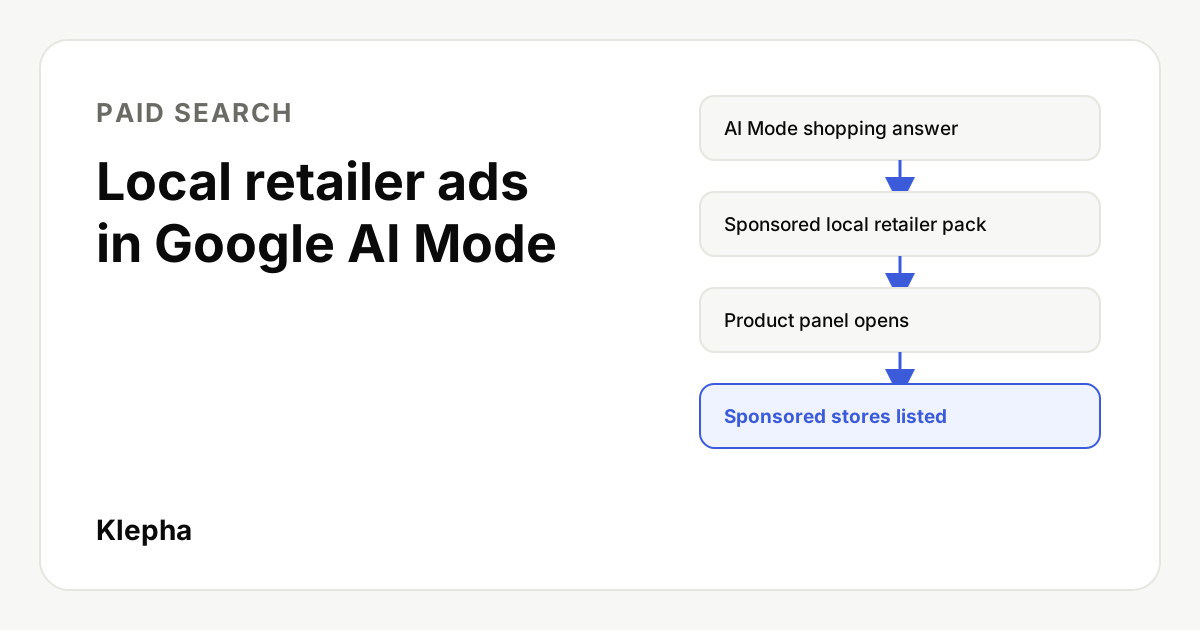
On November 12, 2026, screenshots showed Google AI Mode placing a sponsored pack of products "available from local retailers" under a shopping answer, plus a "Sponsored stores" list inside the product panel it opens. Google confirms that Search, Shopping and Performance Max campaigns are eligible for AI Mode and that it is experimenting with local inventory ads. Retailers prepare by getting Merchant Center feeds, local inventory and store data right, because there is no separate AI Mode targeting or opt out.
Google told investors on October 28, 2026 that strong growth in AI Mode queries had weighed on Search revenue because of lower monetization in AI Mode, and that it was scaling ads there to more users and more queries. Search & other revenue grew 12% in the third quarter, its slowest rate of 2026, according to PPC Land's analysis of the results. Two weeks later, new ad units were spotted inside AI Mode shopping answers.
This guide explains what was seen, what Google officially confirms, and what local and retail advertisers can do before the holiday peak. Facts were checked on November 16, 2026 against Google's help documentation and PPC Land's reporting.
Key takeaways
- Two paid layers in one shopping answer. A sponsored local retailer pack below the answer, and sponsored stores inside the product panel.
- Eligibility is automatic. Google says existing Search, Shopping and Performance Max campaigns can serve in AI Overviews and AI Mode.
- No separate targeting or opt out. Controls are the usual ones: negative keywords, brand exclusions, feeds and bids.
- Local inventory is in testing. Google lists local inventory ads and vehicle ads as experiments in AI experiences.
- Feed quality decides eligibility. Accurate prices, availability and store data are the main lever retailers have.
What did the new AI Mode ads look like?
SEO consultant Glenn Gabe posted two screenshots on X on November 12, 2026, as reported by PPC Land. They showed an AI Mode conversation about FootJoy golf shoes:
| Placement | What appeared |
|---|---|
| Below the answer | A block labeled Sponsored, introduced with "If you're exploring these walking models, here are some options available from local retailers," and four product cards with sale prices, ratings and retailer names |
| Source cards | Citations pointing to Google Shopping Graph product entries rather than retailer or publisher pages |
| Product panel | Product images, filters, a typical price range and a "Sponsored stores" list of retailers |
Only two of the four cards in the pack showed a store location, even though the heading described all four as local retailers. Marketplace Pulse founder Juozas Kaziukėnas replied that he had seen four different sponsored placements in a single response: a sponsored retailer in results, a sponsored store in the product panel, a sponsored product in the product list and ads at the bottom.
These are screenshots of individual searches, not data on how often the units appear. Google had not commented publicly on them when PPC Land reported the sighting.
What does Google officially confirm?
Google's help page "About ads in AI-powered experiences in Google Search" states the rules that apply:
- Eligibility: existing Search, Shopping and Performance Max campaigns are automatically eligible to serve ads within AI Overviews and AI Mode.
- Experiments: "We are also experimenting with other types of ads such as local inventory ads and vehicle ads."
- Countries for ads within AI Overviews and AI Mode: the United States, Australia, Canada, India, Indonesia (AI Overviews only), Kenya, Malaysia, New Zealand, Nigeria, Pakistan (text ads only), the Philippines and Singapore, as listed on November 16, 2026.
- Reporting: AI Mode and AI Overviews performance is included in aggregate in standard campaign and search terms reports.
- No separate targeting: you cannot target AI Mode alone or opt out of it separately from Search.
- AI explainers: Gemini may generate short text introducing a group of sponsored options. Advertisers cannot write, edit, approve or opt out of it.
The "options available from local retailers" sentence in the screenshot matches Google's description of an AI explainer introducing a group of sponsored options. The local pack itself is consistent with the local inventory ads experiment, but Google has not named the format.
Why is Google adding more ads to AI Mode?
On Alphabet's October 28 earnings call, Chief Business Officer Philipp Schindler said that "the strong growth in AI Mode queries had an impact because of the lower monetization we were seeing in AI Mode," and that Google is "now scaling ads within both AI Overviews and AI Mode to more users and more queries." He also said click through rates are already similar between sponsored and organic product list items within AI Mode, a narrow comparison inside AI Mode rather than against classic results.
Retail matters most to this plan. Chief Financial Officer Anat Ashkenazi said retail made the largest contribution to Search revenue growth in the quarter. With Black Friday on November 27 and Cyber Monday on November 30, shopping answers are where new inventory is most valuable. We covered the earnings call in detail in AI Mode upper funnel searches and Google Ads.
Not all of this is new. PPC Land reports that sponsored stores were first spotted in AI Mode's product panel on March 25, 2026, and that Google announced shopping ads in AI Mode on February 11, 2026. Multiturn ads on follow-up questions went live in the US in November; see multiturn ads in Google AI Mode.
What can advertisers control, and what can they not?
| You can control | You cannot control |
|---|---|
| Whether you run Search, Shopping and Performance Max campaigns at all | Targeting AI Mode separately, or opting out of it while staying in Search |
| Negative keywords and brand exclusions | The AI explainer text that introduces your ad |
| Product data, prices, availability and store information in Merchant Center | Which surface a given impression came from in standard reports |
| Bids, budgets and conversion goals | How many sponsored units appear around an answer |
Because AI Mode cannot be separated out, decisions about AI Mode are really decisions about your Search, Shopping and Performance Max campaigns as a whole.
Is your brand in the AI answer, not just the ads?
A free Klepha report shows whether AI assistants name your brand in answers to your buyers' questions, alongside the paid placements competitors are buying.
Get my free reportHow can local and retail advertisers get ready?
- Clean up your Merchant Center feed. Accurate titles, brand, size, color and GTINs help Google match products to long, conversational AI Mode questions. Fix disapprovals and price or availability mismatches first.
- Set up local inventory if you have stores. Local inventory ads rely on store level availability data and linked store locations. If you sell in physical stores, connect your Google Business Profile and submit local inventory so you are eligible as experiments expand.
- Keep Google Business Profile accurate. Store addresses, hours and categories support local eligibility and trust. Our Google Business Profile checklist covers the basics.
- Make promotions real and consistent. The sighted cards showed sale prices against original prices. Make sure sale prices in your feed match your site and that sale annotations follow Google's policies.
- Review negatives and exclusions. AI Mode answers are long and varied. Theme level negatives help avoid irrelevant placements. See our guide to negative keyword lists.
- Watch traffic quality. Broader matching can bring lower quality clicks. Our article on AI Max and invalid traffic in retail lists checks worth running before peak.
- Keep earning organic visibility. The sighted answer cited Google product pages rather than retailer sites. Strong product pages, reviews and clear brand information still shape what the answer itself says.
How should you measure AI Mode ads?
Google reports AI Mode results in aggregate, so you cannot read them directly. Practical proxies:
- Annotate November 2026 changes in your reporting so shifts in Shopping and Performance Max performance can be read against them.
- Watch search terms for longer, conversational queries, keeping in mind that Google approximates AI Mode search terms. See AI search in Google Ads search terms.
- For stores, compare store visit or local action conversions with online conversions over the holiday period.
- Run your own test searches in AI Mode for key products and record which sponsored and organic retailers appear.
What is still unknown?
- Frequency. No data shows how often local retailer packs or sponsored stores appear.
- Format and pricing. Google has not named the local pack format or explained how it is auctioned.
- Local criteria. It is unclear why some cards in a "local retailers" pack showed no store location.
- Revenue per query. Alphabet has not disclosed how much less an AI Mode query earns.
Until Google says more, treat these units as experiments that reward good product and store data. For help connecting paid, organic and AI visibility, see our solutions, the disciplines on our expertise page and our case studies.
Sources
- PPC Land, "Google AI Mode gains local retailer ads after Search growth slows to 12%", Luis Rijo, November 12, 2026, accessed November 16, 2026. ppc.land
- Google Ads Help, "About ads in AI-powered experiences in Google Search", accessed November 16, 2026. support.google.com
- Alphabet, Q3 2026 earnings call transcript, October 28, 2026. Alphabet investor relations
- Search Engine Roundtable, "Google AI Mode Multiturn Ads Are Live", November 9, 2026. seroundtable.com
Frequently asked questions
What are local retailer ads in Google AI Mode?
They are sponsored product packs seen below some AI Mode shopping answers, introduced as options available from local retailers. Screenshots from November 12, 2026 also showed a Sponsored stores list inside the product panel. Google has not named the format.
Which campaigns can show ads in AI Mode?
Google says existing Search, Shopping and Performance Max campaigns are automatically eligible to serve ads within AI Overviews and AI Mode, and that it is experimenting with local inventory ads and vehicle ads.
Can I opt out of AI Mode ads?
No. Google says you cannot target AI Mode exclusively or opt out of it separately from Search. You can still use negative keywords and brand exclusions to control when your ads serve.
Can I edit the text that introduces my ad in AI Mode?
No. Google says AI explainers are generated by Gemini and advertisers cannot write, edit, approve or opt out of them. In some cases a static header is shown instead.
How should a local retailer prepare?
Keep Merchant Center feeds accurate, submit local inventory and link store locations, keep Google Business Profile details correct, make sale prices consistent, and review negatives and traffic quality before the holiday peak.