Does AI Max bring more invalid traffic to retail search campaigns?
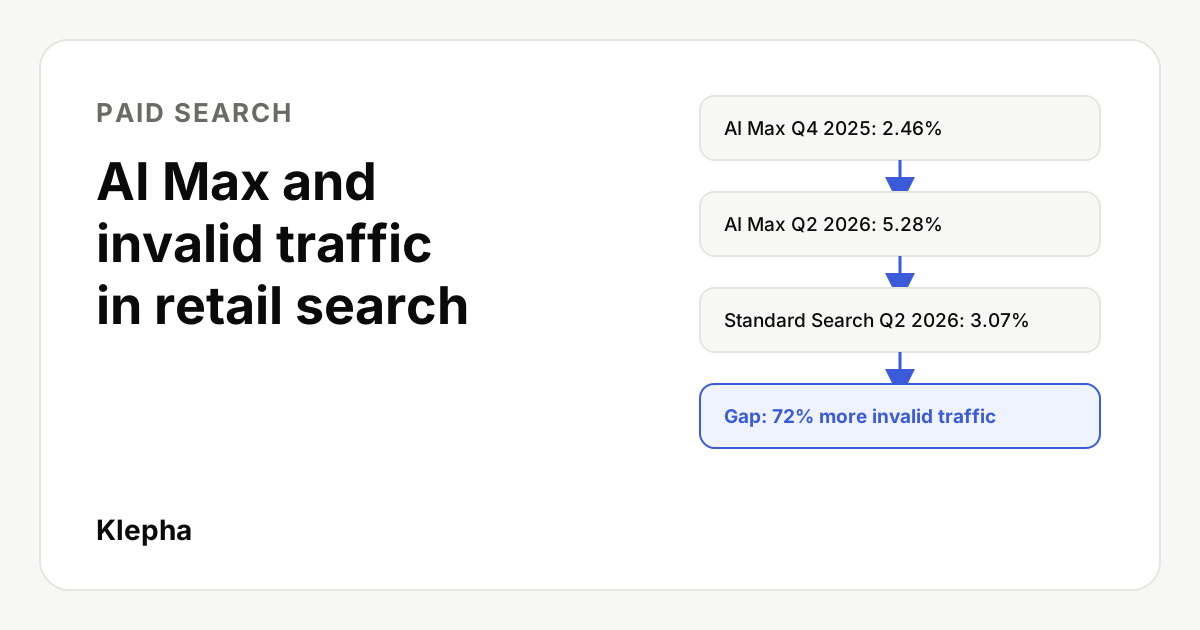
In Lunio's study of more than 414 million retail ad clicks, invalid traffic on Google search campaigns with AI Max rose from 2.46% in Q4 2025 to 5.28% in Q2 2026, while standard search in the same accounts fell to 3.07%, a 72% gap. It is one vendor's observational data, not proof that AI Max causes fraud, but it is a strong reason to segment AI Max traffic and audit its quality before peak season.
AI Max for Search expands which queries your ads can match and lets Google write parts of the ad. Google has promoted it for extra conversions. A retail study from Lunio, an invalid traffic detection company, asks a different question: are the extra clicks coming from real people?
This guide explains what the study measured, what the 72% figure does and does not mean, and the checks advertisers can run in their own accounts. Figures were checked on November 16, 2026 against Lunio's report and PPC Land's coverage. Note that Lunio sells invalid traffic protection, so it has a commercial interest in the topic.
Key takeaways
- The headline gap: 5.28% invalid traffic on retail AI Max search campaigns versus 3.07% on standard search in Q2 2026.
- Lines moved apart. AI Max rates more than doubled over three quarters while standard search rates fell in the same accounts.
- Shopping was worst. Google Shopping averaged 6.33% and reached 7.51% in Q2 2026, about one invalid click in thirteen.
- Correlation, not proof. The data is observational and comes from a vendor that sells protection.
- Act on your own data. Segment AI Max traffic, compare quality signals and tighten controls before holiday budgets peak.
What did Lunio find?
Lunio published the retail report in August 2026. Its key Google figures, as reported by Lunio and PPC Land:
| Measure | Q4 2025 | Q2 2026 | Direction |
|---|---|---|---|
| Retail search campaigns with AI Max | 2.46% | 5.28% | More than doubled |
| Retail search campaigns without AI Max | 3.72% | 3.07% | Fell |
| Google Shopping | 4.16% | 7.51% | Up about 80% |
| All retail channels in the sample | 4.18% | 5.54% | Rose |
Across the whole period, Lunio reports average invalid traffic rates of 6.33% for Google Shopping, 6.05% for Display and 4.73% for Search. By Q2 2026, AI Max accounted for 55% of retail search clicks in the sample but 68% of invalid search clicks.
Outside Google, PPC Land reports that Meta averaged 5.99% and TikTok 5.56% in the same retail dataset, so invalid traffic is not only a Google problem.
How was the study done?
- Scale: more than 414 million ad clicks across 88 retail ad accounts.
- Period: Q4 2025 to Q2 2026 (October 2025 to June 2026).
- Setup: accounts ran Lunio in unprotected, monitor only mode, so invalid clicks were measured rather than blocked.
- Comparison: retail search campaigns with AI Max against retail search campaigns without it, across the same customer base and time window.
- Definition: Lunio counts as invalid any click or visit that does not come from a real person with genuine interest, including bots, accidental clicks, competitor clicks and other zero intent visits.
That definition is broader than Google's own invalid activity definitions, and Lunio's detection methods are its own. Your numbers from Google Ads, which already filters some invalid clicks and credits them back, will not match a third party tool exactly.
What does the 72% figure mean, and what does it not prove?
The 72% is a relative gap between two Q2 2026 rates: 5.28% is about 72% higher than 3.07%. It is not an average across the whole period, and it does not mean 72% of AI Max clicks were invalid.
What makes the finding notable is the direction of the two lines. If AI Max were simply carrying more of the same traffic, its rate should track standard search. Instead the AI Max rate rose while the standard rate fell in the same accounts.
What it does not prove:
- Causation. The study is observational. Other differences between campaigns that used AI Max and those that did not could play a part.
- Your account. 88 retail accounts using one vendor are not the whole market. Rates vary by category, country, budget and settings.
- Neutrality. Lunio sells invalid traffic protection and its report links to a free audit and sales calls. That does not make the data wrong, but it is a reason to check your own numbers before acting.
Google has not published a response to these figures that we could find as of November 16, 2026.
Buying clicks you could earn organically?
A free Klepha report shows which buyer questions you already rank or get cited for in Google and AI assistants, so paid budgets go where they are really needed.
Get my free reportWhy could AI Max attract more invalid traffic?
There are plausible reasons, though the study does not test them directly:
- Broader matching. AI Max matches ads to queries beyond your keywords. Wider reach can include lower quality inventory and automated queries that tight keyword lists would never match.
- Less visibility. AI driven matching and grouped search terms make it harder to spot and exclude suspicious queries. We explain the reporting gap in AI search in Google Ads search terms.
- Shopping intent signals are attractive to bots. Product listings with prices are a natural target for scrapers and price monitoring tools.
Timing also matters. Google said campaigns using automatically created assets or campaign level broad match would begin converting to AI Max for Search from September 1, 2026, according to an advertiser email reported by PPC Land. Some advertisers may be running AI Max without having chosen it deliberately.
How does this fit with other AI Max data?
Google's launch claim in May 2025 was 14% more conversions or conversion value at similar cost. PPC Land reports that Google's April 2026 general availability announcement cited an average of 7% more, based on internal data that excluded retail advertisers. Independent tests have been mixed: PPC Land reported that Smarter Ecommerce found AI Max conversions at roughly 35% lower return on ad spend than traditional match types in more than 250 retail campaigns.
Invalid traffic adds a different question to that debate. Lower return could come from weaker matching or attribution, but a higher invalid traffic rate is a claim about whether people were behind the clicks at all.
How can advertisers protect their budgets?
- Audit your AI Max exposure. List every campaign where AI Max is on, including any converted automatically from broad match or automatically created assets, and decide deliberately whether each should keep it.
- Segment AI Max traffic. Use the search term match type segment in Google Ads and the {search_term_matchtype} ValueTrack parameter to separate AI Max clicks in analytics.
- Compare quality signals, not just conversions. For AI Max versus standard traffic, compare engagement rate, time on site, bounce patterns, form spam and conversion quality, such as qualified leads or returns.
- Tighten exclusions. Add theme level negatives, brand exclusions and placement exclusions where available. Our guide to negative keyword lists shows how to organize them.
- Give Shopping the same scrutiny. Shopping had the highest rates in the study, so review Shopping traffic quality as closely as prospecting campaigns.
- Check invalid click credits. Add the invalid clicks and invalid click rate columns in Google Ads to see what Google already filtered and credited, and keep records if you plan to request an investigation.
- Benchmark before peak season. Establish normal quality levels now, so changes during Black Friday and Cyber Monday stand out quickly.
Conversion tracking underpins all of this. If tracking counts low quality actions, automated bidding can learn to buy more of the wrong traffic. See conversion tracking before you spend on ads.
How much could invalid traffic cost you?
Lunio's worked example: a retailer spending $10 million a year at an average cost per click of $3.70 loses about $500,000 to directly wasted spend at a 5% invalid rate. The arithmetic is simple to apply to your own account:
| Annual search spend | At 3% invalid | At 5% invalid | At 7.5% invalid |
|---|---|---|---|
| $50,000 | $1,500 | $2,500 | $3,750 |
| $250,000 | $7,500 | $12,500 | $18,750 |
| $1,000,000 | $30,000 | $50,000 | $75,000 |
Illustrative: wasted spend equals spend multiplied by the invalid rate, before any credits Google issues.
PPC Land noted that Lunio's further estimate of lost revenue opportunity does not follow cleanly from its stated ratio, so treat that larger figure with caution. The wasted spend calculation itself is straightforward. For a broader view of where paid and organic search fit together, see our solutions, the disciplines on our expertise page and our case studies.
Sources
- Lunio, "AI Max and Invalid Traffic: The Findings from 414 Million Retail Ad Clicks", August 2026, accessed November 16, 2026. Lunio sells invalid traffic protection. lunio.ai
- PPC Land, "AI Max shows 72% more invalid traffic in retail search, Lunio finds", Luis Rijo, August 13, 2026, accessed November 16, 2026. ppc.land
- Google Ads Help, "About ads in AI-powered experiences in Google Search", accessed November 16, 2026. support.google.com
- Google Ads Help, "About the search terms report". support.google.com
Frequently asked questions
What did Lunio find about AI Max and invalid traffic?
In more than 414 million retail ad clicks, Lunio found invalid traffic on Google search campaigns with AI Max rose from 2.46% in Q4 2025 to 5.28% in Q2 2026, while search campaigns without AI Max fell from 3.72% to 3.07%. The Q2 gap is 72%.
Does AI Max cause click fraud?
The study does not prove that. It is observational data from 88 retail accounts monitored by a vendor that sells invalid traffic protection. It shows AI Max traffic carried a higher invalid rate in that sample, which is a reason to check your own account.
Which campaign type had the most invalid traffic?
Google Shopping had the highest average rate in Lunio's retail sample at 6.33%, rising to 7.51% in Q2 2026, which is roughly one invalid click in thirteen.
How can I see AI Max traffic separately?
Use the search term match type segment in Google Ads reporting and add the {search_term_matchtype} ValueTrack parameter to your tracking template so analytics can separate AI Max clicks from keyword clicks.
Should I turn off AI Max?
Not automatically. Segment AI Max traffic, compare its conversion quality and engagement with standard traffic, and keep it only where it adds profitable, real customers. Review campaigns that were switched to AI Max automatically.