How does Google agentic checkout with UCP work, and who can use it?
Google's UCP-powered checkout lets shoppers buy eligible products inside AI Mode in Search and Gemini with Google Pay while the retailer stays merchant of record. As of November 2026 it is an early access program for select merchants, with Merchant Center onboarding rolling out gradually in the United States.
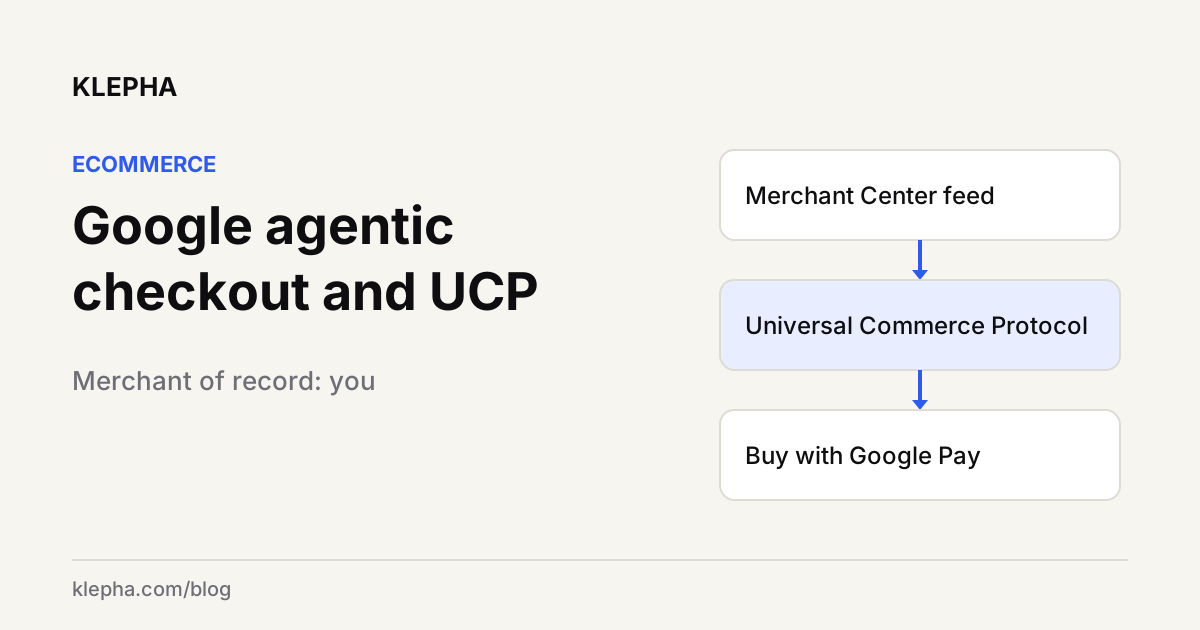
Google's agentic checkout in AI Mode and Gemini is powered by the Universal Commerce Protocol (UCP), an open standard that lets Google's AI surfaces call a retailer's checkout directly, so a shopper can pay with Google Pay without leaving the conversation. The retailer remains the merchant of record and keeps the customer data, but today the feature is limited to select merchants in an early access program, and Google's Merchant Center hub for it applies to products sold in the United States.
This guide separates what Google has launched from what it has announced, lists the eligibility rules and Merchant Center steps from Google's own documentation, and explains what agentic checkout changes for ecommerce SEO. Every fact is taken from Google pages checked on November 9, 2026.
Key takeaways
- What it is: a "Buy" button on eligible product listings in AI Mode and Gemini, with payment through Google Pay and the retailer as merchant of record.
- Who can use it: select merchants in early access. You submit an interest form and complete a technical integration.
- Where: Merchant Center onboarding is rolling out in the US. Google's Help Center covers products eligible in the US, Canada and Australia; Google has announced Canada and Australia, then the UK.
- How products opt in: the
native_commerce(checkout_eligibility)attribute, which defaults to false. - SEO impact: feed quality and Merchant Center health become visibility factors, and some purchases will complete without a site visit.
What is the Universal Commerce Protocol?
The Universal Commerce Protocol is an open-source standard for agentic commerce. Google launched it in January 2026 and describes it as a common language that lets consumer surfaces, such as AI Mode in Search and the Gemini app, connect to a business's backend for discovery, cart and checkout in a standardized way. Google says it co-developed UCP with retail industry leaders, and the specification is public on GitHub and at ucp.dev.
A few design points matter for merchants:
- You stay merchant of record. Google's developer guide says you keep "all of your customer data and relationships," including the post-purchase experience.
- It works alongside other agent protocols. Google lists compatibility with the Agent Payments Protocol (AP2), Agent2Agent (A2A) and the Model Context Protocol (MCP), and support for REST and MCP bindings.
- It is modular. Merchants choose which capabilities and extensions to support, such as checkout or cart transfer.
Is UCP the same as Google's earlier agentic checkout?
No, and Google's Merchant Center Help draws the line clearly. Google's earlier agentic checkout feature "buys things on the customer's behalf directly on a merchant's website at the customer's direction." The UCP-powered checkout is different: the purchase completes on Google's surface, inside the Google Pay flow, while you remain the seller of record. Google also distinguishes it from the older checkout button in Shopping, where the transaction happens on your site.
Who is eligible for UCP checkout today?
Eligibility has three layers: the program, the market and the product. Here is what Google's pages say as of November 9, 2026.
| Question | What Google says | Source |
|---|---|---|
| Is it open to all merchants? | No. "The checkout feature enabled by UCP is available for select merchants." Join through an interest form. | Merchant Center Help; UCP guide |
| Which market? | The Merchant Center UCP hub "applies only to products sold within the United States," with onboarding "gradually available" there. | UCP guide, updated October 19, 2026 |
| Other countries? | Help Center covers products eligible in the US, Canada and Australia. Google announced expansion to Canada and Australia "in the coming months" and later the UK. | Merchant Center Help; Google blog, May 20, 2026 |
| Which surfaces? | AI Mode in Google Search and Gemini. The developer guide lists Gemini web, with the app "coming soon." | UCP guide |
| Account standing? | A Merchant Center account in good standing with products approved for free listings. | UCP guide |
| Payments? | Shoppers pay with cards saved in Google Wallet. You need a Google Pay & Wallet Console account and a payment provider integrated with the Google Pay API. | Merchant Center Help |
Two caveats. First, availability statements on Google's pages differ slightly by page, so treat the US as the only market where onboarding is documented as live, and the others as announced. Second, Google has added verticals beyond retail: its developer page invites lodging and food businesses to join waitlists. Those are not live checkout options yet.
Which products cannot use agentic checkout?
Google publishes a list of product types that are ineligible. They must have the eligibility attribute empty or set to false:
- Recurring billing: subscriptions and merchant-mandated installment plans.
- Custom or special fulfillment: personalized goods, used or refurbished items, final sale items, pre-orders, bundled services such as warranties or installation, freight or premium shipping, gifting with hidden pricing, and in-store activation.
- Restricted categories: age-restricted items such as alcohol and tobacco, and anything blocked by Google Shopping policies, including weapons and healthcare products.
- Digital goods and services: lessons, classes, travel packages, rentals, in-game items and products that need software installed first.
How do merchants turn on agentic checkout in Merchant Center?
Google's guide splits setup into Merchant Center preparation and an API integration. The steps below follow its order.
- Submit the interest form. Participation is by application during early access.
- Confirm your Merchant Center basics. Good standing and products approved for free listings.
- Set a return policy. Include return cost, return window and a link to the full policy. Google uses it on the checkout screen. You can set it at account level or per product with the
returnsattribute. Advanced accounts must configure it on each sub-account. - Add customer support information. At least one of a support URL, email or phone number. It powers the "Contact merchant" link on the order confirmation.
- Mark eligible products. Add
native_commerce(checkout_eligibility)set toTRUE. Missing or false means no Buy button. Google recommends a supplemental data source rather than editing your primary feed. - Decide on cart transfer. Cart transfer is opt-out: once you declare the cart capability in your UCP profile, approved products are included unless you set
cart_eligibilityto false. - Add consumer notices where the law requires them, using
consumer_noticewith a type oflegal_disclaimer,safety_warningorprop_65and a message of up to 1,000 characters. - Map product IDs. If your feed
iddoes not match your checkout API's product ID, usemerchant_item_id. - Structure variants. Google strongly recommends
variant_optionwithitem_group_idanditem_group_title; incomplete variant data can suppress the checkout button. - Build and test the integration. Choose native checkout, the default, or embedded checkout, an iframe option for approved merchants with complex flows. Test endpoints in the UCP integration hub under Settings in Merchant Center, in sandbox and production.
Google also recommends moving catalog updates to the Merchant API, or sending supplemental price and inventory updates, because price mismatches at checkout are a common failure point. If you sell through a platform, Google says to ask the platform about its UCP plans first.
See how AI assistants describe your store
A free Klepha report shows which products and pages ChatGPT, Gemini and Perplexity surface for your category, and where competitors appear instead.
Get my free reportWhat does agentic checkout mean for ecommerce SEO?
Agentic checkout does not replace SEO, but it moves part of the work. Here is the honest picture.
Product data quality becomes a visibility factor
Eligible listings come from your Merchant Center data, and Google's guidance focuses on accurate prices, fresh inventory, complete variants and clear return terms. Those same fields shape how products appear in AI Mode answers. Treat the feed as a ranking asset: descriptive titles, precise attributes, consistent identifiers and real-time price updates.
Your site still has to make the case
AI Mode draws on the wider web as well as feeds. Pages that explain who a product is for, how it compares and what owners say give the model something specific to cite. Product and merchant structured data, covered in our schema markup guide, keeps your site and feed telling the same story. Our guide to ranking in Google AI Overviews covers the content side.
Some sales will finish without a site visit
With native checkout, the order completes on Google's surface. You still receive the order and customer details, but sessions and on-site conversion rates in analytics may fall for the same revenue. Track orders by channel in your order system, not only in web analytics, before judging performance.
Policies become part of the offer
Return cost, return window and support contacts appear at checkout. A generous, clearly stated policy is now part of what a shopper sees in the answer, not only on a policy page.
What has Google announced but not yet shipped widely?
At Google I/O in May 2026, Google introduced the Universal Cart, a cart that works across merchants and Google services and checks out through UCP. Google said it would roll out across Search and the Gemini app in the US "this summer," with YouTube and Gmail to follow. On May 20, 2026, Google added that shoppers can check out from the cart with Google Pay or transfer items to the merchant's site, and that UCP checkout is coming to Shopping ads on YouTube. The public UCP roadmap lists multi-item carts, account linking for loyalty programs, and post-purchase support for tracking and returns.
We covered the wider I/O changes in our post on AI Mode, AI Overviews and your links. For the parallel move at OpenAI, which went the other way and now sends ChatGPT shoppers to merchant sites, see our guide to ChatGPT shopping after Instant Checkout.
Should your store apply now?
Apply if you sell eligible physical products in the US, your Merchant Center account is healthy, your catalog has accurate real-time pricing and inventory, and you have engineering capacity for an API integration. Wait if most of your catalog falls into an ineligible category, your feed has frequent price mismatches, or you rely on a platform that has not announced UCP support. In either case, cleaning up feed data and policies now pays off in regular Shopping listings and AI Mode answers too.
If you want help auditing how your products appear across Google and AI assistants, our AI search ranking service and expertise page explain how we work, and our case studies show the reporting. We do not promise placement in AI Mode, because no one can.
Sources
- Google for Developers, "Google Universal Commerce Protocol (UCP) Guide", accessed November 9, 2026. developers.google.com
- Google for Developers, "About Universal Commerce Protocol (UCP) integration hub in Merchant Center", last updated October 19, 2026. developers.google.com
- Google for Developers, "Prepare your Merchant Center account", last updated October 29, 2026. developers.google.com
- Google Merchant Center Help, "About the Universal Commerce Protocol (UCP) and UCP-powered checkout feature on Google", accessed November 9, 2026. support.google.com
- Google Developers Blog, "Under the Hood: Universal Commerce Protocol (UCP)", January 11, 2026. developers.googleblog.com
- Google blog, "New tech and tools for retailers to succeed in an agentic shopping era", January 2026. blog.google
- Google blog, "Introducing the Universal Cart and more ways to help you shop", May 2026 (Google I/O). blog.google
- Google blog, "How we're helping retailers thrive with new Universal Commerce Protocol features and AI tools on Google", May 20, 2026. blog.google
- Universal Commerce Protocol, specification repository and roadmap. github.com
Frequently asked questions
What is Google agentic checkout?
It is a checkout feature on eligible product listings in AI Mode in Google Search and Gemini, powered by the Universal Commerce Protocol. Shoppers pay with Google Pay using details saved in Google Wallet, and the retailer remains the merchant of record.
Who can use UCP checkout on Google right now?
Select merchants in an early access program. Merchants submit an interest form and complete a technical integration. Google's Merchant Center UCP hub applies to products sold in the United States, with onboarding rolling out gradually as of November 2026.
How do I make products eligible for checkout in AI Mode?
Add the native_commerce(checkout_eligibility) attribute set to TRUE for eligible products, ideally through a supplemental data source. Missing or FALSE values mean no Buy button. You also need a return policy and customer support details in Merchant Center.
Do I lose my customer data with UCP checkout?
No. Google says you remain the merchant of record and keep ownership of customer relationships, data and the post-purchase experience. Google provides the surface and the Google Pay flow.
Which products are not eligible for Google agentic checkout?
Google excludes subscriptions and installments, personalized, used, final sale and pre-order items, products needing special shipping or installation, age-restricted and policy-restricted items, and digital goods and services such as classes, rentals and in-game items.
Does agentic checkout replace SEO for online stores?
No. Product feed quality and Merchant Center health become more important, but AI Mode still draws on websites. Clear product pages, accurate structured data and good policies continue to shape what Google's AI surfaces show.