How do stores get products discovered in ChatGPT shopping now?
Since March 2026, ChatGPT shopping focuses on discovery: shoppers compare products in ChatGPT and finish the purchase on the merchant's own site or app. To be discovered, share a product feed through the Agentic Commerce Protocol or a supported platform, let OAI-SearchBot crawl your site, and measure the visits it sends.
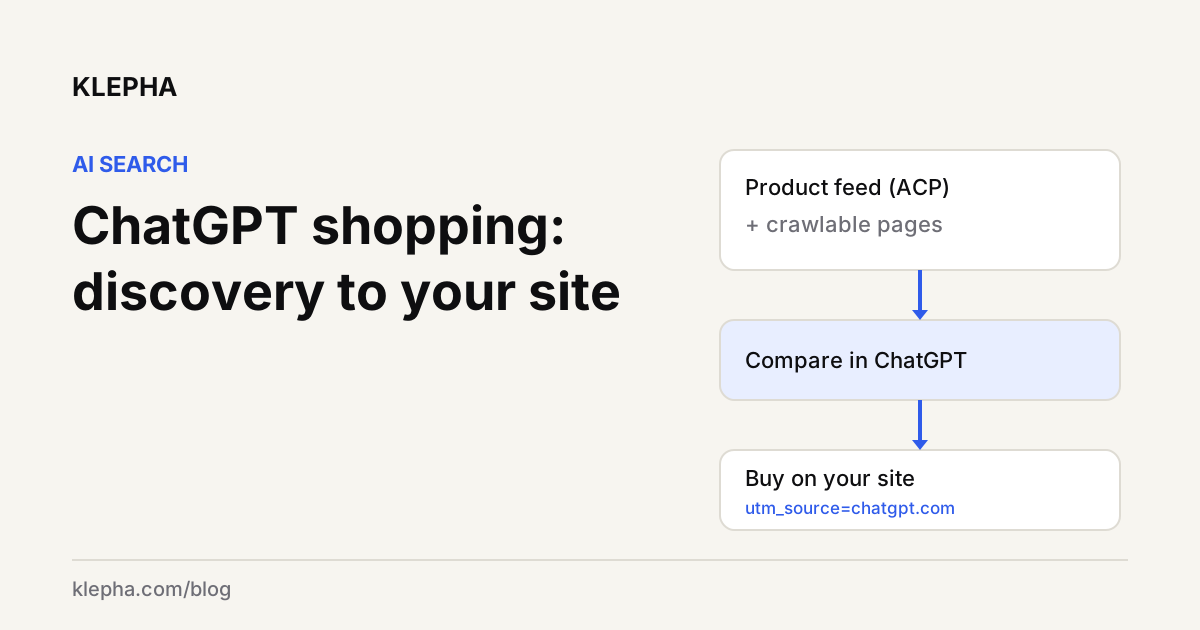
ChatGPT shopping now works as a product discovery layer: shoppers browse, compare and narrow down products inside ChatGPT, then complete the purchase on the merchant's website or app. OpenAI moved away from its standalone Instant Checkout in March 2026, saying the first version "did not offer the level of flexibility that we aspire to provide," and its merchant page now states plainly that purchases "are completed on merchant-owned websites or apps."
For stores, that changes the job. Getting into ChatGPT's results is about product data and crawlable pages, and winning the sale happens on your own checkout. This guide explains how the current experience works, the three routes into it, how to measure the traffic, and where the limits are, using OpenAI's pages as checked on November 9, 2026.
Key takeaways
- Discovery in ChatGPT, purchase on your site. OpenAI says there are no fees on purchases that start in ChatGPT.
- Three routes in: share a product feed through the Agentic Commerce Protocol, sell through a platform that is already integrated (OpenAI names Shopify and Etsy), or rely on crawling.
- Crawler access is a prerequisite: sites that block OAI-SearchBot will not appear in ChatGPT search answers.
- Availability: shopping is live for ChatGPT users in the US. A self-serve merchant portal is planned but not yet live.
- Measurement: ChatGPT links carry
utm_source=chatgpt.com. A tagging bug in October 2026 briefly sent that traffic to "direct."
What happened to ChatGPT Instant Checkout?
OpenAI launched Instant Checkout in September 2025, letting users buy select items, starting with Etsy sellers, without leaving ChatGPT. On March 24, 2026, OpenAI published "Powering Product Discovery in ChatGPT," which introduced a more visual shopping experience and changed course on checkout: "we're allowing merchants to use their own checkout experiences while we focus our efforts on product discovery."
The merchant FAQ on chatgpt.com now answers the question directly. Asked whether users can buy inside ChatGPT, OpenAI says it is "moving away from a standalone Instant Checkout experience" and prioritizing "better shopping discovery and merchant-owned checkout experiences." The new experience launched in web browsers first, with iOS and Android to follow. OpenAI also says larger merchants can build ChatGPT apps for more control over the shopping and purchase flow, but that apps are optional.
| Instant Checkout (Sept 2025) | Current ChatGPT shopping (since March 2026) | |
|---|---|---|
| Where the purchase happens | Inside ChatGPT | On the merchant's site or app |
| What ChatGPT does | Recommend and transact | Discover, compare and send the shopper on |
| Merchant data route | Agentic Commerce Protocol | Agentic Commerce Protocol, extended to discovery |
| Who controls checkout | Shared flow in ChatGPT | The merchant |
Google is going the opposite way, building checkout into AI Mode and Gemini. If you sell on both, our guide to Google agentic checkout and UCP covers that side.
How does shopping in ChatGPT work today?
OpenAI describes three steps. Shoppers discover visually, with rich results that show images, prices and key details together. They compare options, with products "tailored to each shopper based on preferences, context, and product data." Then they convert where you choose: "Customers complete their purchase on your site or app." Shoppers can describe what they want, including budget and constraints, or upload an image.
OpenAI also says ChatGPT "helps match your products to people based on shopper preferences and past interactions." In practice, that means two shoppers asking the same question may see different products, which makes single-query rank checks less meaningful than they are in Google.
For merchants, the discovery-first model has a clear upside and a clear cost. The upside is control: your checkout, your payment provider, your upsells and your customer relationship all stay where they were, and the visit lands on a page you can measure and improve. The cost is that ChatGPT now acts much like a search engine sending referral traffic, so the shopper has to choose your product in the answer and then still convert on your site. Both halves need work, and the rest of this guide takes them in that order.
How can a store get its products discovered in ChatGPT?
Route 1: share a product feed through the Agentic Commerce Protocol
The Agentic Commerce Protocol (ACP) is OpenAI's open standard for merchant data in ChatGPT. In March 2026, OpenAI extended it to product discovery, and OpenAI names retailers including Target, Sephora, Nordstrom, Lowe's, Best Buy, The Home Depot and Wayfair as integrated for discovery. Merchants apply through the form on chatgpt.com/merchants. OpenAI's developer docs describe two ways to send data: file upload and an API that covers feeds, products and promotions. The merchant page lists SFTP, APIs, and leading commerce platforms and feed providers as supported.
OpenAI says a feed lets you expand catalog coverage, share richer details such as images, pricing and reviews, get "better placement in results" through richer data, and keep pricing and availability in sync. If you have applied, you are on a waitlist; OpenAI says it is accelerating onboarding and aims to launch a self-service merchant portal.
Route 2: sell through an integrated platform
OpenAI's merchant page says: "If you sell through Shopify or Etsy, your catalog is already integrated, and no additional setup or application is required." For those merchants, the work is making sure the platform catalog itself is complete and accurate.
Route 3: be crawlable and worth citing
A feed is not mandatory. OpenAI's FAQ says you do not need one if ChatGPT already crawls your site, although feeds give "greater control over how your products appear." Crawling depends on OpenAI's search crawler. Its crawler documentation is explicit: "Sites that are opted out of OAI-SearchBot will not be shown in ChatGPT search answers." It recommends allowing OAI-SearchBot in robots.txt and allowing requests from its published IP ranges, and notes that changes can take about 24 hours to take effect. Blocking GPTBot, the training crawler, is a separate choice that does not affect search inclusion.
A minimal robots.txt rule that allows search crawling looks like this:
User-agent: OAI-SearchBot
Allow: /
Check your CDN or firewall too. Bot protection that blocks unfamiliar user agents can block OAI-SearchBot even when robots.txt allows it.
What makes products more likely to appear?
OpenAI does not publish a ranking formula for shopping results, and no one can guarantee placement. What it does say is that complete, current product data improves how products surface. Based on that, and on how ChatGPT search selects sources more broadly, these are the levers you control:
- Complete product data. Accurate titles, descriptions, variants, prices, availability, images and identifiers in your feed or platform catalog. OpenAI's ACP best practices cover product copy and variant modeling.
- Fresh prices and stock. A product shown at the wrong price loses the click and the trust. Sync updates rather than relying on weekly uploads.
- Product pages that answer buying questions. Who it suits, sizes and fit, materials, compatibility and how it compares. ChatGPT works from what it can read. Our guide to appearing in ChatGPT answers explains the retrieval and selection stages.
- Reviews and third-party mentions. OpenAI lists reviews among the richer details a feed can carry, and independent reviews and forum discussions shape how assistants describe brands. Our Reddit marketing page covers the community side.
- Structured data on your pages. Product, offer and review markup keeps your site consistent with your feed. See our schema markup guide.
- A fast, trustworthy checkout. Because the purchase now happens on your site, the landing page and checkout are part of whether ChatGPT traffic converts.
Find out if ChatGPT recommends your products
A free Klepha report checks the shopping prompts your buyers ask in ChatGPT, Gemini and Perplexity and shows which brands appear instead of you.
Get my free reportHow do you measure traffic and sales from ChatGPT?
Because purchases now happen on your site, ChatGPT shopping is measurable like any referral channel, with a few quirks.
- Segment by source. ChatGPT adds
utm_source=chatgpt.comto outbound links. In GA4, filter session source forchatgpt.com, and includechat.openai.comfor older sessions. Build an "AI assistants" channel group so the numbers sit in one place. - Watch direct traffic. In October 2026, after the GPT-6 release, links briefly stopped carrying the tag and visits showed up as direct. Search Engine Roundtable reported the tags were back by October 15, 2026, after it was identified as a bug. Sudden swaps between ChatGPT and direct traffic on the same landing pages are a sign of tagging problems, not demand changes.
- Keep the tag through checkout. Make sure redirects, consent tools and payment pages do not strip query parameters, or the conversion will lose its source.
- Report revenue, not only sessions. Track orders and revenue by source in your store platform and compare the conversion rate of ChatGPT visitors with your site average.
- Track visibility separately. Traffic only shows the visits you won. To see the prompts where you are missing, you need prompt-level monitoring, which our guide to tracking AI brand visibility walks through.
What are the limits right now?
- US only. OpenAI says shopping is live for ChatGPT users in the US and will expand to more regions over time.
- Onboarding is gated. Merchants outside Shopify and Etsy apply and wait. The self-serve portal OpenAI promised for "later this year" was not live on November 9, 2026.
- Personalized results. What one person sees is not what everyone sees, so measure across many prompts.
- Separate from ads. Paid placements in ChatGPT are a different program, covered in our guide to ChatGPT ads. Shopping results are not bought.
If you want help building this into a channel plan, our ChatGPT Ranking service, expertise page and case studies explain how we work. As with Google, we measure and improve your odds; we do not promise placement.
Sources
- OpenAI, "Powering Product Discovery in ChatGPT", March 24, 2026. openai.com
- OpenAI, "Power product discovery in ChatGPT" merchant page and FAQ, accessed November 9, 2026. chatgpt.com
- OpenAI Developers, "Agentic Commerce Protocol" documentation, accessed November 9, 2026. developers.openai.com
- OpenAI Developers, "Overview of OpenAI Crawlers", accessed November 9, 2026. developers.openai.com
- OpenAI, "Buy it in ChatGPT: Instant Checkout and the Agentic Commerce Protocol", September 2025. openai.com
- CNBC, "OpenAI revamps shopping experience in ChatGPT after struggling with Instant Checkout offering", March 24, 2026. cnbc.com
- Search Engine Roundtable (Barry Schwartz), "OpenAI Drops UTM Parameters From ChatGPT Results (GPT-6)", October 14, 2026, updated October 15, 2026. seroundtable.com
Frequently asked questions
Can you still buy products directly inside ChatGPT?
Generally no. OpenAI says it is moving away from a standalone Instant Checkout experience. Users discover and evaluate products in ChatGPT, and purchases are completed on merchant-owned websites or apps. Some larger merchants offer their own ChatGPT apps with deeper shopping flows.
How do I get my products into ChatGPT shopping?
Apply to share a product feed through OpenAI's merchant page, which uses the Agentic Commerce Protocol, or sell through Shopify or Etsy, whose catalogs OpenAI says are already integrated. Also allow OAI-SearchBot to crawl your site, because blocked sites will not appear in ChatGPT search answers.
Does OpenAI charge merchants for ChatGPT shopping?
OpenAI's merchant page says there are no fees on purchases that start in ChatGPT and no fees for purchases made on your own site or app. Advertising in ChatGPT is a separate, paid program.
Do I need a product feed if ChatGPT already crawls my site?
No, according to OpenAI. A feed is optional, but OpenAI says it gives you greater control over how products appear and helps keep prices and availability accurate.
How do I track ChatGPT shopping traffic in Google Analytics?
Filter session source for chatgpt.com, since ChatGPT links carry utm_source=chatgpt.com, and add chat.openai.com for older sessions. Watch for tagging gaps: in October 2026 a bug briefly sent ChatGPT visits to direct traffic until it was fixed around October 15.
Where is ChatGPT shopping available?
OpenAI says shopping is currently live for ChatGPT users in the United States and will expand to more merchants and regions over time.