What did Google I/O 2026 change for links in AI Mode and AI Overviews?
I/O made AI Mode the center of Google Search. The changes that matter most for your links arrived in the months after it, and most of them reward the same thing: being the source worth labelling.
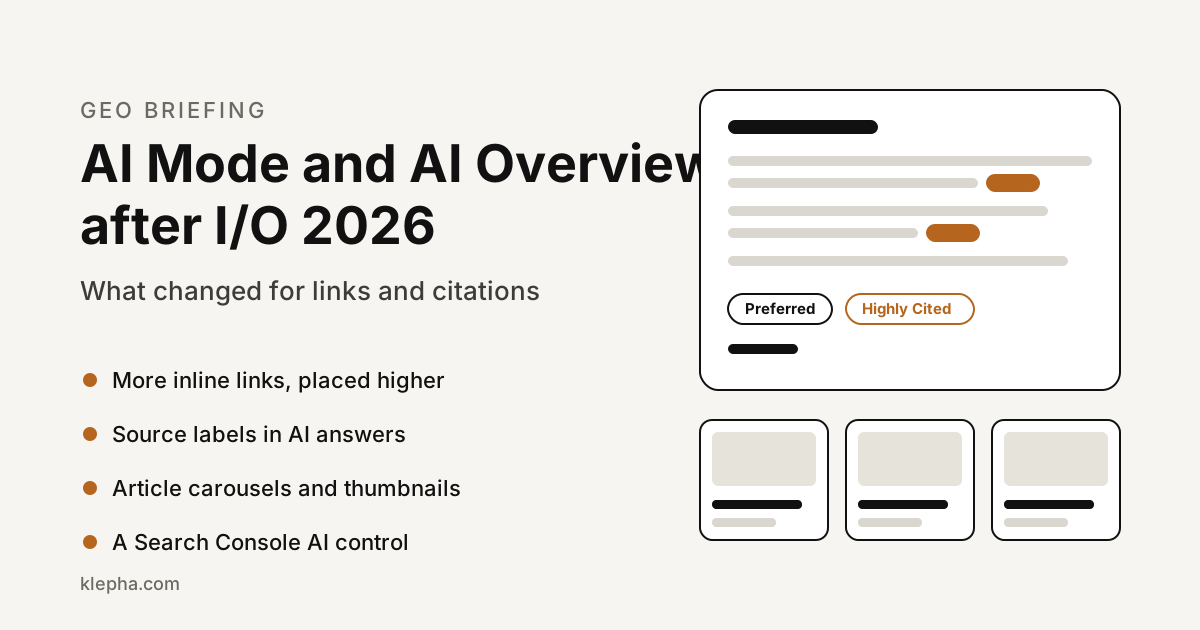
At I/O on May 19, 2026, Google made Gemini 3.5 Flash the default model in AI Mode globally, began rolling out an AI powered Search box wherever AI Mode is available, and made the flow from an AI Overview into an AI Mode conversation live worldwide. The link changes came around it: more inline links placed higher in answers, Preferred and Highly Cited labels, article carousels, and, from August 31, a Search Console control and report for AI features.
This briefing separates what Google actually shipped from what it only announced, dates every change from Google’s own posts and documentation, and turns it into a short list of moves. If you want the evergreen version of how inclusion works, start with our guide to ranking in Google AI Overviews; this page is about what changed in 2026.
Key takeaways
- AI Mode is now the main stage. Google reported more than one billion monthly users at I/O, and AI Overviews now hand off directly into it.
- Links became more visible, not fewer. More inline links, placed higher, with hover previews, thumbnails and carousels.
- Labels are the new differentiator. Preferred, Subscribed and Highly Cited badges reward sources people chose or other publishers cite.
- You now have a control and a report. Since August 31, 2026, Search Console lets every site include or exclude itself and see AI feature impressions.
- No special optimization is required. Google’s documented requirement is still indexing plus snippet eligibility. The edge comes from being cited, chosen and measured.
What did Google announce for Search at I/O 2026?
Google’s Search announcements came in a post by Elizabeth Reid, VP of Search, on May 19, 2026, with a recap list published on May 20. The headline number was that AI Mode had passed one billion monthly users a year after launch, with queries more than doubling every quarter since launch, according to Google.
Availability varied a great deal by feature, so the table below sticks to the scope Google stated. “Announced” means Google gave a window but we have not found a later Google post confirming a full rollout.
| Announcement | Scope Google stated | Status as of Nov 8, 2026 |
|---|---|---|
| Gemini 3.5 Flash as the default model in AI Mode | Everyone, globally, from May 19 | Shipped |
| Intelligent, AI powered Search box (text, images, files, videos, Chrome tabs as input) | All countries and languages where AI Mode is available | Rolling out from May 19 |
| Follow-up questions from an AI Overview straight into AI Mode | Desktop and mobile, worldwide | Live (mobile first launched January 27) |
| Information agents (“keep me updated” monitoring) | Google AI Pro and Ultra subscribers first, summer 2026 | Announced |
| Agentic booking for local experiences and services, plus calling businesses | Everyone in the U.S., summer 2026 | Announced |
| Generative UI (custom visual layouts built per question) | Everyone in Search, free, summer 2026 | Announced |
| Antigravity mini apps built inside Search | AI Pro and Ultra in the U.S. first, “coming months” | Coming later |
| Personal Intelligence in AI Mode (Gmail, Google Photos; Calendar “soon”) | Nearly 200 countries and territories, 98 languages, no subscription | Expanding from May 19 |
Two of these matter directly for links. The merged AI Overview to AI Mode flow means a user who starts with a short summary can keep asking without leaving Google, and Google said that as they go deeper “the links and supporting articles get even more relevant.” The agentic booking feature brings together pricing and availability with direct links to finish booking through the provider the user chooses. Both shift value toward pages that answer narrow follow-up questions and toward accurate structured business data.
How did links and citations change in AI Mode and AI Overviews?
The I/O keynote itself said little about link design. The link changes were announced in three Search posts: two weeks before I/O on May 6, a week after on May 27, and on October 15. Read together, they show a consistent direction: more links, shown earlier, with more context about who the source is.
| Date | Change | Shipped or test |
|---|---|---|
| May 6, 2026 | More links directly inside AI responses, next to the relevant text | Shipped |
| May 6, 2026 | Hover preview on desktop showing the site name or page title | Shipped |
| May 6, 2026 | “Where to go next” links to in-depth articles at the end of many responses | Rolling out |
| May 6, 2026 | Previews of perspectives from forums and social media, with creator or community names | Shipped |
| May 6, 2026 | “Subscribed” labels on links from a user’s linked news subscriptions | Rolling out |
| May 27, 2026 | Preferred Sources labelled inside AI Overviews and AI Mode | Shipped |
| May 27, 2026 | Prominent article carousel for questions about developing topics | Rolling out for some searches |
| May 27, 2026 | “Highly Cited” badge on more web article links | Shipped |
| Oct 15, 2026 | Inline links shown higher up in responses more often | Launching |
| Oct 15, 2026 | Article carousels expanded to more locations and languages | Rolling out |
| Oct 15, 2026 | Related article links at the end of responses with image thumbnails | Rolling out |
| Oct 15, 2026 | Dedicated section at the top for official websites, with context on why each link helps | Testing |
| Oct 15, 2026 | Clickable creator and publisher names on video results, linking to Search profiles in AI Mode | Testing |
Inline links moved up the answer
The most consequential change is placement. In May, Google said users would see more links right next to the relevant text in AI responses. In October it described “continued and substantial increases” to inline links and said it was launching updates to show them higher in responses more often. A link inside the second sentence of an answer is a very different asset from a source card below the fold, and it is attached to a specific claim. That raises the value of owning one clear, quotable claim per page section.
Labels now separate sources
Three labels can now sit on a link. Preferred appears for users who have added your site in their source preferences. Subscribed appears for users who linked a news subscription. Highly Cited marks articles that many other stories have cited, and Google also indicates when an article explicitly references a Highly Cited source. Google reported that people are twice as likely to click a Preferred Source, that users had selected more than 345,000 unique sources by May 27, and, on October 15, that use of the feature had grown more than sevenfold since the start of the year.
Carousels and thumbnails reward fresh, distinct pages
For developing topics, responses can now open with a short context paragraph followed by a carousel of timely articles, which also highlights a user’s Preferred Sources. Google said a similar carousel of perspectives from discussions, forums and social media was coming. Related links at the end of responses now carry image thumbnails, which makes your page’s lead image part of the click decision.
Two features are still tests
The official website section and clickable creator names on video results were both described as tests on October 15. Treat them as signals of direction, not as surfaces you can plan around yet.
What changed for site owners after I/O?
The biggest practical change for site owners was not in the keynote. On August 31, 2026, Google finished rolling out two Search Console features to all websites worldwide.
The Search generative AI control. Under Settings, each property can now choose to include or exclude its links and content from AI Overviews, AI Mode and generative AI features in Discover. Inclusion is the default. Google’s help page says exclusion generally takes effect within a few days, is not used as a ranking or inclusion signal for the rest of Search, and does not affect AI training, which is handled separately through Google-Extended. Child properties inherit the setting of their parent unless an owner overrides it.
The Generative AI performance report. This report shows how many times links to your site were shown in AI Overviews and AI Mode, with dimensions for pages, countries, dates and devices, and a filter that separates text queries from multimodal ones such as Lens and Circle to Search. Search Labs experiments are excluded. Before this, AI feature traffic was only folded into the overall Web search type in the Performance report, which is still how Search Central documents it.
The control also gates one of the new labels. Google’s Preferred Sources documentation, last updated September 18, 2026, says a site must be included in Search generative AI features to be eligible for display as a preferred source in AI Mode and AI Overviews. Only domains and subdomains qualify, not subdirectories.
What does Google say you need to appear in AI features?
Google’s Search Central page on AI features and your website is explicit: to be eligible as a supporting link in AI Overviews or AI Mode, a page must be indexed and eligible to be shown in Search with a snippet, and “there are no additional technical requirements.” It also says specific optimization isn’t required.
The same page explains two things that shape strategy. Both features may use a query fan-out technique, issuing multiple related searches across subtopics to build a response, which is why they can show a wider and more diverse set of links than classic results. And because AI Mode and AI Overviews may use different models and techniques, the links each shows will vary. A page cited in one is not automatically cited in the other.
Its listed best practices are the SEO fundamentals: allow crawling in robots.txt and at your CDN or host, make content findable through internal links, provide a good page experience, keep important content in text, support it with quality images and video, match structured data to visible text, and keep Merchant Center and Business Profile information current.
Which GEO moves should brands make now?
None of the moves below is a shortcut, and none guarantees inclusion. They combine Google’s published guidance with what we see in practice when tracking AI answers for clients: the brands that gain are the ones that are easy to cite, easy to verify and easy for a person to choose.
1. Confirm your Search Console setting and open the new report
Check Settings, then Search generative AI, on your domain property and any child properties. An inherited exclusion set by another team is the kind of silent block that costs months. Then open the Generative AI performance report and export a baseline by page and country, so every later change has something to compare against.
2. Write sections that earn an inline link
Inline links attach to claims. Give each important question its own section, answer it in the first two sentences, and include one specific, sourced fact a model would need to credit. Because of query fan-out, pages that answer the narrow follow-up questions in your category, not just the head term, have more chances to be pulled in. Our guide to generative engine optimization covers the extraction side in depth.
3. Ask your readers to choose you
Preferred Sources is the one label you can directly ask for. If your site appears in Google’s source preferences tool, Google documents a two line button and a deeplink you can use on pages, newsletters and social posts. Google’s May 27 announcement says any website that publishes fresh content is eligible, so this is not only for news publishers. Remember it applies at domain or subdomain level only.
4. Publish what others will cite
The Highly Cited badge goes to articles many other stories cite. That rewards original data, primary reporting and first statements of fact in your field, and it rewards linking to primary sources yourself, since Google also flags articles that reference a Highly Cited source. One genuinely new number does more here than ten summaries.
5. Show up where perspectives are pulled from
AI responses now preview perspectives from forums, communities and social media, with names attached, and Google said a dedicated carousel for them was coming. Useful, honest participation in the communities your buyers use is now part of being visible in Google, not only in ChatGPT. Our Reddit marketing approach covers doing that without spam.
6. Make thumbnails, titles and business data work for you
Hover previews show your site name and page title, related links show thumbnails, and agentic booking draws on pricing and availability. Use clear page titles and a consistent site name, give key pages a relevant lead image, keep Organization and Article markup in line with the visible page, and keep Business Profile and Merchant Center data accurate. Our schema markup guide covers the markup. For retailers, the buying side of this now runs on the Universal Commerce Protocol, which we cover in our guide to Google agentic checkout and UCP.
7. Measure the answer, not only the impression
The new report counts impressions of your links. It does not show what the answer said about you, which competitor sat above you, or whether you were named without a link. Track a fixed set of prompts across AI Overviews and AI Mode on a schedule and keep the history, as described in our guide to tracking AI brand visibility. Expect variation between identical runs and judge trends over weeks.
See how Google’s AI answers describe you
A free report runs your category’s real questions through AI search engines and shows who gets cited, so you can see where the gaps are before you change anything.
Get my free reportWhat should brands avoid?
Excluding your site out of frustration. The new control is clean and reversible, but exclusion removes your links from AI Overviews and AI Mode while competitors’ similar content keeps appearing, as Google’s help page notes. Look at the performance report and your conversion data before deciding, and decide per property rather than for the whole domain by default.
Treating agents and generative UI as channels to optimize. Information agents, generative UI and Antigravity mini apps were announced with summer or later windows and limited audiences. Nothing Google has published describes a way to target them. The fundamentals that get you cited in AI Mode are the same ones these features draw on.
Buying promises. Google says no special optimization is required, and nobody outside Google controls which link is placed inline. Anyone guaranteeing AI Overview or AI Mode placement is selling something they cannot deliver. If traffic dropped and you are unsure why, our analysis of the AI Overviews engagement drop is a better starting point.
What is still unconfirmed?
As of November 8, 2026, we could not find a Google post confirming that information agents, U.S. agentic booking expansion or generative UI reached the full audiences announced for summer 2026, so we list them as announced rather than live. The official website section and creator name links remain tests. Google’s October roundup did say that Gemini 4 Argon rolled out globally across products including Search, but it did not describe changes to how links are shown.
We will update this page when Google publishes rollout confirmations. For the broader picture of how AI engines pick sources across Google, ChatGPT and Perplexity, see how LLMs choose which websites to reference, and for how we run these programmes for clients, see our AI search ranking service, our expertise and our case studies.
Since I/O, two related changes are worth tracking: Google has moved many brand AI Overviews into the right-hand column of desktop results, and advertisers have found that AI Mode activity barely shows up in Google Ads search terms reports. Publishers using AI to produce content for these surfaces should also read Google's October 2026 guidance on fact checking and authorship. On November 10, Google also made Gemini 4 Carbon available in AI Mode for Google AI Ultra subscribers.
Sources
- Google, The Keyword: “A new era for AI Search” by Elizabeth Reid, May 19, 2026. blog.google
- Google, The Keyword: “100 things we announced at I/O 2026”, May 20, 2026. blog.google
- Google, The Keyword: “Just ask anything: a seamless new Search experience” by Robby Stein, January 27, 2026. blog.google
- Google, The Keyword: “5 new ways to explore the web with generative AI in Search” by Hema Budaraju, May 6, 2026. blog.google
- Google, The Keyword: “New ways to find your favorite sources and original content in AI Search” by Duncan Osborn, May 27, 2026. blog.google
- Google, The Keyword: “More ways to connect with the web from Search” by Hema Budaraju, October 15, 2026. blog.google
- Google, The Keyword: “The latest AI news we announced in October 2026”, November 2, 2026. blog.google
- Google Search Central: “AI features and your website”, last updated December 10, 2025, checked November 8, 2026. developers.google.com
- Google Search Central: “Help your readers find your site through preferred sources in Google Search”, last updated September 18, 2026. developers.google.com
- Search Console Help: “Search generative AI control”, rolled out to all websites August 31, 2026. support.google.com
- Search Console Help: “Generative AI performance report (Search)”, rolled out to all websites August 31, 2026. support.google.com
Frequently asked questions
What did Google announce for AI Mode at I/O 2026?
On May 19, 2026 Google said AI Mode had passed one billion monthly users, made Gemini 3.5 Flash its default model globally, began rolling out a redesigned AI powered Search box in every country and language where AI Mode is available, and made the flow from an AI Overview into an AI Mode conversation live worldwide. It also announced information agents, expanded agentic booking, generative UI and expanded Personal Intelligence, several of them for later in 2026.
How do links and citations look different in AI Overviews and AI Mode now?
There are more inline links placed next to the relevant text and, since October 2026, higher up in responses. Links can carry Preferred or Subscribed labels for individual users, Highly Cited badges mark primary reporting, timely topics get article carousels, and related links at the end of responses now show image thumbnails. A dedicated section for official websites and clickable creator names on videos were still described as tests.
Can I stop my site appearing in AI Overviews and AI Mode?
Yes. Since August 31, 2026 every site can use the Search generative AI control in Search Console settings to exclude its links and content from AI Overviews, AI Mode and generative features in Discover. Google says the choice is not a ranking signal for the rest of Search, takes effect in a few days, and does not affect AI training, which is managed separately through Google-Extended.
How do I measure my visibility in AI Overviews and AI Mode?
Use the Generative AI performance report in Search Console, rolled out to all sites on August 31, 2026. It shows how often links to your site were shown in AI Overviews and AI Mode, by page, country, device and date. It does not tell you what the answer said about your brand, so pair it with regular checks of the answers themselves.
Do I need special optimization to appear in Google AI features?
Google says no. A page must be indexed and eligible to show with a snippet, and there are no additional technical requirements. Its guidance is to keep following SEO fundamentals: allow crawling, link pages internally, keep important content in text, match structured data to visible text and keep Merchant Center and Business Profile details current.