How do you write Meta ad copy that stops the scroll?
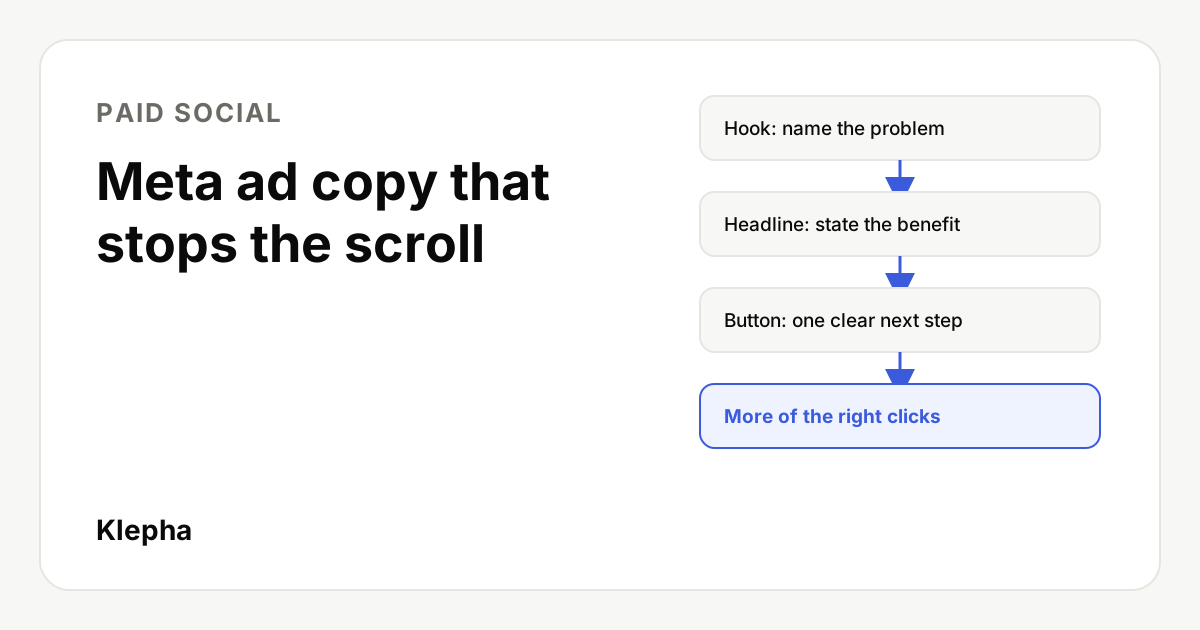
Meta ad copy stops the scroll when the first line names a specific problem or outcome your audience already cares about, the headline states the benefit in plain words, and the call to action tells people exactly what happens next. Write for the first visible line, because Meta hides the rest of long primary text behind a "See more" link in many placements.
People do not open Facebook or Instagram to see ads. They scroll fast, and your copy gets a moment to earn attention before the thumb moves on. Good Meta ad copy is not clever wordplay. It is a specific message, aimed at a specific person, that answers "why should I care?" before they have time to ask.
This guide breaks a Meta ad into its parts, then shows how to write each one: the hook, the headline and the call to action. Every section has a simple before and after rewrite you can adapt. The example brands are made up so the lessons stay general.
Key takeaways
- The first line is the ad. Long primary text is often cut behind "See more", so the hook must work alone.
- Specific beats clever. A concrete problem, number or outcome stops more scrolls than a pun.
- Headlines sell the benefit, not the feature or the brand name.
- One action per ad. The button, the copy and the landing page should all promise the same next step.
- Stay inside the rules. Meta's Advertising Standards ban copy that asserts or implies personal attributes about the viewer.
What are the parts of a Meta ad?
Most Meta ads in Feeds, Stories and Reels are built from the same text fields. Where each appears depends on the placement, but the jobs stay the same.
| Part | Where it shows | Its job |
|---|---|---|
| Primary text | Above the image or video in Feeds; overlaid or shortened in Stories and Reels | Stop the scroll with the hook, then give one or two reasons to act |
| Creative (image or video) | Center of the ad | Show the product, the problem or the result; carry the hook visually |
| Headline | Bold line near the button | State the main benefit or offer in a few words |
| Description | Under the headline in some placements | Add a supporting detail; often hidden, so never put key information only here |
| Call to action button | Beside or under the headline | Tell people what happens when they tap, chosen from Meta's fixed list |
Meta's Ads Guide lists current text and media specs per placement. Check it before you write, because display limits differ between Feeds, Stories and Reels and change over time.
What should you know before writing a word?
Weak ad copy usually comes from weak inputs, not weak writing. Before you draft, answer four questions in one sentence each:
- Who exactly is this for? "Small bakery owners who do their own social media" beats "small businesses".
- What problem do they feel right now? Use the words customers use in reviews, support tickets and sales calls.
- What changes for them after buying? The outcome, not the feature list.
- What is the single next step? Buy, book, sign up, download. Pick one.
If you cannot answer these, no hook formula will save the ad. A one sentence brand positioning statement answers the first three before any campaign starts. Customer language is the best raw material you have; a short list of exact phrases from reviews often gives you three hooks to test.
How do you write a hook that stops the scroll?
The hook is the first line of primary text, together with what the creative shows in the first second. It has one job: make the right person stop. These six patterns cover most good hooks.
| Hook type | How it works | Example |
|---|---|---|
| Call out the audience | Names who the ad is for, so the right people self select | "Running a Shopify store on your own?" |
| Name the pain | Describes a moment of frustration the reader recognizes | "Spent Sunday night building next week's schedule again?" |
| Show the outcome | Leads with the result instead of the product | "Invoices sent in 30 seconds, from your phone." |
| Use a specific number | Concrete numbers feel credible and scannable | "3 ingredients. 10 minutes. No oven." |
| Challenge a belief | Contradicts something the audience assumes | "You don't need more followers to get more bookings." |
| Start the story | Opens a short, relatable scene | "Our first 40 orders were packed on a kitchen table." |
Any number or claim in a hook must be true and provable. A "3 ingredient" recipe needs three ingredients; "30 seconds" needs to be a typical result, not a best case.
Before and after: hooks
| Before | After | What changed |
|---|---|---|
| "Introducing BrightBooks, the all in one accounting platform." | "Still chasing clients for payment? BrightBooks sends the reminders for you." | Starts with the reader's pain, not the brand |
| "We have a great new range of running shoes." | "Shin splints after 5K? Our wide toe trainers were built for flat feet." | Calls out a specific runner and a specific fix |
| "Learn more about our meal kits." | "Dinner on the table in 20 minutes, with 5 ingredients you already know." | Leads with a concrete outcome and numbers |
How do you write a benefit led headline?
The headline sits near the button and is read as the last thing before the tap. It should finish the thought the hook started. A useful test: if someone saw only the headline and the button, would they know what they get?
- Benefit over feature. "Automatic payment reminders" is a feature. "Get paid without the awkward emails" is the benefit.
- Plain words. Say it the way a customer would say it to a friend.
- Include the offer when there is one. "Free 14 day trial" or "Free shipping over $50" belongs here, stated exactly as it appears on the landing page.
- Do not repeat the hook. If the primary text already names the pain, the headline names the result.
- Keep it short. Headlines are often truncated, so put the key words first.
Before and after: headlines
| Before | After |
|---|---|
| "BrightBooks Accounting Software" | "Get paid faster, without chasing" |
| "New Collection Available" | "Wide fit trainers for flat feet" |
| "Best Meal Kit Service" | "20 minute dinners, delivered weekly" |
Avoid unprovable superlatives such as "best" unless you can back them up. They rarely persuade, and some industries face stricter rules on claims.
What goes in the rest of the primary text?
After the hook, give the reader just enough to act. A simple structure that works for most offers:
- Hook: the problem, outcome or callout.
- Bridge: one line on how the product solves it.
- Proof: one concrete reason to believe: a specific feature, a guarantee you actually offer, a real review quote you have permission to use, or a verifiable number.
- Action: what to do next, matching the button.
Example for a fictional invoicing app:
Still chasing clients for payment? BrightBooks sends polite reminders automatically, so you never have to write that email again. Set it up once in about five minutes. Start your free 14 day trial, no card needed.
Short copy is not always better. Higher priced or less familiar products often need more explanation, while impulse purchases need less. Write the long version, cut every line that does not help the decision, then test a short and a long version against each other.
How do you choose a clear call to action?
The call to action has two parts: the button you choose from Meta's list and the last line of your copy. Both should describe the same next step, and the landing page should deliver it.
| What happens after the tap | Button to use | Copy line that matches |
|---|---|---|
| Product page with a buy button | Shop now | "Pick your size and get free returns." |
| Sign up form or free trial | Sign up | "Start your free trial in two minutes." |
| Article, guide or explainer | Learn more | "Read the 5 minute guide." |
| Booking calendar | Book now | "Choose a time that suits you." |
| App store listing | Install now | "Download free on iPhone and Android." |
The most common conversion leak is a mismatch: the ad says "Free trial" but the landing page leads with pricing tiers. Our guide to writing a landing page for paid ad traffic covers message match in detail.
Your customers also ask AI assistants
The same questions people answer with your ads, they now ask ChatGPT and Gemini. A free Klepha report shows whether AI assistants recommend your brand or a competitor.
Get my free reportWhich Meta ad policies affect your copy?
Copy that breaks Meta's Advertising Standards can be rejected or restricted. The rules most likely to catch scroll stopping copy:
- Personal attributes. Ads must not assert or imply personal attributes about the viewer, such as health, financial status or other sensitive traits. "Are you in debt?" implies something about the reader; "A simple plan for paying down credit cards" does not.
- Misleading claims. Exaggerated before and after promises, fake urgency and claims you cannot support are risky and erode trust.
- Restricted categories. Finance, health, alcohol, dating and some other categories carry extra requirements. Check the standards for your category before launch.
- AI text options. If you turn on Advantage+ creative features that generate or adjust text, review the variations they can produce, so nothing you did not approve reaches your audience.
Policy is not the only risk. Meta can also add offers it detects on your website to ads; see which Meta offer settings to audit so ads never show discounts you did not approve.
How do you test ad copy without fooling yourself?
- Test big differences first. Three different hook types tell you more than three versions of one sentence.
- Change one thing at a time. Keep the creative, audience and offer the same when you test copy.
- Judge on the right metric. Click through rate shows whether the hook works; cost per conversion shows whether the promise matches the page. A hook can win clicks and lose sales.
- Wait for enough data. Small differences over a few days are often noise.
- Track properly. Without working conversion tracking and consistent UTM parameters, you cannot tell which copy drove sales.
For sample sizes and test length, see how to A/B test ads and landing pages.
If you test AI generated creative across platforms, note that Google Ads bans AI impersonation of public figures even when the ad discloses AI use.
A quick Meta ad copy checklist
- The first line works on its own and names a specific person, problem or outcome.
- The creative reinforces the hook in the first second.
- The headline states the benefit or offer in plain words.
- Every claim and number is true and provable.
- No copy implies personal attributes about the viewer.
- The button, the last line and the landing page promise the same next step.
- At least two clearly different hooks are ready to test.
If you want help connecting paid social to search and AI visibility, see our solutions, the disciplines on our expertise page, and how we approach growth in our case studies.
Sources
- Meta, "Meta Ads Guide" (text and media specifications by placement). facebook.com
- Meta Transparency Center, "Advertising Standards" (including personal attributes). transparency.meta.com
Frequently asked questions
How long should Meta ad primary text be?
Long enough to make the point, with the hook in the first line. Meta truncates longer primary text behind a "See more" link in many placements, and the cut off point varies by placement and device, so the first sentence must work on its own. Test short and long versions rather than assuming one wins.
What is the difference between the headline and the primary text in a Meta ad?
Primary text is the copy above the image or video, where the hook lives. The headline is the short bold line near the call to action button, and it should state the main benefit or offer. The two should work together, not repeat each other.
Which call to action button should I choose?
Pick the button that matches what really happens after the click. Use "Shop now" for a product page, "Sign up" for a form, "Learn more" for an article or explainer. A mismatch between the button and the landing page usually lowers conversion.
Can I ask questions like "Are you struggling with debt?" in Meta ads?
Be careful. Meta's Advertising Standards prohibit ad text that asserts or implies personal attributes, such as health, finances or other sensitive traits, about the person seeing the ad. Talk about the situation or the outcome instead of implying something about the reader.
How many ad copy variations should I test?
Start with two or three clearly different hooks rather than many small wording tweaks. Keep the image, audience and offer the same so you know the copy caused the difference, and give each variant enough conversions before you choose a winner.