How do you write a brand positioning statement?
A brand positioning statement is one or two internal sentences that say who your best customer is, what category you compete in, the main benefit you deliver and why you are a better choice than the alternative. Write it from evidence about real customers, keep it specific enough that a competitor could not sign it, and use it to judge every ad, page and pitch.
Most small businesses never write their positioning down. They have a logo, a tagline and a website, but if you ask three people on the team "why should a customer pick us?" you get three different answers. That gap shows up everywhere: in vague ads, in homepages that try to speak to everyone, and in AI assistants that describe the brand in generic terms because the brand never described itself clearly.
This guide gives you a simple template, shows how to fill each part with evidence instead of opinion, and walks through four worked examples for typical small businesses. The example businesses are made up so the method stays general.
Key takeaways
- It is an internal tool, not a slogan. Customers rarely see it; your team uses it to make consistent decisions.
- Four parts do the work: target customer, category, key benefit and the reason you beat the alternative.
- Specific beats broad. If a competitor could sign your statement, it is not positioning yet.
- Start from evidence. Your best customers, their words and the alternatives they really considered.
- Test it in the wild. Ads, landing pages and sales calls show quickly whether the positioning lands.
What is a brand positioning statement?
A brand positioning statement is a short internal description of the place you want your brand to hold in a specific customer's mind compared with the alternatives. It answers four questions in one or two sentences: who is this for, what is it, what does it do for them, and why is it a better choice than what they would otherwise do?
It is easy to confuse with other brand words. The differences matter because each one has a different job:
| Term | Audience | Job | Example (fictional) |
|---|---|---|---|
| Positioning statement | Your team, agencies, freelancers | Decide who you serve and how you win | "For busy parents who want a home cooked dinner without planning, FreshTable is a meal kit that..." |
| Value proposition | Customers | Promise a specific benefit on a page or in an ad | "Dinner in 20 minutes, with 5 ingredients you already know." |
| Tagline | Everyone | Be memorable | "Real food, less fuss." |
| Mission statement | Team and public | Explain why the company exists | "Help families eat together more often." |
The positioning statement comes first. The value proposition, tagline, ad copy and homepage headline are all written from it.
What is a simple positioning statement template?
The most widely used format comes from Geoffrey Moore's book Crossing the Chasm. Lightly simplified, it reads:
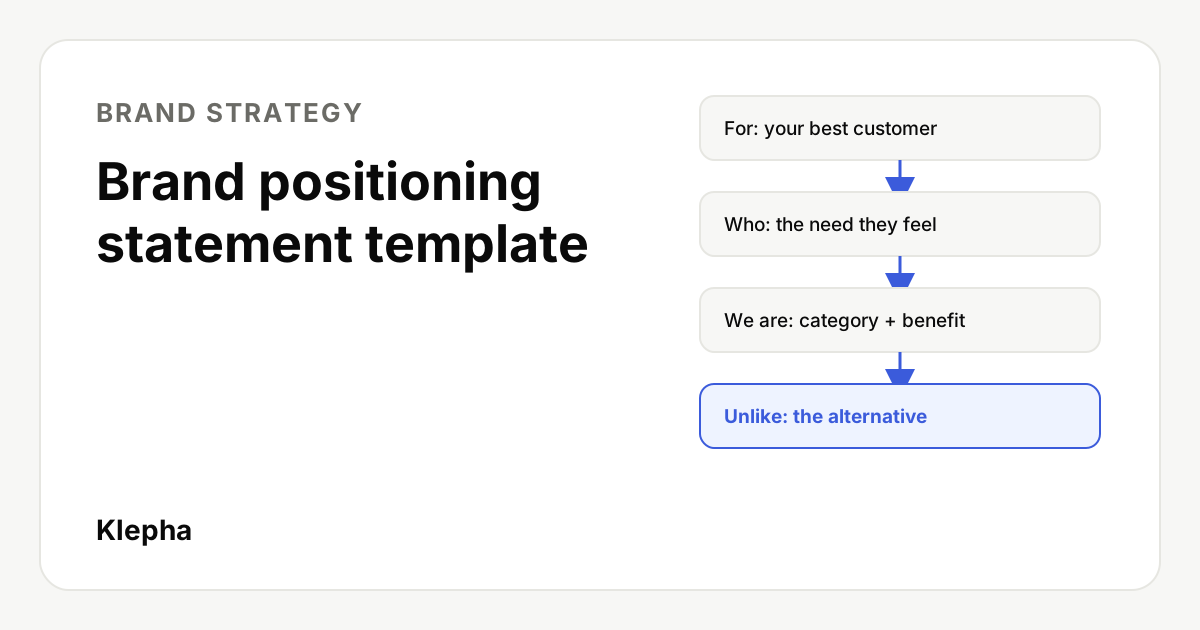
For [target customer] who [need or problem], [brand] is a [category] that [key benefit]. Unlike [main alternative], we [main point of difference].
Each blank has a clear job:
| Part | What to write | Common mistake |
|---|---|---|
| Target customer | The specific group that gets the most value and buys most easily | "Small businesses" or "anyone who..." |
| Need or problem | The situation that makes them look for a solution, in their words | A feature described as a need |
| Category | The frame of reference customers already understand | An invented category nobody searches for |
| Key benefit | The single most important outcome they get | A list of five benefits |
| Main alternative | What they would really do instead, including doing nothing or using a spreadsheet | Naming only the biggest brand in the market |
| Point of difference | A provable reason you deliver the benefit better | "Better quality" or "great service" with no proof |
April Dunford's book Obviously Awesome adds a useful order of work: start from the competitive alternatives, then your unique attributes, then the value those attributes create, then the customers who care most about that value, and only then choose the category. Working in that order stops you writing the statement you wish were true.
What do you need before you write it?
Weak positioning usually comes from guessing. Before filling in the template, collect four inputs. A small business can do this in an afternoon.
- Your best customers. List the ten customers who bought fastest, stayed longest or spent the most. What do they have in common: industry, size, life stage, location, trigger event?
- Their words. Pull exact phrases from reviews, support emails, sales calls and survey answers. How do they describe the problem before they found you, and the result after?
- The real alternatives. Ask recent customers what they would have done if you did not exist. The honest answer is often "keep using a spreadsheet", "hire a freelancer" or "do nothing", not your named competitor.
- Your provable differences. What do you do that the alternative does not, and can you show it? A guarantee, a speed, a specialism, a process, a location, a price structure.
If you sell online, two more sources are worth checking. Search queries in Google Search Console show the words people use when they find you. And asking ChatGPT, Gemini or Perplexity "what is [your brand]?" and "best [category] for [customer]" shows how the market is already describing you, which is often different from how you describe yourself.
How do you write it step by step?
- Pick one primary customer. You can serve others, but the statement is written for the group you most want more of.
- Write the need in their language. Use a phrase you found in reviews or calls, not internal jargon.
- Choose the category people already use. "Bookkeeping app" is clearer than "financial clarity platform". If you need a new category, explain it with a familiar one first.
- Commit to one key benefit. Ask: if customers could keep only one result, which would it be?
- Name the honest alternative. Use what customers told you they would do instead.
- State a provable difference. If you cannot point to evidence, it is a hope, not a difference.
- Run the swap test. Replace your brand name with a competitor's. If the sentence is still true, make it more specific.
- Read it aloud to a customer. If they nod and add detail, you are close. If they look puzzled, rewrite the need and benefit in plainer words.
What do good positioning statements look like for small businesses?
These four examples use fictional businesses. Each one shows a weak first draft and a stronger rewrite.
Local bakery
Weak: "For people who love great bread, Hearth & Grain is a bakery that offers quality products made with care."
Stronger: "For office managers in central Leeds who need breakfast for team meetings at short notice, Hearth & Grain is a bakery that delivers fresh pastries before 9am with same day ordering. Unlike supermarket platters, we bake every order that morning and deliver within the city centre in under an hour."
SaaS tool
Weak: "For businesses, BrightBooks is an innovative financial platform that makes accounting easy."
Stronger: "For freelance designers who lose time chasing late payments, BrightBooks is an invoicing app that gets them paid faster by sending polite reminders automatically. Unlike a spreadsheet and manual emails, BrightBooks follows up on a schedule the freelancer sets, so they never have to write an awkward chaser again."
Marketing agency
Weak: "For companies that want to grow, Northpeak is a full service digital agency delivering results."
Stronger: "For independent dental clinics that want more new patient bookings, Northpeak is a local search agency that fills appointment calendars through Google Business Profile and local landing pages. Unlike general agencies, we work only with dental clinics and report on booked appointments, not clicks."
Online store
Weak: "For runners, Stridewell sells high quality running shoes at great prices."
Stronger: "For new runners with flat feet who get sore shins, Stridewell is an online running shop that matches them to a wide fit trainer through a short video gait check. Unlike big sports retailers, every pair is chosen for flat feet and can be swapped free within 60 days of running in it."
Notice what changed in every rewrite: a narrower customer, a need in plain language, a familiar category, one benefit and a difference you could check. Every promise in a real statement, such as a delivery time or a returns window, must be something the business actually does.
How do AI assistants position your brand today?
Your positioning only works if the market repeats it. A free Klepha report shows how ChatGPT, Gemini and Perplexity describe your brand and which competitors they recommend instead.
Get my free reportWhat are the most common positioning mistakes?
- Targeting everyone. A broad target feels safer but makes every message weaker. Narrow positioning does not stop other customers from buying.
- Listing features. "AI powered", "all in one" and "easy to use" describe the product, not what changes for the customer.
- Unprovable superlatives. "Best", "leading" and "world class" add nothing unless you can back them up, and they can create advertising compliance problems.
- Ignoring the real alternative. If most prospects compare you with doing it themselves, positioning against a famous competitor misses the actual decision.
- Changing it every month. Positioning should be stable for a year or more. Campaigns change; the core does not.
- Writing it and filing it. A statement nobody uses is wasted. Put it at the top of every creative brief and every SEO content brief.
How do you use the statement across marketing?
The statement becomes a filter. Before anything goes out, check that it speaks to the target customer, names their need and supports the key benefit.
| Channel | How the statement shapes it |
|---|---|
| Homepage | The headline states the key benefit; the subheading names the customer and category. |
| Paid ads | Hooks use the customer's words for the need. See how to write Meta ad copy that stops the scroll. |
| Landing pages | The promise in the ad and the page match the same benefit. See landing pages for paid ad traffic. |
| SEO and content | Topics come from the customer's problems, and category words become target keywords. A keyword gap analysis shows which of those terms competitors already own. |
| About page and profiles | Describe the brand in the same words everywhere, so search engines and AI assistants see a consistent entity. |
| Welcome emails repeat the benefit and the difference. See our 5 email welcome sequence. |
Consistency matters more than it used to. AI assistants build their description of a brand from the text they find about it across the web. If your site, profiles and reviews describe you in the same specific terms, the answers people get are more likely to match your intended positioning. Our guide to brand visibility across search and AI covers how to check this.
How do you know if your positioning works?
You cannot prove positioning with a survey alone. Watch what customers do when they meet it:
- Sales conversations get shorter. Prospects who arrive already understanding what you do and who it is for are a good sign.
- Ad tests favor the positioned message. Run the positioned hook against a generic one with the same creative and audience, and compare cost per conversion, not just clicks.
- Customers repeat your words. Reviews and referrals start using the benefit and difference you chose.
- AI answers align. When you ask assistants about your category and customer, your brand is described the way you intended.
Review the statement once or twice a year, or after a big change in product, price or market. If you want help connecting positioning to search and AI visibility, see our solutions, the disciplines on our expertise page and our case studies.
Sources
- Geoffrey A. Moore, Crossing the Chasm (HarperBusiness, first published 1991; 3rd edition 2014), positioning statement template.
- April Dunford, Obviously Awesome: How to Nail Product Positioning so Customers Get It, Buy It, Love It (Ambient Press, 2019), positioning process.
- Google Search Central, "Creating helpful, reliable, people-first content". developers.google.com
Frequently asked questions
What is the difference between a positioning statement and a value proposition?
A positioning statement is an internal sentence that defines your target customer, category, key benefit and point of difference. A value proposition is the customer facing promise you write from it, such as a homepage headline or ad message. Positioning comes first; the value proposition expresses it.
How long should a brand positioning statement be?
One or two sentences is enough. If it needs a paragraph, you are probably trying to serve too many customers or claim too many benefits. Short statements are easier for a team to remember and apply.
Should customers ever see my positioning statement?
Usually not in its raw form. It is a working tool for your team, agencies and freelancers. Customers see its effects in your headlines, ads, product pages and sales conversations.
Can a small business have more than one positioning statement?
Have one for the brand. If you sell clearly different products to clearly different customers, you can write a separate statement for each product line, but they should not contradict the brand statement.
How often should I update my positioning statement?
Review it once or twice a year, or after a major change in your product, pricing, customers or competitors. Changing it more often makes your marketing inconsistent and harder for customers to remember.