How can I increase my brand’s visibility across Google, ChatGPT, Gemini and Perplexity?
Four surfaces with different mechanics share one input: whether the web can describe you consistently. Most companies fail that before any channel work begins.
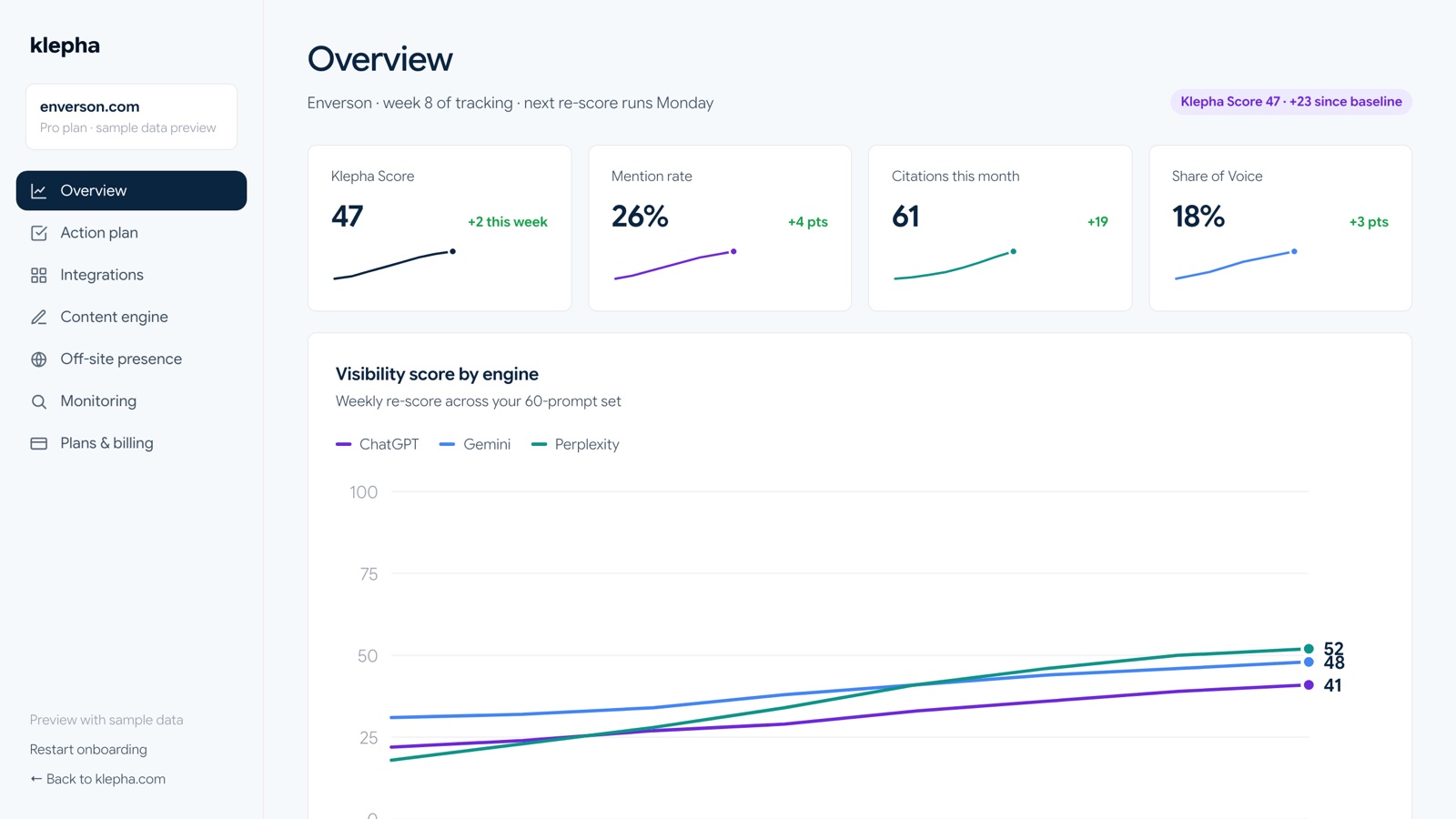
Four surfaces with different mechanics, one brand. It is tempting to run four programmes. There is a better starting point, because all four draw on the same underlying question.
The one shared input
Can the web describe you consistently?
Google needs to understand what entity you are to associate you with a category. ChatGPT needs enough consistent third-party description to name you with confidence. Gemini inherits Google’s understanding. Perplexity retrieves live and needs sources that say the same thing.
Every surface is asking the same question in a different accent: what is this company, and can I say something about it without being wrong?
Most companies fail this before any channel-specific work begins, and no amount of optimisation compensates for a brand the web cannot describe.
Becoming describable
The exercise is unglamorous and takes an afternoon.
Write one sentence: “[Brand] is a [category] for [audience] that [specific capability], used instead of [named alternatives].”
Then check where that sentence is currently contradicted. Most companies find:
- The homepage describes a mission and never names the category.
- The about page uses different vocabulary from the product pages.
- Sales decks position against competitors the website never mentions.
- Directory listings and old press releases carry a description from two pivots ago.
- Organization schema, where it exists, says something else again.
Fixing this is internal alignment with a direct external payoff. Put the sentence on the homepage, in the about page, in Organization schema, and in every third-party profile you control. It is the cheapest brand visibility work available and almost nobody does it deliberately.
Four surfaces, four mechanics
| Surface | What drives brand visibility |
|---|---|
| Google organic | Ranking, branded search volume, entity recognition |
| Google AI Overviews | Organic strength plus a clean passage on the sub-question |
| ChatGPT | Third-party corroboration above all; raw-HTML retrievability required |
| Perplexity | Live retrieval, currency, clear structure; retrievability required |
The practical reading: Google and AI Overviews reward the SEO programme you already run. ChatGPT and Perplexity reward being readable without JavaScript and being described consistently by others. Those are different bodies of work with one shared foundation.
See all four surfaces at once
A free scan reports what ChatGPT, Gemini and Perplexity say about your brand, alongside the Search Console picture.
Run my free scanBuilding corroboration
The highest-ceiling work for the assistant surfaces, and the slowest.
Models weigh what independent sources say about you far more heavily than what you say about yourself, and unlinked mentions count. This is the largest departure from link-era SEO: a mention with no hyperlink still shapes what a model believes.
The efficient version is not broad PR. It is targeted at the specific domains that already get cited in your category, which you can derive rather than guess — run your category’s questions through the assistants and record every URL they cite. That list, ranked by frequency, is your brief.
Three actions against it. Get listed accurately where you are absent. Get corrected where the description is stale. Get your data cited in the roundups and comparisons that appear repeatedly, because being the source inside a frequently-cited page is more efficient than competing with it.
Reddit deserves specific mention, being cited disproportionately often in AI answers. Genuine participation — answering questions in your area of expertise without pitching — builds the footprint models read; our forum visibility guide covers doing that without being counterproductive.
The branded search loop
Branded search is the one form of demand you can directly create, and it now pays into two channels.
Anything that makes people remember your name — a genuinely useful free tool, original research people cite, a visible presence where your audience already gathers — converts into searches with no competition. That is valuable on its own.
It also feeds the assistants. Branded search volume is evidence that a brand is a real, recognised entity, which supports the confidence an engine needs to name you unprompted. And the loop closes: when assistants begin naming you, branded search rises further, which strengthens the signal that made them name you.
This is why brand work has become better value than it was three years ago rather than worse, despite the discussion focusing almost entirely on technical GEO tactics.
Measuring brand visibility
Four numbers, reported separately.
- Branded impressions and clicks in Search Console, split from non-branded with a regex filter.
- Mention rate per engine across a fixed prompt set, run several times because answers vary.
- Share of voice against two named competitors on the same prompts — the most legible number for an executive audience.
- Accuracy: when you are mentioned, is what is said correct? An assistant confidently quoting abandoned pricing is more urgent than a few points of mention rate.
Do not blend these into one index. The surfaces move at different speeds and for different reasons, and a composite score moves for reasons nobody can attribute.
If you are a small or new brand
The advice above assumes an established company. A newer or smaller brand faces a different constraint: there may genuinely not be enough about you anywhere for an engine to say something with confidence.
That is not permanent and it is not a judgement. It does mean the sequence changes. On-site optimisation will not substitute for the absence of external description, so corroboration moves from fourth priority to first — after retrievability, which remains binary and cheap.
It also means going narrow rather than broad. A new company will not be named for “best project management software” regardless of execution. It can absolutely be named for the constrained version — a specific industry, size or use case — where three accurate third-party descriptions are enough to make it the obvious answer. Winning ten narrow questions completely is a better first year than being absent from one broad one.
Four things that waste brand budget
Broad PR with no target list. Coverage in outlets nobody in your category cites contributes very little. Derive the target list from which domains assistants actually cite when answering your buying questions, and pursue those specifically.
Rebranding vocabulary without propagating it. Changing how you describe yourself on the homepage while forty third-party listings carry the previous version produces inconsistency, which is worse than the old description. Propagation is the work; the new sentence is the easy part.
Chasing volume of mentions. Ten sources describing you identically is stronger evidence than fifty describing you five different ways. Inconsistency gives a model nothing stable to state, so an aggressive mention campaign with no message discipline can actively reduce visibility.
Treating AI visibility as a separate brand project. The inputs are the same inputs — clear positioning, credible third-party description, recognisable name. Running it as a distinct initiative duplicates effort and produces two conflicting descriptions of the same company.
How long each surface takes to respond
Setting expectations per surface prevents the most common misreading, which is concluding at week four that brand work has failed.
Perplexity reflects site changes within days and description changes within weeks, making it the earliest visible signal.
Google organic and AI Overviews respond on recrawl cadence — weeks for content changes, considerably longer for entity and authority signals to consolidate.
ChatGPT is slowest on every dimension, because it depends on third-party sources updating and then on those updates being crawled. Description changes propagating here can take a full quarter.
The practical implication: judge entity and corroboration work on a two-quarter horizon, not a monthly one, and use Perplexity as the leading indicator that something is moving at all.
The awkward internal question
This work frequently surfaces something uncomfortable: the company does not agree on what it is.
When marketing, sales and product each describe the category differently, the web reflects that faithfully and no engine can state anything confident. The fix is not a content project. It is a decision, made once, by someone with the authority to make it stick — and it is the highest-leverage hour available in the entire programme.
A sequence that compounds
- Week 1. Write the entity sentence. Baseline all four surfaces.
- Weeks 1–2. Fix retrievability and crawler access — gates the two assistant surfaces entirely.
- Weeks 2–4. Propagate the entity sentence: site, schema, every profile you control.
- Weeks 3–12. Work the citation map. Accurate description on the domains the assistants already cite.
- Ongoing. One piece of original data per year, refreshed annually. It earns links, citations and branded search from a single investment.
One measurement note on this sequence: baseline before step two rather than after. Retrievability fixes frequently produce the largest single improvement in the whole programme, and a team that starts measuring afterwards has no way to demonstrate it — which makes the rest of the budget harder to defend.
Step three is the one most often skipped and it is nearly free. A brand that describes itself the same way everywhere is measurably easier for every surface to name, and it costs a meeting rather than a budget.
Sources
- Vercel and MERJ — analysis of 500M+ GPTBot fetches finding zero JavaScript execution; same behaviour for ClaudeBot and PerplexityBot.
- Google — 2.5 billion monthly active users for AI Overviews and 1 billion for AI Mode, stated 19 May 2026.
- Aggarwal, Murahari, Rajpurohit, Kalyan, Narasimhan and Deshpande — “GEO: Generative Engine Optimization”, ACM SIGKDD 2024 (arXiv:2311.09735).
Frequently asked questions
How can I increase my brand’s visibility across Google, ChatGPT, Gemini and Perplexity?
Start with entity clarity — one plain sentence stating your category, audience and alternatives, used identically everywhere. Then build consistent third-party description on the sources those engines already cite. Then make sure your own pages are retrievable and quotable. All four surfaces draw on the same underlying question: can the web describe you consistently?
What is entity clarity and why does it matter?
Entity clarity is whether engines can identify unambiguously who you are, what category you compete in, and how your products relate. Models reason about entities rather than matching strings, so a brand described three different ways across its own site and the wider web gives them nothing stable to state. Fixing it is an internal alignment exercise with a direct external payoff.
Do unlinked brand mentions help?
Yes, and this is the biggest shift from link-era SEO. Models weigh how the web describes you regardless of whether a hyperlink is present. Reviews, forum threads, roundups and comparison posts all contribute, with Reddit cited disproportionately often in AI answers.
How do I get mentioned more consistently?
Agree one description internally and use it everywhere — your site, your schema, your profiles, your press materials, your sales decks. Then correct the highest-frequency third-party sources that carry an older version. Consistency across ten sources beats volume across fifty saying different things.
Does branded search help AI visibility?
Indirectly and meaningfully. Branded search is evidence that a brand is a real, recognised entity, which supports the confidence an engine needs to name you. It also loops: when assistants name you, branded search rises, which strengthens the signal that made them name you.
How do I measure brand visibility across all four?
Track branded impressions and clicks in Search Console for Google, and mention rate plus share of voice across a fixed prompt set for the assistants, reported per engine. Do not blend them into one index — they move at different speeds and for different reasons, and a blended number cannot be attributed.