Does Google Ads allow AI-generated public figures in ads if you disclose the AI?
No. Google's Unacceptable Business Practices policy now states that "ads that impersonate public figures using AI aren't allowed, even if they disclose that they were generated or edited using AI." Search Engine Land reported the clarification on November 12, 2026. Violations are treated as egregious: Google says accounts are suspended upon detection, without prior warning.
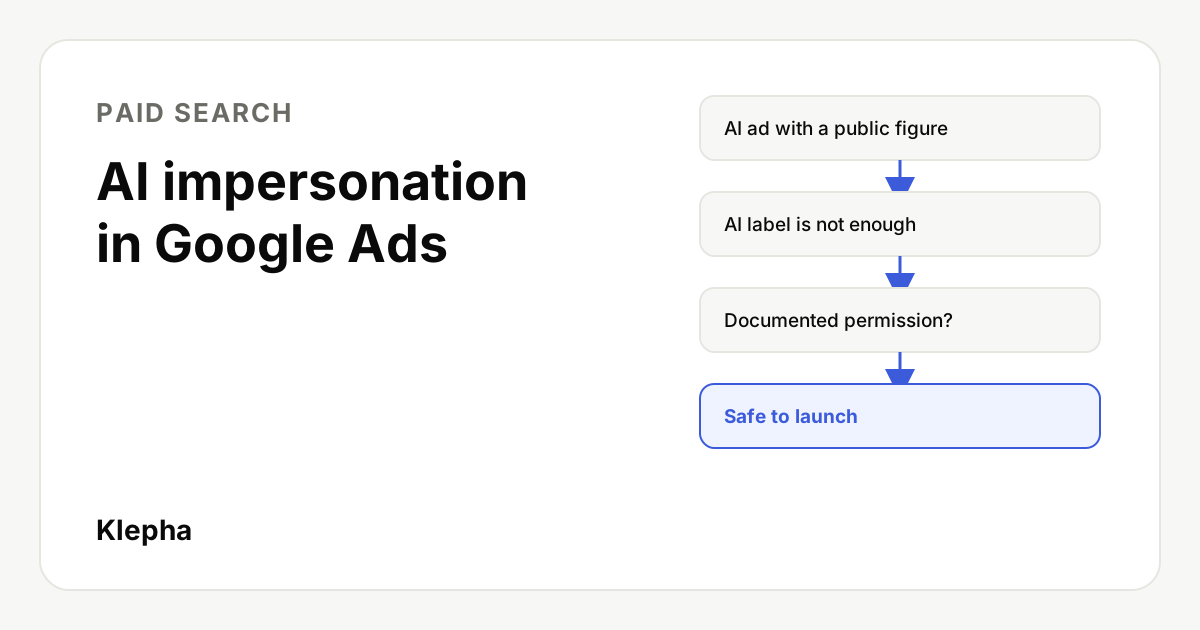
Generative AI makes it cheap to produce a realistic video of a famous athlete, a cloned voice of a TV presenter, or a photo of a well known founder holding your product. Some advertisers assumed that adding an "AI generated" label made this acceptable. Google has now said plainly that it does not.
This article explains what the policy says, what changed in November 2026, what it does and does not cover, and a practical review process for teams that use AI in ad creative.
Key takeaways
- The rule: ads that impersonate public figures using AI are not allowed, even with an AI disclosure.
- It is a clarification. Search Engine Land reports it clarifies existing rules rather than adding new enforcement.
- The penalty is severe. Google treats these violations as egregious, with suspension on detection and no prior warning.
- AI creative is not banned. The target is impersonation and false endorsement, not AI tools themselves.
- Documented permission is the safe path for any real public figure in your ads.
What does Google's policy now say?
The public figure impersonation section of Google's Unacceptable Business Practices policy explains that you cannot "scam people into giving you money or personal information by pretending to be a public figure or making it seem like you have a connection to one when you don't." It now includes this note:
"Ads that impersonate public figures using AI aren't allowed, even if they disclose that they were generated or edited using AI."
Google's own examples of what is not allowed include:
- Using a famous singer's name or image without permission to make it seem they are happy clients of an investment service.
- Falsely stating that a professional athlete sponsors a weight loss product.
- Using AI generated videos of popular YouTubers to mislead people into thinking they endorse a "get rich quick" scheme.
Search Engine Land reported the update on November 12, 2026, describing it as a clarification of existing rules rather than a new enforcement policy, with no new penalties, detection methods or procedures announced.
How serious is the enforcement?
Very. Google's policy page states that violations of the Unacceptable Business Practices policy "are taken very seriously and are considered egregious." It continues: "If we find violations of this policy, your Google Ads accounts will be suspended. This suspension occurs upon detection and without prior warning. You will not be allowed to advertise with Google Ads again."
Most Google Ads policy problems lead to a disapproved ad you can fix. This category is different: one ad can end an account. For agencies, that risk extends to client accounts, so the review process below matters.
What does the rule cover, and what does it not?
| Situation | Likely status | Why |
|---|---|---|
| AI video of a celebrity "recommending" your product, without consent, labeled as AI | Not allowed | Impersonation; the label does not fix it |
| Cloned voice of a known presenter reading your ad script | Not allowed without documented permission | Voice can imply the person is speaking for you |
| Licensed spokesperson, filmed or AI edited with their written consent | Can be allowed | Google's guidance asks for documented permission |
| Fully fictional AI presenter that resembles no real person | Not the target of this rule | No public figure is impersonated; other policies still apply |
| AI generated product photos or illustrations | Not the target of this rule | No impersonation involved |
| A lookalike that viewers could mistake for a real celebrity | High risk | The test is whether people could be misled |
This table is our reading of the policy, not legal advice. When a case is borderline, treat it as not allowed until you have permission or remove the likeness.
Why did Google spell this out?
Scams using fake celebrity endorsements are a long standing problem in online ads, and AI tools make convincing fakes far easier to produce. Google's policy explains its reasoning simply: "Impersonation or false endorsements can be used to trick people." The November note closes a loophole some advertisers believed existed: that transparency about the tool would excuse the deception in the message. Google's position is that the harm comes from the false impression of endorsement, which a small label does not undo.
How should you review AI ad creative before launch?
Build a short review step into every campaign that uses AI generated or AI edited people, voices or likenesses:
- Flag every real person. List each face, voice, name or likeness that could be read as a real public figure, including lookalikes and soundalikes.
- Check documented permission. Google advises having consent "from any public figures and that you can prove it before using their name, image, video or voice to suggest they've endorsed the product or service." Store the signed agreement with the ad.
- Test the impression, not the intent. Show the ad to someone outside the team. Would they believe the person appears in, speaks in or endorses the ad? If yes, you need permission.
- Remove or replace. Swap unlicensed likenesses for licensed talent, original characters, customers who have consented, or the product alone.
- Check the claims. Google also asks advertisers to "make accurate claims". Results tied to a famous name, such as weight loss or income, are a red flag on their own.
- Record sign off. Keep who reviewed the ad, when, and which consents apply. It helps if you ever need to appeal or audit.
The same discipline improves ad performance anyway. Clear, honest hooks and a landing page that delivers the promise tend to outperform borrowed credibility. Our guides to writing scroll stopping ad copy and landing pages for paid traffic cover both.
Trust signals matter in AI answers too
Assistants like ChatGPT and Gemini weigh credible sources when they describe brands. A free Klepha report shows how AI search presents your brand today.
Get my free reportWhat should agencies and AI creative teams change?
- Add a likeness check to briefs. Ask clients up front whether any real person will appear and whether consent exists.
- Set rules for AI tools. Do not prompt image, video or voice tools with real public figures' names unless a license covers it.
- Separate risk across accounts carefully. A suspension for this policy is account level and permanent, so do not test borderline creative "to see if it passes".
- Watch other platforms' rules. Meta, TikTok and others have their own policies on impersonation and synthetic media. Review each before reusing creative across channels.
- Keep structure simple. A clean account makes it easier to see which ads use which assets; our guide to Google Ads account structure shows a simple setup.
If you want help building paid and organic programs that rely on real proof rather than borrowed fame, see our solutions, the disciplines on our expertise page, and our case studies.
Sources
- Google Advertising Policies Help, "Unacceptable business practices", public figure impersonation section and enforcement statement, accessed November 14, 2026. support.google.com
- Search Engine Land, "Google Ads clarifies AI-generated public figure impersonation is banned, even with disclosure", Anu Adegbola, November 12, 2026, accessed November 14, 2026. searchengineland.com
Frequently asked questions
What exactly did Google change in November 2026?
Google added a note to the public figure impersonation section of its Unacceptable Business Practices policy: ads that impersonate public figures using AI are not allowed, even if they disclose that they were generated or edited using AI. Search Engine Land describes it as a clarification of existing rules rather than a new enforcement policy.
Does Google ban all AI generated ad creative?
No. The clarification is about impersonation, not AI in general. Search Engine Land notes it does not create a blanket ban on AI creative or on every depiction of a public figure. AI generated product shots, illustrations or fictional characters are not what this rule targets.
Can I use a celebrity in a Google ad if I have permission?
Google's guidance says to have documented permission: consent from the public figure that you can prove before using their name, image, video or voice to suggest they endorse your product or service. Other Google Ads policies, such as trademarks and misrepresentation, still apply.
What happens if my ad breaks this policy?
Google says violations of the Unacceptable Business Practices policy are considered egregious. Accounts are suspended upon detection and without prior warning, and the advertiser will not be allowed to advertise with Google Ads again.
Does an AI disclosure label help at all?
Disclosure does not make prohibited impersonation acceptable under this policy. Labels may still be useful or required for other reasons, but they cannot fix an ad that makes people believe a public figure endorses you when they do not.