How does Google Ads Quality Score work, and how do you improve it?
Quality Score is Google Ads' 1 to 10 rating of how relevant and useful your ads and landing pages are for a keyword, compared with other advertisers. It is built from three components. Here is how each is judged, what Quality Score is not, and practical fixes for every component.
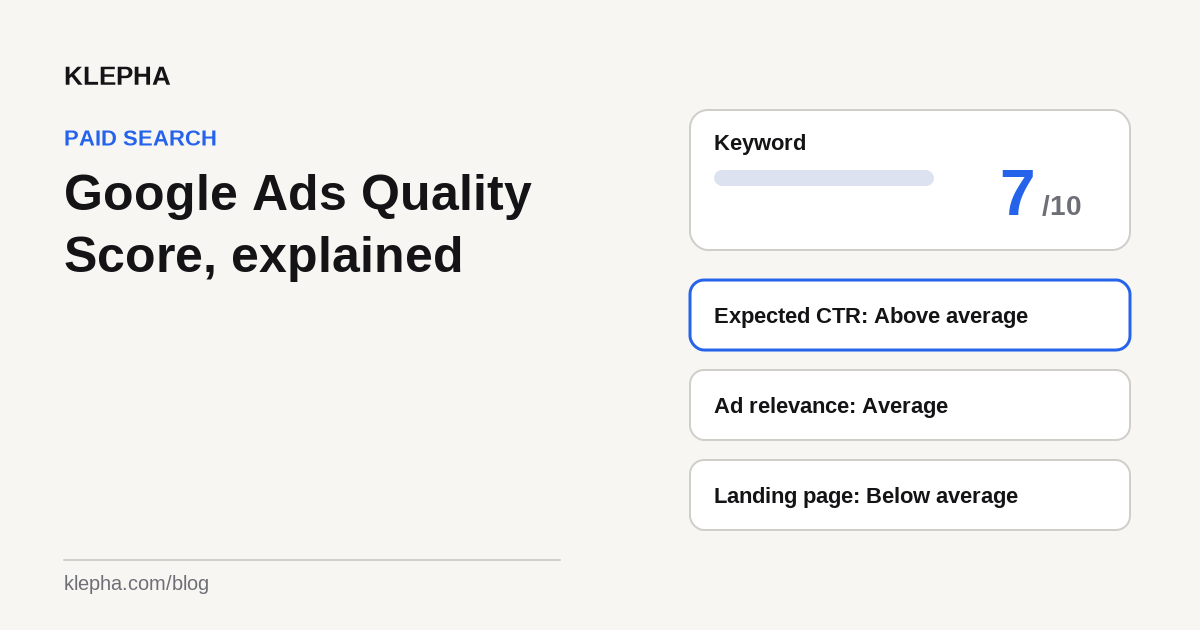
Google Ads Quality Score is a keyword level diagnostic, scored from 1 to 10, that compares your ad quality with other advertisers who showed ads for the exact same search over the last 90 days. It combines three components: expected clickthrough rate, ad relevance and landing page experience, each rated Above average, Average or Below average.
Google is clear that Quality Score is not a key performance indicator and not an input in the ad auction. It is a symptom checker. The underlying ad quality it reflects does affect what you pay and where you show, so a Below average component is worth fixing. This guide explains each component and gives specific fixes, in order of impact.
Key takeaways
- Three components: expected CTR, ad relevance and landing page experience, each rated against other advertisers on the same exact search.
- Diagnostic, not a KPI: Google says not to optimize, aggregate or bid on Quality Score itself.
- Fix the weakest component first: one Below average rating usually explains a low score.
- Match types do not change it: the score is based on exact searches of your keyword, so switching to exact match will not raise it.
- A dash is not a bad score: an empty value in the column means there is not enough exact match traffic yet.
What is Google Ads Quality Score?
Google calls Quality Score "a diagnostic tool meant to give you a sense of how well your ad quality compares to other advertisers." It is reported per keyword in Search campaigns on a scale of 1 to 10. A higher score means your ad and landing page are more relevant and useful to someone searching for that keyword than those of other advertisers.
The comparison is the key idea. A score of 5 does not mean your ad is half good. It means that, for people searching that exact term over the last 90 days, your expected CTR, ad relevance and landing page compared to the field the way a 5 implies. A small business in a category full of strong competitors can have solid ads and still see average ratings.
What are the three components of Quality Score?
| Component | Google's definition | Typical cause of Below average |
|---|---|---|
| Expected clickthrough rate | The likelihood that your ad will be clicked when shown | Generic headlines, weak offer, ads that do not repeat the searcher's words |
| Ad relevance | How closely your ad matches the intent behind a user's search | Ad groups that mix unrelated keywords, so one ad tries to fit them all |
| Landing page experience | How relevant and useful your landing page is to people who click your ad | Sending every click to the homepage, slow mobile pages, content that does not deliver what the ad promised |
Each component gets one of three statuses: Above average, Average or Below average. Google says an Average or Below average status "may indicate an opportunity to make improvements." Google does not publish the exact weighting between components, so treat any formula you see online as an estimate.
What Quality Score is not
Three misunderstandings cause most wasted effort:
- It is not an auction input. Google states that Quality Score "is not an input in the ad auction." The auction uses real time ad quality signals; Quality Score is a summary of how those signals look historically for exact searches of your keyword.
- It is not a KPI. Google says it "should not be optimized or aggregated with the rest of your data." A campaign with average Quality Scores and profitable conversions is healthier than one with 9s and no sales.
- It does not capture everything. Google lists factors that may affect ad quality but are not captured by Quality Score, including device, user location, time of day and assets.
Also note two mechanical points from Google's help page. Because the score is based on historical impressions for exact searches of your keyword, changing match types does not change Quality Score. And a dash in the column means there are not enough exact match searches to calculate a score yet; Google suggests broadening match types or choosing higher volume keywords so the keyword joins more auctions.
How do you check Quality Score?
- Open Keywords in the Campaigns menu.
- Click the columns icon at the top right of the table.
- Under "Modify columns for keywords", open the Quality score section.
- Add Quality Score, Landing Page Exp., Exp. CTR and Ad Relevance. Add the "(hist.)" versions to see past values for the date range, and segment by day to see changes.
- Click Apply.
Sort by cost, not by Quality Score. A Below average rating on a keyword that spends $5 a month is not worth an afternoon; the same rating on your top spending keyword is.
How do you improve expected CTR?
Expected CTR predicts how often your ad will be clicked when shown, relative to competitors. Practical fixes:
- Mirror the query in a headline. If people search "same day boiler repair", a headline with those words reads as the answer.
- Lead with a concrete offer. Prices, delivery times, free trials and guarantees you can actually honour beat vague claims like "best service."
- Use assets. Sitelinks, callouts and structured snippets make the ad larger and give more reasons to click.
- Cut irrelevant impressions. Add negative keywords for searches you never want; they dilute CTR. Our guide to negative keyword lists shows how to build them.
- Test, do not guess. Pin one variable at a time and judge on conversions as well as clicks, as described in how to A/B test ads and landing pages.
How do you improve ad relevance?
Ad relevance is usually a structure problem, not a copywriting problem. When one ad group holds keywords for different intents, no single ad can match all of them.
- Group keywords by intent. "Accounting software for freelancers" and "accounting software for restaurants" deserve separate ad groups and ads.
- Use the keyword theme in headlines and descriptions. Not every keyword verbatim, but the core phrase and its meaning.
- Check the search terms report. If matched searches drift away from your keyword's intent, the ad will look less relevant for them. Add negatives or tighten the keyword.
- Keep it simple on small budgets. Fewer, tightly themed ad groups beat dozens of thin ones. Our Google Ads account structure guide for small budgets shows a layout that works.
Paid search is one channel. How visible are you everywhere else?
Klepha's free report shows how ChatGPT, Gemini and Perplexity describe your brand, and which buyer questions you are not answering yet.
Get my free reportHow do you improve landing page experience?
Landing page experience measures how relevant and useful the page is to people who click. Google also notes that information from its crawlers may be used to assess ad quality, so the page has to be crawlable and readable.
- Send each ad group to the most specific page. A search for "waterproof hiking boots women" should land on that collection, not the homepage.
- Deliver the ad's promise above the fold. If the ad says "free shipping over $50", say it on the page.
- Make it fast and usable on mobile. Compress images, remove intrusive pop ups and keep the main action visible without scrolling.
- Be transparent. Clear pricing, contact details, returns and business information build trust with visitors.
- Do not block Google's crawlers. Check robots.txt and any bot protection that might serve an error to Google's ads crawler.
Our checklist for building a landing page for paid ads covers layout and copy in more detail.
A worked example
Imagine a local plumbing company whose keyword "emergency plumber near me" shows Quality Score 4, with expected CTR Average, ad relevance Above average and landing page experience Below average. The ad matches the search well, so rewriting headlines would not help much. The landing page is the homepage, which leads with a general services menu, loads slowly on mobile and hides the phone number. The fix is a dedicated emergency page with the phone number and "available 24/7" at the top, a short list of areas served, real reviews and transparent call out pricing. That page usually improves conversion rate in the following weeks even before the reported score catches up, which is the better reason to make the change.
The reverse case is also common: landing page Above average, expected CTR Below average. That usually points to generic ads competing against rivals with sharper offers. Look at the ads that appear next to yours for the same search and make sure yours gives a stronger, specific reason to click.
In what order should you fix things?
| Step | Action | Why first |
|---|---|---|
| 1 | Export keywords with cost, conversions and the three component columns | Focus on spend, not on scores |
| 2 | For high spend keywords, find the Below average component | One weak component usually explains the score |
| 3 | Fix structure (ad relevance) before copy | Better copy cannot fix a mixed intent ad group |
| 4 | Fix landing pages for the top spending ad groups | Improves conversion rate as well as the score |
| 5 | Test new headlines for expected CTR | Easiest to iterate once structure and pages are right |
| 6 | Review the "(hist.)" columns after a few weeks | Scores update as new exact match data arrives |
Keep conversions as the judge. Before investing in Quality Score work, confirm that conversion tracking is set up correctly; otherwise you cannot tell whether a higher score made you any money.
The same relevance principles drive organic search and AI answers: a page that precisely answers one intent tends to do well everywhere. The disciplines we apply across paid and organic are on our expertise page, our Blog Ranking service covers the content side, and our case studies show the approach in practice.
Sources
- Google Ads Help: About Quality Score for Search campaigns. Accessed November 23, 2026. Definition, 1 to 10 scale, three components, 90 day comparison, match type and dash notes, factors not captured and how to check it.
- Google Ads Help: 5 ways to use Quality Score to improve your performance. Linked from the Quality Score help page; accessed November 23, 2026.
- Google Ads Help: About ad quality. Linked from the Quality Score help page; accessed November 23, 2026.
Frequently asked questions
What is a good Quality Score in Google Ads?
Google does not define a target. A higher score means your ad and landing page are more relevant than other advertisers' for that exact search. Focus on fixing any component rated Below average on keywords that spend the most, and judge success by conversions and cost per conversion.
Does Quality Score affect what I pay per click?
Quality Score itself is not an input in the ad auction, according to Google. It reflects ad quality, and the real time ad quality signals used in the auction do influence where your ad shows and what you pay. Improving the components usually improves those signals.
Why does my keyword show a dash instead of a Quality Score?
A dash means there are not enough searches that exactly match your keyword to calculate a score. Google suggests choosing higher volume keywords or broadening match types so the keyword participates in more auctions and gathers data.
Will switching to exact match improve Quality Score?
No. Google says Quality Score is based on historical impressions for exact searches of your keyword, so changing the match type does not change it.
How long does it take for Quality Score to update?
Google does not publish a fixed schedule. The score compares you with other advertisers over the last 90 days, so it changes as new exact match impressions accumulate. Review the historical columns a few weeks after a change.