ChatGPT ads vs Google Ads: what are the key differences, and how should you split budget?
Google Ads matches ads mostly to what people type and gives you mature keyword, audience and conversion controls, while ChatGPT ads are matched by OpenAI's system to the context of a conversation, with broad targeting and aggregate reporting. For most advertisers the sensible split in November 2026 is to keep proven Google Ads spend tied to break-even ROAS and fund a separate, capped ChatGPT test with success criteria set before launch.
Search Engine Land published a practitioner comparison of the two platforms on November 11, 2026, written by agency founder Tyler Jordan. His conclusion was blunt: Google Ads remains fundamental to performance marketing, ChatGPT ads are "nowhere near replacing it", and brands should give ChatGPT a smaller test budget. This guide puts that view next to what OpenAI's and Google's own help pages say today, then turns it into a budget-split framework you can apply.
If you need the full explainer on how ChatGPT ads work, launch dates and the move from Max Bid to cost targets, read our guide to ChatGPT ads in 2026. This article is the comparison and the decision. Platform facts were checked on November 17, 2026.
Key takeaways
- Different matching logic. Google still leans on keywords and queries; ChatGPT ads use context hints that OpenAI says are not exact-match keywords and do not guarantee delivery.
- Google has the deeper toolkit. Negative keywords, brand controls, URL controls, Smart Bidding and conversion imports versus a smaller set of ChatGPT levers.
- ChatGPT reporting is aggregate. Impressions, clicks, spend, CTR, CPC, CPM and conversions, with no view of the conversation that triggered an ad.
- Do not cut what works. Fund ChatGPT from a separate, capped test budget, not from Google campaigns that clear break-even.
- Percentages here are illustrative. No public benchmark tells you the right split.
- Ads are not citations. Paying for ChatGPT ads does not get your brand named inside the answer.
What is the core difference between ChatGPT ads and Google Ads?
The short version is intent versus context. In Jordan's words, "search ads match what someone types, while ChatGPT ads are trying to understand what someone wants to accomplish." Google has moved toward broader, AI-driven matching, but he notes it "remains relatively keyword-centric."
On the ChatGPT side, OpenAI's Help Center says its ads system selects ads based on the context and intent of the current conversation, the ad's landing page, title and copy, advertiser-provided context hints and, when a user has ads personalization switched on, select signals from their broader ChatGPT use. Ads appear below ChatGPT responses as a separate, labeled unit. Our ChatGPT ads guide covers who sees them and how pricing works.
Google is also blurring the line. Its help page on ads in AI-powered experiences says ads in AI Overviews and AI Mode are matched either directly to the query or contextually to both the query and the AI response, so a question like "why is my pool green" can surface ads for pool vacuums. Existing Search, Shopping and Performance Max campaigns are eligible automatically. We explain how this works across follow-up questions in multiturn ads in Google AI Mode.
How do ChatGPT ads and Google Ads compare side by side?
The table below uses only what OpenAI's and Google's help pages state, as checked on November 17, 2026.
| Dimension | ChatGPT ads | Google Ads |
|---|---|---|
| Intent and context | Matched to the context and intent of the current conversation, plus personalization signals when enabled | Matched to the query; in AI Overviews and AI Mode, also contextually to the query and the AI response |
| Targeting levers | Context hints per ad group (not exact-match keywords); country, and for most campaign types region, city or postal code; five platforms; custom audiences (25,000 matched users minimum to include) | Keywords and match types, AI Max search term matching (broad match and keywordless), locations of interest, brand inclusions and exclusions, Shopping and Performance Max |
| Formats | One unit below the response with advertiser name, favicon, headline, copy, image and landing page; product-feed campaigns for catalogs | Text ads and Shopping ads in AI Overviews and AI Mode, plus all standard campaign types; local inventory and vehicle ads in testing in AI surfaces |
| Buying and bidding | Views (CPM), Clicks (CPC) or Conversions billed per click or per 1,000 impressions, never per conversion; auction based | Same auction for AI surfaces as standard Search; CPC or conversion-based Smart Bidding such as target CPA and target ROAS |
| Minimums | 25 USD, 15 EUR or 15 GBP minimum daily budget, averaged over a 7-day period | No minimum stated on the help pages we checked |
| Measurement | OpenAI pixel or Conversions API; reporting on impressions, clicks, spend, CTR, average CPC, average CPM and conversions; UTMs persist on clicks | Google tag or Google Analytics import, app, call and offline conversion imports; primary and secondary conversion actions |
| Reporting depth | Aggregate only; no conversation-level data | Campaign, keyword, search terms, landing page and asset reports; AI Mode and AI Overviews included in aggregate, not separately |
| Controls and brand safety | OpenAI policy keeps ads away from sensitive contexts; Negative Phrases only for qualifying advertisers | Negative keywords, asset pinning, brand exclusions, URL exclusions in AI Max; no opt out of AI Mode separate from Search |
| Availability | Self-serve for advertisers whose billed legal entity is in one of 89 listed countries; some new accounts limited to their home country at first | Ads within AI Overviews and AI Mode in English in 12 listed markets including the US; ads above or below AI Overviews wherever AI Overviews run |
| Maturity | Ads Manager is still labeled Beta | Long-established platform |
One inconsistency is worth knowing. OpenAI's "The Basics" page, updated in mid-November, still describes setting a maximum CPC bid and recommends starting at 3 to 5 USD per click. OpenAI's bidding strategies page, covered in our ChatGPT ads guide, says new campaigns moved to average Target CPA and Target CPC from November 9, 2026, with Max Bid and Max CPC retiring on January 1, 2027. Treat the bidding page as current and check Ads Manager itself.
What are advertisers seeing in practice?
Jordan's agency works mainly with B2B, SaaS and fintech clients. In the Search Engine Land piece he reported:
- Earlier-stage reach. ChatGPT lets you reach people describing a problem before they know the product category, such as a finance team struggling with spreadsheets that has not yet searched for ERP software.
- Comparable CPCs, weaker engagement. His tests showed average CPCs comparable to Google Ads but "significantly lower engagement and limited conversion volume." He says ecommerce results may differ.
- Optimization on early signals. With few conversions, his team judges ads on CTR and CPC, pausing weak variations and adding conversion data once volume allows.
- Thinner reporting. He also notes that Google's own reporting for AI Mode ads is far less developed than for standard search placements.
Other early data does not agree on cost. The StubGroup case study we summarized in our ChatGPT ads guide reported much cheaper clicks than Google for one B2B account, but a far lower conversion rate. Both are single-agency observations, so treat CPC as something your own test must establish, not something you can assume.
How should you split budget between Google Ads and ChatGPT ads?
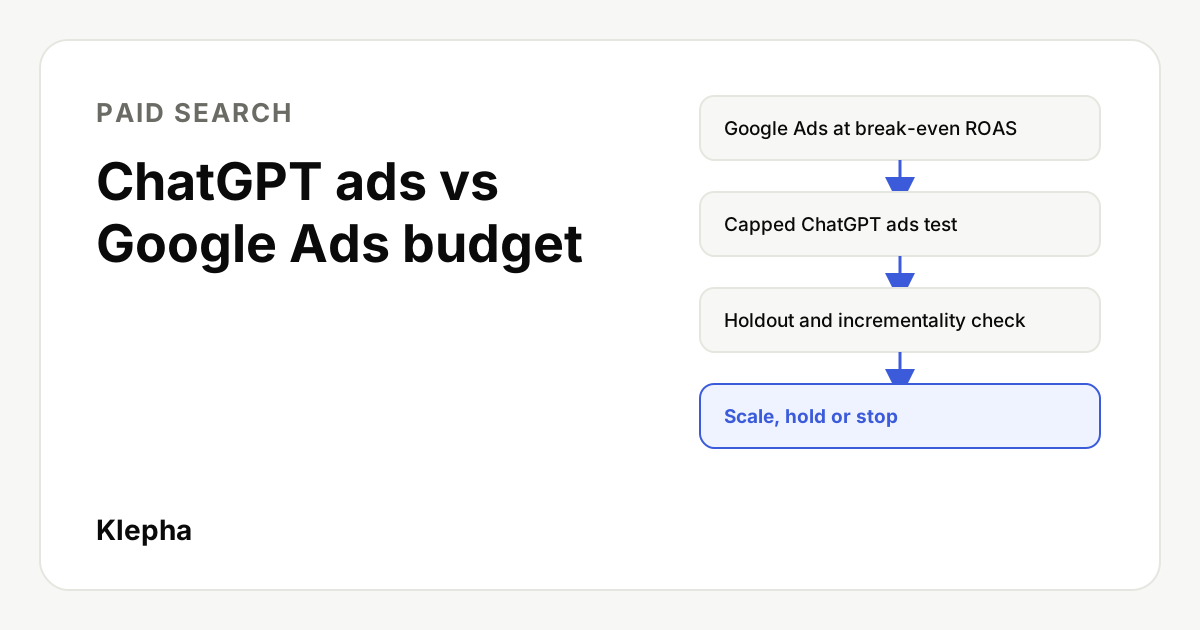
Ask what stays protected and what is ring-fenced for learning, not what percentage moves. A four-part approach:
1. Protect proven Google Ads spend
Work out your break-even ROAS (or the CPA you can afford from margin and lifetime value). Google campaigns that clear it keep their budget. Google's AI Max page notes that AI Max "won't be effective if campaigns are limited by budget," and its AI experiences page recommends keeping budgets flexible on high-performing campaigns, so starving proven campaigns to fund a test can cost you twice.
2. Carve out a fixed, capped test budget
Fund ChatGPT from a separate line, set a total cap and an end date, and size it so you can afford to lose all of it. OpenAI recommends that new advertisers start with a daily budget so they can watch delivery, and campaign-total budgets are the stricter cap on spend. Remember that one day can spend up to twice the daily budget, and 7 days up to seven times it.
3. Set success criteria before launch
Write down what "worked" means before you see a number: for example, cost per qualified lead within a set range of your Google benchmark, revenue per session above a floor, or a minimum share of new customers. Decide the review date and the minimum data you need.
4. Decide with an incrementality check
Platform-reported conversions are not proof of extra sales. Use a holdout (described below) and compare against your Google baseline before scaling, holding or stopping.
Here is an illustrative example only. These numbers are not benchmarks; use your own margins and goals.
| Line | Illustrative monthly plan | Rule |
|---|---|---|
| Google Ads campaigns above break-even ROAS | 20,000 USD, unchanged | Protected; scale only on Google's own results |
| Google Ads campaigns below break-even | Fix or trim first | Freed budget can fund the test |
| ChatGPT ads test | A fixed amount such as 1,500 USD for 6 to 8 weeks | Hard cap, campaign-total budget, pre-set criteria |
| Decision | After the test window | Scale in steps, hold, or stop |
For context, OpenAI's 25 USD daily minimum works out to roughly 750 USD over 30 days, which is the floor for a single campaign running continuously.
Know where ChatGPT already names you before you pay for placement
A free Klepha report shows how ChatGPT, Gemini and Perplexity answer your buyers' questions today, and which competitors they mention instead of you.
Get my free reportWho should test ChatGPT ads now, and who should wait?
| Test now if you | Wait if you |
|---|---|
| Run Google Ads profitably and can fund a test without cutting winners | Are still finding break-even on Google Ads |
| Have working conversion tracking and can judge lead quality or revenue | Cannot track conversions reliably yet |
| Sell something people research in conversation, such as B2B software or considered purchases | Rely on narrow, exact-intent keywords that already convert well |
| Have a billing entity in a supported country | Are in a sensitive or restricted category where eligibility is limited |
| Can write copy and landing pages for problem-led conversations | Can only recycle search ads |
Jordan's recommendation is aimed at "brands with a strong Google Ads strategy and the budget to experiment." Without a stable Google baseline, a ChatGPT test is hard to read.
How do you measure a ChatGPT ads test fairly?
Start with tracking you trust. Our checklist on conversion tracking before you spend on ads covers the setup. Then:
- Tag every ChatGPT ad with UTMs. OpenAI says static tracking parameters persist on ad clicks and can be read in your existing analytics. Use a consistent scheme, as in our guide to UTM parameters.
- Filter review crawler visits. OpenAI notes that its ad-review crawlers may visit landing pages with your tracking parameters. Third-party analytics may count these as paid traffic, but they are not billable clicks.
- Allow for reporting delay. Impressions, clicks and CTR refresh about every 15 minutes in Ads Manager, but spend can lag 7 to 8 hours.
- Use the same conversion definition on both platforms. In Google, Smart Bidding optimizes toward primary conversion actions, so make sure the event you compare is the same one. Google also advises giving Smart Bidding 1 to 2 conversion cycles to adapt after a goal change.
- Run a holdout. Because ChatGPT ads support region, city or postal code targeting for most campaign types, you can run ads in some comparable regions and hold others out, then compare total conversions, not just attributed ones. Product-feed campaigns created now are limited to country-level targeting, so they need a time-based or audience-based holdout instead.
- Judge down-funnel quality. For B2B, follow leads to pipeline. For ecommerce, compare revenue per session and new-customer share with Google traffic.
Neither platform fully isolates AI surfaces today: ChatGPT hides the triggering conversation, and Google reports AI Mode and AI Overviews only in aggregate.
How is paid ChatGPT placement different from organic citations?
A ChatGPT ad is a labeled unit below the answer. An organic citation is your brand or page named or linked inside the answer. OpenAI says ads run on separate systems and advertisers cannot shape, rank or alter responses. Google says the same of AI Overviews and AI Mode: buying ads does not influence organic AI answers, and being cited organically does not affect ad auction eligibility.
Jordan makes the same point: paid ads "don't directly influence organic visibility within ChatGPT," but they can give you another chance to introduce your brand during research. So budget for both separately. Paid buys guaranteed placement for part of the audience while budget runs. Organic visibility, often called generative engine optimization or GEO, is earned through citable content and third-party corroboration and reaches users on every plan. Our guide on how to appear in ChatGPT answers explains the organic side, and our ChatGPT Ranking service handles it for brands that want it done for them. We share our broader approach on the expertise page.
What is still unknown?
- Benchmarks. OpenAI has not published performance benchmarks, and the practitioner data so far comes from individual agencies with different client mixes.
- Cost direction. Reports conflict on whether ChatGPT CPCs are cheaper than or comparable to Google's, and the move to average cost targets may change actual costs.
- Reporting roadmap. Neither OpenAI nor Google has said when AI surfaces will get conversation-level or surface-level reporting.
- Documentation lag. OpenAI's help pages disagreed on bidding controls when we checked on November 17, 2026.
Until those gaps close, treat ChatGPT ads as a learning budget with a cap and a decision date, and keep Google funded on the results it already proves.
Sources
- Search Engine Land, "ChatGPT ads vs. Google Ads: 6 key differences to know", Tyler Jordan, November 11, 2026, checked November 17, 2026. searchengineland.com
- OpenAI Help Center, "Ads in ChatGPT: The Basics", checked November 17, 2026. help.openai.com
- OpenAI Help Center, "Creating campaigns for ChatGPT Ads" (budgets, targeting, minimum spend), checked November 17, 2026. help.openai.com
- OpenAI Help Center, "Ads Manager Availability", checked November 17, 2026. help.openai.com
- Google Ads Help, "About ads in AI-powered experiences in Google Search", checked November 17, 2026. support.google.com
- Google Ads Help, "How AI Max for Search campaigns works", checked November 17, 2026. support.google.com
- Google Ads Help, "About conversion measurement", checked November 17, 2026. support.google.com
- OpenAI Help Center, "Bidding strategies and how pricing works in ChatGPT Ads", as summarized in our ChatGPT ads guide, accessed November 15, 2026. help.openai.com
Frequently asked questions
What is the main difference between ChatGPT ads and Google Ads?
Google Ads still matches ads largely to what people type, using keywords, broad match, AI Max, Shopping and Performance Max, with mature conversion tracking and reporting. ChatGPT ads are matched by OpenAI's system to the context of a conversation, guided by context hints that are not exact-match keywords, and reporting is limited to aggregate impressions, clicks, spend and conversions.
How much of my Google Ads budget should I move to ChatGPT ads?
There is no benchmark. A safer approach is not to move proven spend at all: keep Google Ads campaigns that clear break-even ROAS or target CPA funded, and fund a separate, capped ChatGPT test with success criteria set in advance. Any percentage you choose is a planning decision for your business, not an industry standard.
What is the minimum budget for ChatGPT ads?
OpenAI's Help Center lists a minimum daily budget of 25 USD, 15 EUR or 15 GBP, with other amounts for other billing currencies. The daily budget is an average over a 7-day period, so one day can spend up to twice the amount.
Can I measure ChatGPT ads the same way as Google Ads?
Partly. ChatGPT Ads Manager reports impressions, clicks, spend, CTR, average CPC, average CPM and conversions, and UTM parameters persist on ad clicks. It does not show which conversation triggered an ad, so use UTMs, your own analytics and a holdout or geo test to judge incremental results.
Do ChatGPT ads help my brand get cited in ChatGPT answers?
No. OpenAI says ads run on separate systems and advertisers cannot shape, rank or alter ChatGPT's responses. Being named or cited inside the answer depends on organic visibility, which is a separate workstream from paid placement.