How many websites get AI referral traffic, and how should you report it?
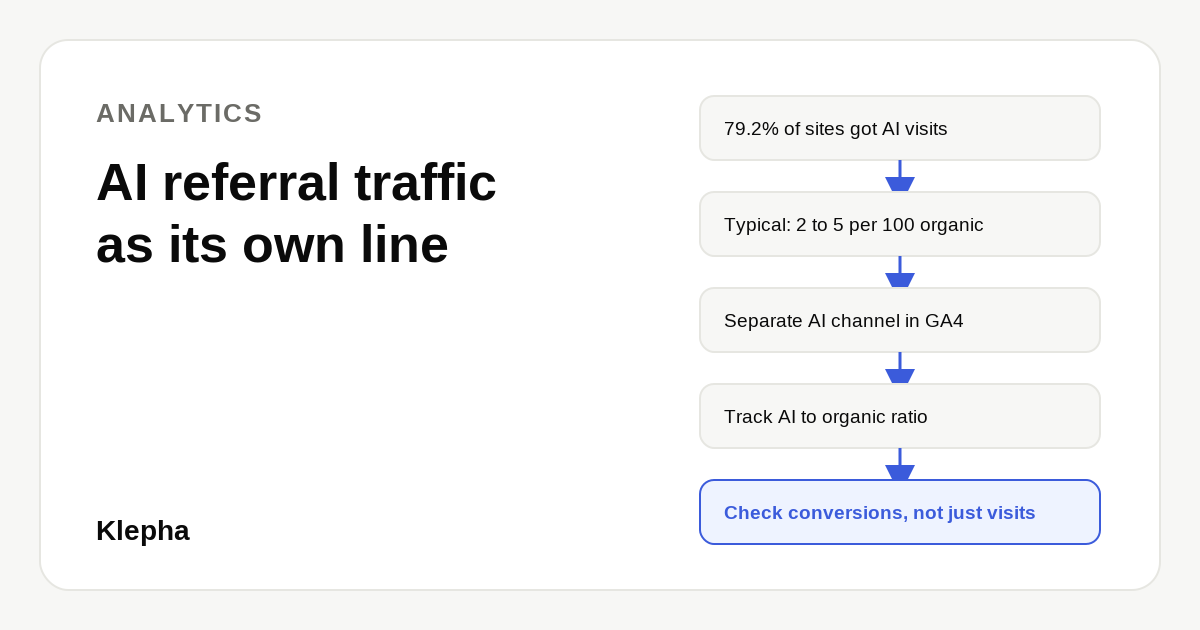
An SE Visible study of 28,500 websites found that 79.2% received at least one visit from an AI platform in September 2026, up from 39.7% in January 2025, and that the typical site with 1,000+ monthly organic visits got 2 to 5 AI visits per 100 organic visits. To report it, give AI referrals their own channel line in analytics and track an AI to organic ratio over time, read alongside conversions and organic trends.
For most of the last two years, AI referral traffic was something a few sites noticed in their referral reports. A new study suggests it is now something most sites receive, even if the volumes are still small next to organic search.
This post summarizes what the SE Visible study measured and found, then turns it into a reporting setup: how to separate AI referrals in Google Analytics 4, how to calculate and read an AI to organic ratio, and what the number can and cannot tell you. Study figures and GA4 documentation were checked on November 18, 2026.
Key takeaways
- AI referrals are now common. 79.2% of 28,500 sites got at least one AI visit in September 2026, versus 39.7% in January 2025.
- Volumes are still small. Among sites with 1,000+ monthly organic visits, the most common range was 2 to 5 AI visits per 100 organic visits.
- The jump came in summer 2026. The share of sites with AI traffic rose from 58.4% in May to 73.1% in June.
- GA4 now has an AI Assistant channel. It covers sources like ChatGPT, Gemini, Copilot and others, but Google AI Overviews and AI Mode clicks stay in Organic Search.
- Read the ratio with care. A rising AI to organic ratio can mean AI traffic grew, organic fell, or both. Always report the two lines next to each other.
What did the SE Visible study measure?
SE Visible, the AI visibility product from SE Ranking, published "AI Traffic Reaches Nearly 80% of Websites: November 2026 Study" on November 12, 2026. The researchers analysed 28,500 randomly selected websites from their research index. Every site in the sample received organic search traffic in every month from January 2025 to September 2026.
For each month they measured:
- the share of sites receiving at least one visit from an AI platform;
- the share receiving none;
- for sites with at least 1,000 organic visits that month, AI visits as a percentage of organic search visits (AI visits divided by organic visits, times 100);
- how the distribution of that ratio changed over time.
The study's own disclaimer matters for how you use the numbers: findings describe the sample, not all websites; "receiving AI traffic" means at least one AI visit, not a steady flow; and a higher AI to organic ratio "can reflect rising AI traffic, falling organic traffic, or both."
What were the key findings?
| Measure | January 2025 | September 2026 |
|---|---|---|
| Sites with at least one AI referral (all 28,500) | 39.7% | 79.2% |
| Sites with 1,000+ organic visits that got AI traffic | Not reported | 99.7% |
| Sites (1,000+ organic) with at least 1 AI visit per 100 organic | 5.1% | 75.5% |
| Sites (1,000+ organic) in the 2 to 5 per 100 range | 1.2% | 34.2% |
| Sites (1,000+ organic) with 5 or more per 100 | 0% | 20% (13.5% at 5 to 10, 6.5% at 10+) |
The growth was not steady. The share of sites with AI visits rose to 54.3% by June 2025, then stayed between 54.3% and 59.2% for nearly a year. In June 2026 it jumped from 58.4% to 73.1% in a single month, and reached 79.2% by September.
The authors point to ChatGPT as a likely factor. Citing their earlier research, they say ChatGPT sent roughly three of every four AI referrals in January to April 2026, and that reports from around May 7 described more prominent, clickable brand names in ChatGPT answers. They are careful to say timing does not establish causation. For more on ChatGPT's own click reporting, see our post on the ChatGPT Business Hub, and for overall usage trends, AI usage at 76 billion monthly sessions.
What does "2 to 5 AI visits per 100 organic visits" mean in practice?
The study's own illustration: a site with 20,000 monthly organic visits at a 2 to 5% ratio would get roughly 400 to 1,000 AI visits a month. That is meaningful but far from replacing organic search. The median site in the 1,000+ group sat in the 2 to 5% band in September 2026, compared with under 1% in January 2025.
Two practitioner comments in the study are useful context. Anastasia Kotsiubynska said AI traffic was about 2% of her team's organic traffic but around 10% of organic qualified registrations, and that self-reported attribution usually shows a higher share for AI than referral data does. That is one team's experience, not a benchmark, but it shows why visit counts alone undersell the channel.
How do you report AI referral traffic as its own line in GA4?
There are two ways, and it helps to know both.
Option 1: Use GA4's default AI Assistant channel
Google's documentation for the GA4 default channel group now lists an AI Assistant channel, described as users arriving "from sources like ChatGPT, Gemini, Deepseek, Copilot, or Grok." GA4 sets the medium to "ai-assistant" when the referrer matches its list of AI assistants. Open Reports, then Acquisition, then Traffic acquisition, and look for the AI Assistant row in the Session default channel group.
One important detail: the definition excludes Google's AI Overviews and AI Mode. Clicks from those features are counted in Organic Search. To see Google AI feature visibility you need Search Console's Generative AI performance report, which reports impressions, not clicks. Our note on the Search Console AI report logging error explains a current caveat with that report.
Option 2: Build a custom channel group
If you want control over which sources count as AI, create a custom channel group. Google's help page gives an AI assistants example. In outline:
- In Admin, under Data display, open Channel groups and create a new group (it starts as a copy of the default).
- Add a channel named "AI assistants" with a condition on Source that matches a regex for the assistants you care about.
- Reorder so "AI assistants" sits above Referral, because traffic goes to the first channel it matches.
- Save, then use the group as the primary dimension in the Acquisition reports.
A simple, readable starting regex for the Source field, which you should adjust to what you actually see in your referral report:
chatgpt\.com|openai\.com|perplexity\.ai|gemini\.google\.com|copilot\.microsoft\.com|claude\.ai|deepseek\.com
Standard GA4 properties can have two custom channel groups in addition to the predefined one, and custom channel groups apply to past data. Review the regex every quarter, because new assistants and domains appear. Consistent UTM parameters on links you control, such as links in your own GPTs or apps, also help.
Referrals are only part of AI visibility
A free Klepha report shows how often ChatGPT, Gemini and Perplexity mention your brand for your buyers' questions, including answers that never send a click.
Get my free reportHow do you calculate and read the AI to organic ratio?
Use the same definition as the study so you can compare: AI to organic ratio = AI sessions / Organic Search sessions x 100, by month. Then read it with these rules:
| Situation | Ratio | What it probably means |
|---|---|---|
| AI sessions up, organic flat | Rising | AI channel growing; good sign |
| AI sessions flat, organic down | Rising | Not AI growth; investigate organic loss |
| Both up, AI faster | Rising | Healthy growth in both |
| AI sessions down, organic flat | Falling | Check AI visibility and referrer changes |
| Very small site (under 1,000 organic visits) | Volatile | Ratios are unreliable at low volume, as the study notes |
Against the study, a ratio below 1 per 100 in late 2026 puts a site with meaningful organic traffic behind most of the sample; 2 to 5 is typical; 5 or more is in the top fifth. Treat that as context, not a target: industry, audience and content type all change what is normal.
What should an AI traffic report include?
A monthly report that gives AI its own place without overstating it:
- Organic Search sessions and AI Assistant sessions as two separate lines, with month on month and year on year change.
- The AI to organic ratio, with a note on which line moved.
- AI sessions by source (ChatGPT, Perplexity, Gemini, Copilot, Claude and others).
- Top landing pages from AI, which show which content assistants send people to.
- Key events from AI, such as sign ups, demo requests or purchases, with conversion rate. Watch sample size: a handful of conversions can make a small channel look unusually strong.
- Visibility context: how often AI answers mention or cite the brand for tracked prompts, because many people see your brand in an answer and never click.
- Data notes: changes to the channel definition, tracking issues and known platform changes.
Our existing guide on whether AI search is driving traffic covers the indirect signals, such as direct traffic and branded search lift, that referral data misses. For the bigger picture of growing both channels, see getting traffic from Google and AI search, and for mention tracking, how to track AI brand visibility.
If you are deciding how much budget AI search deserves, the October 2026 studies comparing AI referrals with organic search are a useful second data point; we turn them into a budgeting method in how to split SEO and GEO budgets.
What are the limits of AI referral data?
- Missing referrers. Some AI app and browser traffic arrives without a referrer and lands in Direct.
- Google's AI features are in Organic Search. GA4's AI Assistant channel excludes AI Overviews and AI Mode by definition.
- Influence without clicks. An assistant can recommend you, and the person visits later by typing your name. That shows up as direct or branded search, not as AI.
- Sample studies are not your site. The SE Visible sample includes only sites with organic traffic every month, and the ratio analysis covers only those with 1,000+ organic visits.
That is why we recommend reading referral data next to visibility data and self-reported attribution ("How did you hear about us?") rather than on its own. Our ChatGPT Ranking solution covers visibility tracking, and our expertise page and case studies show how we report it.
Sources
- SE Visible (Yulia Deda), "AI Traffic Reaches Nearly 80% of Websites: November 2026 Study", published November 12, 2026, checked November 18, 2026. Methodology: 28,500 randomly selected sites with organic traffic every month from January 2025 to September 2026. visible.seranking.com
- Google Analytics Help, "Default channel group", AI Assistant channel definition, checked November 18, 2026. support.google.com
- Google Analytics Help, "Custom channel groups", including the AI assistants example and per-property limits, checked November 18, 2026. support.google.com
- Google Search Console Help, "Generative AI performance report (Search)", checked November 18, 2026. support.google.com
Frequently asked questions
What share of websites get AI referral traffic?
In the SE Visible study of 28,500 websites, 79.2% received at least one AI referral in September 2026, up from 39.7% in January 2025. Among sites with at least 1,000 monthly organic visits, 99.7% received AI traffic.
How much AI traffic does a typical website get?
Among sites with at least 1,000 monthly organic visits, the most common range in September 2026 was 2 to 5 AI visits for every 100 organic search visits, covering 34.2% of those sites. One in five got 5 or more per 100.
Does GA4 track AI traffic automatically?
GA4 has an AI Assistant channel in its default channel group for sources such as ChatGPT, Gemini, Deepseek, Copilot and Grok. It excludes Google AI Overviews and AI Mode, whose clicks are counted in Organic Search.
How do I calculate the AI to organic traffic ratio?
Divide AI sessions by Organic Search sessions for the same month and multiply by 100. For example, 500 AI sessions and 20,000 organic sessions gives a ratio of 2.5. Report both lines alongside the ratio, because a rising ratio can also mean organic traffic fell.
Why did AI referral traffic jump in summer 2026?
The study found the share of sites with AI traffic rose from 58.4% in May to 73.1% in June 2026. The authors suggest more prominent clickable brand links in ChatGPT answers may have contributed, but say the timing does not prove causation.