What does the report counting 76 billion monthly AI sessions mean for SEO and GEO?
Graphite's State of Gen AI report, published November 9, 2026, estimates that six AI assistants drew about 76 billion sessions a month worldwide in September 2026, up 37% in a year, yet AI still sends less than 1% of traffic to the average website. It also stopped comparing AI usage with search engines, because its earlier comparison likely undercounted Google. The practical reading: AI is now a major place where buyers form opinions, search is still the main traffic source, and you need strategies and measurement for both.
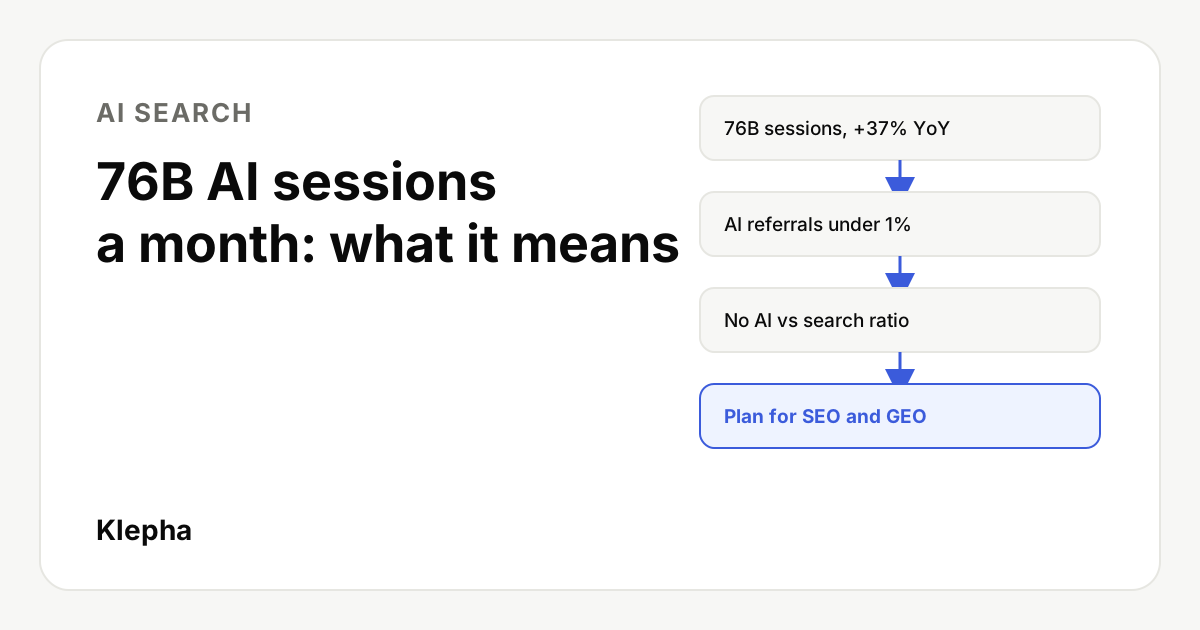
Big AI usage numbers travel fast in marketing decks. The newest one comes from Graphite, an SEO and AEO agency, which published an updated AI usage report on November 9, 2026 using Similarweb data. The headline figure is 76 billion monthly sessions across six AI assistants. The more important detail is what the report no longer claims.
This article summarizes what the report measured, what changed since its March 2026 edition, and what the numbers do and do not mean for SEO and GEO (generative engine optimization) planning. Figures were checked against the Graphite report and Search Engine Journal's coverage on November 15, 2026.
Key takeaways
- 76 billion sessions a month across ChatGPT, Gemini, Claude, Grok, Perplexity and DeepSeek in September 2026, up 37% worldwide and 45% in the US year over year.
- No more AI versus search ratio. Graphite says it "can no longer reliably compare" AI used for search with search engines after likely undercounting Google app usage.
- AI referrals are still small: under 1% of traffic on average, with organic search about 49 times larger in the US in Q2 2026.
- Influence is bigger than clicks. Some AI influenced visits show up as direct or branded search, so referral reports undercount AI.
- Plan for both. Keep SEO as the traffic engine and use GEO to win the answers where buyers form opinions.
What does the report actually measure?
Graphite's "The State of Gen AI" counts sessions for six AI assistants: ChatGPT, Gemini, Claude, Grok, Perplexity and DeepSeek. Session counts are Similarweb estimates of web visits plus mobile app sessions on Android and iOS. Desktop apps are not included, because the report says reliable data is not available for them.
Two disclosures are worth keeping in mind when you quote it. Graphite sells SEO and AEO services, and Similarweb sells the underlying data. Both have an interest in AI being seen as large. That does not make the numbers wrong, but it is a reason to read the methodology before putting a figure in a board deck.
What are the headline numbers?
| Metric | Figure | Period |
|---|---|---|
| Monthly sessions, six assistants, worldwide | 76 billion | September 2026 |
| Year over year growth | +37% worldwide, +45% US | September 2025 to September 2026 |
| Growth during the "plateau" | +2.3% worldwide, +10% US | July to December 2025 |
| Growth since January | +19% worldwide, +20% US | January to September 2026 |
| ChatGPT share of sessions | 81.2% worldwide, 80.7% US | September 2026 |
| Fastest growing assistant | Claude, +1,901% worldwide, +862% US | Year over year |
| Declining assistant | Perplexity, down 27% worldwide | Year over year |
| Share of sessions on mobile (app or mobile web) | 89% worldwide, 78% US | Q3 2026 |
Two more details from the growth data: ChatGPT accounted for 58.9% of the sessions added over the year and Claude for 26%, according to SEJ's summary. Gemini grew 182% and Grok 123% worldwide.
Why did the report stop comparing AI with search engines?
Graphite's March 2026 edition, "AI Is Much Bigger Than You Think", put monthly AI sessions at 56% of the size of search worldwide and 34% in the US. Those figures spread widely.
The November report revisits that method. In March, search engine usage was counted from website visits only, because search apps seemed to see little use. The new report says Google's Android app is different: Graphite estimates it at about 11.8 billion monthly sessions in the US alone, used for image recognition, translation and Google Discover as well as search, and it has "no reliable data source" for how much of that is search. So the report says it "can no longer reliably compare" the size of AI used for search with search engines, and the March comparison likely undercounted Google.
Other estimates count different things. SEJ notes that OpenAI said ChatGPT receives roughly one fifth as many search like queries as Google, counting a search whenever a question sends ChatGPT to the web, while Graphite counts sessions. Before any AI to search ratio goes into a channel plan, check how its source counted Google.
How much traffic does AI actually send to websites?
Very little, relative to search, but it is growing quickly.
- Under 1% of traffic. The report's data "suggest that AI accounts for less than 1% of traffic on average to websites."
- Search is far larger. For US traffic in Q2 2026, organic search was about 49 times the volume of AI referrals, and paid search about 8 times.
- Fast growth from a small base. AI referral traffic grew 92% year over year worldwide and 75% in the US, as of July 2026.
- Concentrated in ChatGPT. In July, ChatGPT sent 60% of AI referrals worldwide, Gemini 14% and Claude 10%. In the US the split was ChatGPT 66%, Claude 11% and Gemini 10%.
The referral figures cover the top 43,000 sites among domains with at least 100,000 monthly US visits in six or more months between July 2023 and July 2026, according to SEJ.
Why do referral numbers undercount AI's influence?
AI answers often recommend a brand without a clickable link, or the user does not click it. Graphite cites anecdotal evidence that many people then open a new tab and type the brand name into a search engine or go straight to the site. That visit is recorded as branded search or direct traffic, not as AI. The report says its early numbers suggest branded search traffic is fairly flat year over year, with fuller results to come.
For marketers, the gap means two things. First, AI referral reports in analytics are a floor, not the full picture. Second, the share of buyers who meet your brand inside an AI answer, before they ever search, is not visible in your traffic reports at all. Our guide to whether AI search is driving traffic to your site covers how to read the signals you do have.
See what AI assistants say about you
With billions of AI sessions a month, the answer matters even when nobody clicks. A free Klepha report shows how ChatGPT, Gemini and Perplexity describe your brand and who they recommend instead.
Get my free reportWhat do the numbers mean for SEO and GEO strategy?
Read together, the figures support a balanced plan rather than a pivot.
| Finding | What it suggests |
|---|---|
| Search still sends far more traffic | Keep investing in SEO fundamentals: technical health, useful pages, links. It remains the main source of visits for most sites. |
| AI usage is large and growing | Track how AI assistants answer your buyers' questions and whether your brand is named. This is the core of GEO. |
| AI influence shows up as direct and branded traffic | Watch branded search and direct trends alongside AI referrals, and ask new customers where they first heard of you. |
| ChatGPT dominates sessions and referrals | Prioritize ChatGPT visibility first, then Gemini and Claude, which are growing fastest. |
| Most AI use happens on mobile apps | Make sure the pages AI assistants cite load well on mobile and answer the question near the top. |
The good news is that much of the work overlaps. Clear answers near the top of a page, self contained sections, specific facts with sources, consistent brand descriptions and third party mentions help both rankings and citations. Our guides to generative engine optimization and tracking your brand's visibility in AI search go deeper.
How should you use statistics like these?
- Quote the source and period. "76 billion monthly sessions across six assistants in September 2026, per Graphite using Similarweb data" is accurate. "AI is bigger than search" is not supported by this report.
- Check what was counted. Sessions, users, queries and searches that trigger web lookups are different measures and cannot be compared directly.
- Note who published it. Vendor research is useful but has incentives; look for methodology and disclosures.
- Use your own data for decisions. Your Search Console, analytics and AI visibility tracking matter more than global averages. The ChatGPT Business Hub now gives verified businesses first party ChatGPT click data.
If you want help building a plan that covers both search and AI answers, see our solutions, the disciplines on our expertise page and our case studies.
Sources
- Graphite, "The State of Gen AI", November 9, 2026 (Similarweb data). graphite.io
- Graphite, "AI Is Much Bigger Than You Think", March 2026. graphite.io
- Search Engine Journal, Matt G. Southern, "Why An AI Usage Report Stopped Comparing AI With Search Engines", November 9, 2026. searchenginejournal.com
- Search Engine Journal, report on OpenAI's comparison of ChatGPT and Google search volume, November 3, 2026. searchenginejournal.com
Frequently asked questions
How many people use AI assistants in 2026?
Graphite's State of Gen AI report, using Similarweb data, estimates about 76 billion monthly sessions across ChatGPT, Gemini, Claude, Grok, Perplexity and DeepSeek worldwide in September 2026, up 37% from a year earlier. That counts web visits and mobile app sessions, not unique people, and excludes desktop apps.
Is AI bigger than Google Search?
This report does not say so. Graphite's March 2026 edition put AI at 56% of search worldwide, but the November 2026 report says that comparison likely undercounted Google's Android app and that it can no longer reliably compare AI used for search with search engines.
How much website traffic comes from AI?
On average, less than 1% of website traffic, according to the report. For US traffic in Q2 2026, organic search was about 49 times larger than AI referrals. AI referrals are growing fast, up 92% year over year worldwide as of July 2026.
Which AI assistant sends the most traffic?
ChatGPT. In July 2026 it accounted for 60% of AI referral traffic worldwide, followed by Gemini at 14% and Claude at 10%. In the US, ChatGPT had 66%, Claude 11% and Gemini 10%.
Should I move budget from SEO to GEO?
Not wholesale. Search still sends far more traffic than AI, so SEO remains the main traffic engine. Add GEO work to track and improve how AI assistants describe and recommend your brand, since much of the same content work helps both.