What does it mean that AI answers now hand out coupon codes?
During the 2026 holiday season, Google AI Overviews, ChatGPT and other AI engines started showing promo codes directly in their answers, in ChatGPT's case as cards with a copy button. Here is what was observed, why it threatens the coupon site model, and how merchants should manage their codes now.
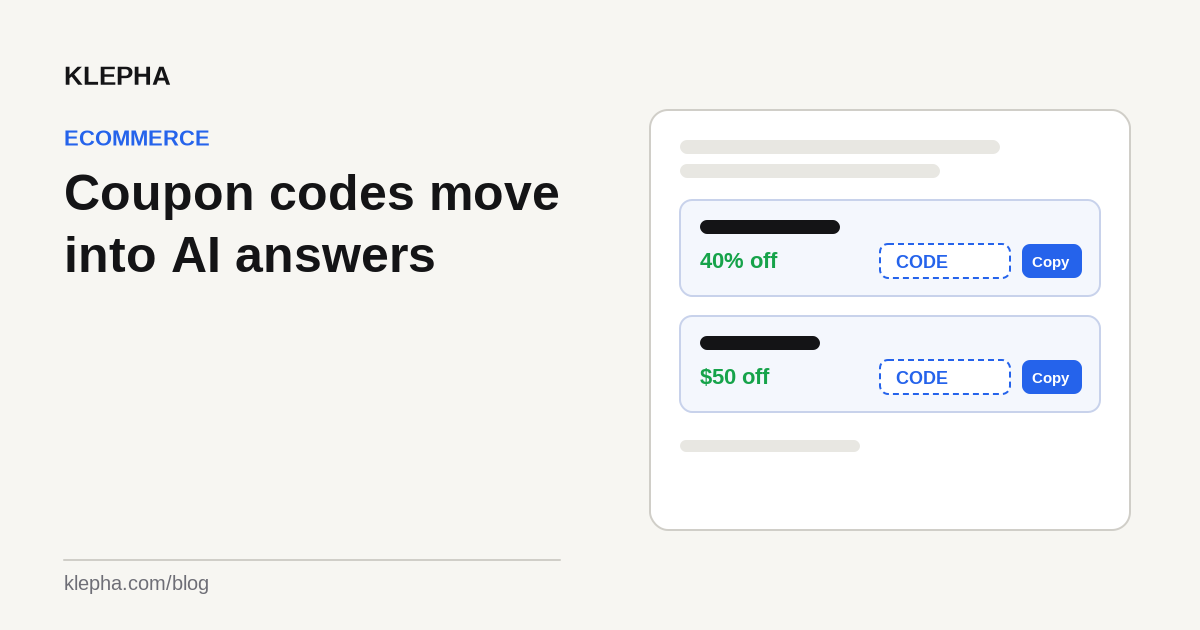
AI engines now hand out coupon codes directly in their answers: when people ask for a merchant's promo codes, Google AI Overviews lists them and ChatGPT can show deal cards with the code, an end date and a copy button. Search Engine Roundtable documented this on November 20, 2026, a week before Black Friday, based on screenshots from SEO consultants Glenn Gabe and Metehan Yesilyurt.
For coupon and affiliate sites this is a direct threat, because their model depends on the click that sets an affiliate cookie. For merchants it is mostly an opportunity and a control problem: the codes AI shows may come from your own pages, your Merchant Center feed, or a stale code on Reddit. Publish one current, official promo page, keep promotion data accurate, and use exclusive codes where you need attribution.
Key takeaways
- What changed: Google AI Overviews, ChatGPT and other engines show promo codes in answers; ChatGPT can render them as cards with a copy button and a "Get deal" button.
- Growth: one tracker saw ChatGPT deal cards rise from about 3% to 16% of product showing answers on Black Friday prompts in four weeks.
- Affiliates: when the code is on the card, the user may never click through, so the affiliate cookie is never set.
- Merchants: AI may surface any code it can find, including expired or community codes, so publish an official, current promo page.
- Google: merchants can supply promotions through Merchant Center, which Google reviews and shows across its surfaces.
What happened?
On November 19 and 20, 2026, several search professionals shared screenshots of AI engines answering coupon questions with the codes themselves. Search Engine Roundtable summarized it: when you ask a search or AI engine for a merchant's coupon or promo codes, "Google provides them in AI Overviews, ChatGPT provides them in its answers, so do the others." You do not need to visit a coupon website; you copy the code from the response.
Glenn Gabe noted that AI Overviews were triggering for "coupon code" queries and that ChatGPT can publish coupon code cards "directly in the answer with 'copy code' buttons." He also observed differences between ChatGPT plans: in his tests the free version showed the cards, while the paid version did not show cards but still provided codes.
Metehan Yesilyurt asked ChatGPT for web hosting coupon codes and, instead of a list of links, got a card for each brand showing the discount and price, an end date such as "Ends December 7", the code with a copy button and a "Get deal" button. In a write up on November 19, 2026, he reported that in the Black Friday prompts he tracks, these deal cards went from about 3% to 16% of ChatGPT answers that show products in four weeks, while they did not grow on normal shopping prompts. He also saw the classic product carousel drop by about half since mid October, replaced by single product cards inside the answer text.
None of this is entirely new for Google. Search Engine Roundtable points out that Google has shown promotions in ads for about a decade, has had clippable coupons in results for several years, and receives promotion data directly from merchants through Merchant Center. What is new is the format: a complete coupon site experience inside an AI answer, at the start of the biggest shopping week of the year. Black Friday falls on November 27, 2026.
How do the AI engines differ?
Yesilyurt ran the same hosting coupon question across several engines. His observations, which are a snapshot from one category on one day rather than a systematic study, show how differently each engine treats the websites the codes come from:
| Engine | How codes appeared | How sources were shown |
|---|---|---|
| ChatGPT | Deal cards with discount, end date, code, copy button and "Get deal" button | A small source pill at the top, for example "Hostinger +5" |
| Google AI Mode | Codes listed as text | Source cards next to the answer, including HostAdvice, Reddit and the merchant |
| Google AI Overviews | Codes listed in the overview for coupon queries (Gabe, Search Engine Roundtable screenshots) | Standard AI Overview links |
| Claude | Codes listed as plain text | Named publishers next to each code, such as Gizmodo and Cybernews |
| Bing | Described as the response that showed the most respect for websites | Not detailed |
Yesilyurt also noticed that some codes, such as one named BLACKFRIDAYREDDIT, clearly came from community and affiliate pages. In other words, the engines read coupon pages and forum threads and lift the code, often without sending the user there.
What does this mean for coupon and affiliate sites?
Coupon sites earn money in a simple way: a shopper arrives looking for a code, clicks through to the merchant, the affiliate cookie is set, and the site earns a commission if the shopper buys. Yesilyurt put the problem bluntly: "If the code is already on the card with a Copy button, why would anyone click?" Gabe made the same point about AI Overviews: users would not have to click through.
The pressure on this model is not new. Search Engine Roundtable recalls that many white label coupon sections were hit when Google introduced its site reputation abuse policy. Google's current spam policy is more nuanced than many assume, though. Its own example of a case where it is not likely to take action is an integrated coupons and deals section run by a publisher with a partner, clearly disclosed, curated, and connected to the publisher's editorial content. The sites most at risk now are the thin ones that simply republish the same public codes as everyone else, which is also the content AI engines can reproduce most easily.
What does it mean for merchants?
For merchants, the code being in the answer is not necessarily bad. Gabe noted that when ChatGPT provides codes directly from retailers, that will not really hurt them. The risks are different:
- Wrong or expired codes. If AI picks up an old code from a forum, the shopper reaches checkout, the code fails, and the frustration lands on you.
- Margin leakage. Codes meant for a narrow audience, such as a partner, influencer or win back campaign, can be surfaced to everyone.
- Lost attribution. If shoppers copy a public code from an AI card, affiliate and influencer reports may stop reflecting where demand actually came from.
- Price accuracy. Yesilyurt's advice to ecommerce teams was to look at the product and price data you give ChatGPT, because "the card shows your price, not your page."
Check what AI says about your offers
Klepha's free report shows how ChatGPT, Gemini, Perplexity and Google describe your brand and products, so you can spot wrong prices or outdated promotions before buyers do.
Get my free reportHow should merchants manage promo codes now?
The practical goal is to make sure that when an AI engine looks for your codes, the best, current and official answer is the easiest one to find.
- Publish one official promo page. Create a crawlable page on your own domain that lists current public codes with what they do, who they are for and when they expire, in plain HTML text. Update it the moment a promotion starts or ends. Yesilyurt's recommendation for brands was exactly this: put the real, current code on your official promo page, "Otherwise AI will pick whatever it finds on Reddit."
- Submit promotions to Google Merchant Center. Google's promotions data specification lets merchants supply promotions that are distributed across Google properties, including Google Search, the Shopping tab and Chrome, in 13 countries including the United States and United Kingdom. Google reviews each promotion against its program policies and editorial requirements before showing it.
- Use the fields that prevent confusion. In Merchant Center, set the coupon requirement (no code or a generic code), the generic redemption code (up to 20 characters), a title of up to 60 characters, exact effective dates and fine print of up to 500 characters. Google limits promotions to 183 days, and its spec says the information on your promotion URL must match the data submitted.
- Separate public and private codes. Assume any public code will be surfaced by AI. Use unique, single use or audience restricted codes for partners, influencers and retention offers, so a leaked code cannot be used by everyone.
- Retire old codes properly. Expire codes in your checkout system, remove them from your promo page, and do not leave old campaign landing pages live with outdated codes.
- Check the answers yourself. Before and during peak days, ask ChatGPT, Google and other engines for your brand's coupon codes and note what they show. Our guide on monitoring AI brand mentions explains how to make this a routine.
These steps fit within a broader holiday plan; see our holiday SEO and ads strategy for the rest of the checklist.
How should coupon and affiliate sites respond?
Yesilyurt suggested three immediate steps for coupon and affiliate operators: check which of your codes show up in ChatGPT answers, track ChatGPT referrals to coupon pages daily through Cyber Monday and compare with last year, and push exclusive codes that only work through your own link, because "public codes are now free content for AI." Beyond the holiday week, the durable responses are:
- Add value AI cannot copy in one line. Verified testing of codes, price history, stacking rules, cashback and genuine comparisons are harder to compress into a card than a bare code. Google's thin affiliation policy describes good affiliate pages in similar terms: original reviews, testing, price information and comparisons.
- Secure exclusive deals. Negotiate codes with merchants that are unique to your audience and tied to your tracking.
- Diversify traffic. Email lists, browser extensions and communities give you an audience that does not depend on a search or AI click.
- Do not hide codes from bots while showing them to users. Search Engine Roundtable raised the question of whether coupon sites might stop showing valid codes to Googlebot. Showing search engines different content than users is cloaking under Google's spam policies, and many sites already expose codes in structured data, so this is a risky path.
Being cited is still worth something: Yesilyurt noted that if your code is on the card, "you are the source but not the destination." Tracking citations as well as clicks, as we describe in how to increase AI citations, gives a fuller picture of your visibility.
What is still unclear?
- Test or rollout. Yesilyurt said he was not sure whether ChatGPT's cards are a test or a rollout, and planned to check again after Cyber Monday.
- Where "Get deal" goes. It is not known whether the button sends users to the merchant, an affiliate link or elsewhere. If it goes straight to the brand, coupon sites lose both the click and the commission.
- Code accuracy. Neither OpenAI nor Google has published how codes are verified. Treat AI shown codes as unverified until you check them against your own system.
- Geography. Yesilyurt asked readers whether the cards were US only; that has not been confirmed.
Klepha helps brands see and improve how AI engines describe them through our ChatGPT Ranking service and the generative engine optimization work on our expertise page; our case studies show the approach on sites we run. For more on how AI assistants are reshaping shopping, read our guide to ChatGPT shopping and product discovery.
Sources
- Search Engine Roundtable: Google, ChatGPT and Others AI Engines Provide Coupon Codes. Barry Schwartz, published November 20, 2026; accessed November 22, 2026. Screenshots and quotes from Glenn Gabe and Metehan Yesilyurt, background on Google promotions and coupon sites.
- Metehan Yesilyurt: ChatGPT is giving out Black Friday coupon codes. Affiliate sites and publishers should worry. Published November 19, 2026; accessed November 22, 2026. Deal card share on tracked Black Friday prompts (about 3% to 16% in four weeks), carousel changes and recommendations. Author's own tracking; methodology not published in detail.
- Google Merchant Center Help: Promotions data specification. Accessed November 22, 2026. Where promotions display, supported countries, required attributes, code and title limits, 183 day limit, policy review.
- Google Search Central: Spam policies for Google web search. Last updated August 28, 2026; accessed November 22, 2026. Cloaking, thin affiliation and the site reputation policy example on integrated coupon sections.
Frequently asked questions
Do AI engines show coupon codes in their answers?
Yes. As of November 2026, Google AI Overviews and ChatGPT show promo codes directly in answers to coupon questions, and ChatGPT can display them as cards with the code, an end date, a copy button and a "Get deal" button.
Why are coupon codes in AI answers bad for affiliate sites?
Coupon sites earn commission when a shopper clicks through and an affiliate cookie is set. If the shopper copies the code from the AI answer, there may be no click, no cookie and no commission, even if the code came from the coupon site.
Where do AI engines get coupon codes from?
From the pages they can read, including merchants' own pages, coupon and affiliate sites, and community sites such as Reddit. Google also receives promotion data directly from merchants through Merchant Center.
How can merchants control which promo codes AI shows?
Publish one official, crawlable promo page with current codes and expiry dates, submit promotions to Google Merchant Center, expire old codes in checkout, and use unique or restricted codes for partners so leaked codes cannot be used widely.
Should coupon sites hide codes from Googlebot?
That is risky. Showing search engines different content than users is cloaking under Google's spam policies. Adding original value such as verified testing, price history and exclusive codes is a safer response.