What does Google's new collapsible sidebar change for search and marketers?
Google is rolling out a collapsible sidebar on its desktop homepage that lists recent AI searches so people can pick up where they left off. Here is what is confirmed, what it is likely to change about search journeys, and the traffic signals worth watching.
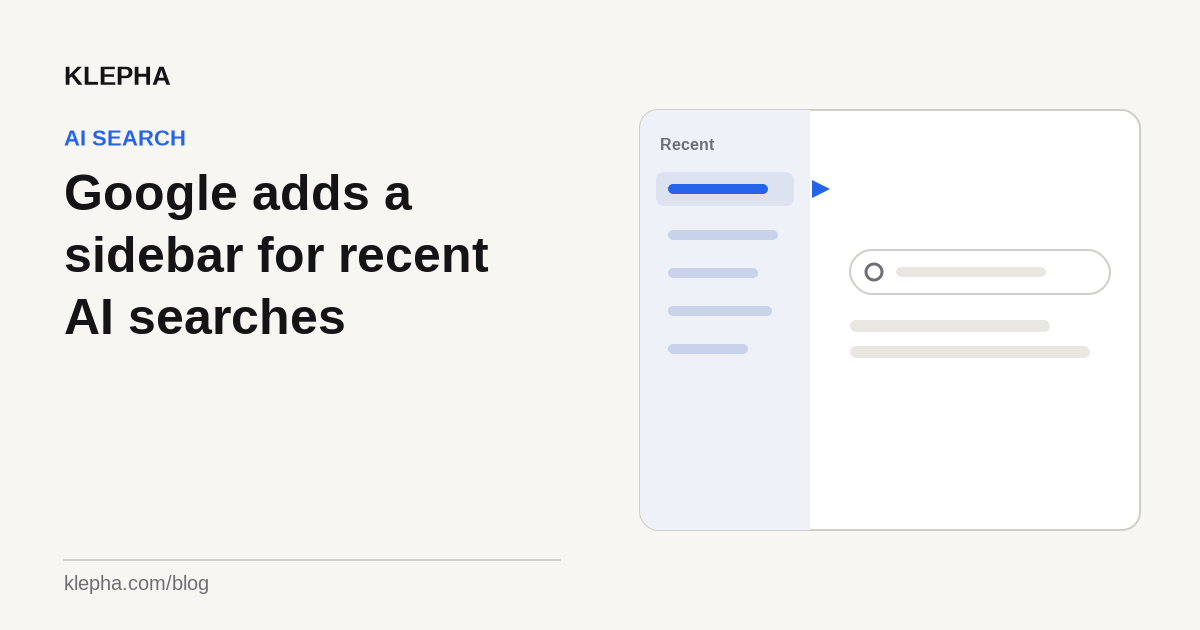
Google is rolling out a collapsible sidebar on the desktop Google homepage, globally, that lists your recent AI searches so you can reopen them and continue where you left off. Google's Robby Stein announced it on November 19, 2026, saying people increasingly come to Search with questions that are "not just one and done" and that the sidebar helped testers keep making progress across sessions.
For marketers, the change matters less as a design tweak and more as a signal: Google is building Search around longer, multi visit research threads, much like a chat app. Expect more returning, conversational journeys inside Google before a click, and plan reporting and content for buyers who research over several sittings rather than in a single query.
Key takeaways
- Confirmed: a collapsible sidebar of recent AI searches is rolling out on the desktop Google homepage globally, announced November 19, 2026.
- The intent: make it easy to resume multi step research, which Google says made a "big difference" in testing.
- Likely effect: more follow up questions inside AI Mode threads, with clicks arriving later and from fewer, more considered sessions.
- What to watch: branded and long, conversational queries in Search Console, AI referral patterns, and assisted conversions over longer windows.
- What to do: publish content that answers the second and third question in a journey, not only the first one.
What did Google launch?
On November 19, 2026, Search Engine Roundtable reported that Google is officially rolling out what it calls a "collapsible sidebar" in Google Search. Robby Stein of Google described it on X: "New on the Google desktop homepage globally: we're rolling out a collapsible sidebar to easily find & jump back into your recent AI searches." He added that it is "a much simpler way to pick up where you left off."
The feature was not a surprise to people who track Google's interface. Search Engine Roundtable had spotted it weeks earlier and called it the AI Mode sidebar, and its editor Barry Schwartz reported on October 30, 2026 that he was seeing the left sidebar in the main search results before the full rollout. By the official announcement he said he had been in the experience for about three weeks.
| Detail | What is confirmed | Source |
|---|---|---|
| Name | "Collapsible sidebar" (earlier reported as the AI Mode sidebar) | Search Engine Roundtable, Nov 19, 2026 |
| Where | Google desktop homepage | Robby Stein, Google, via X |
| Who | Rolling out globally | Robby Stein, Google, via X |
| Purpose | Find and jump back into recent AI searches | Robby Stein, Google, via X |
| Why | Questions are often not "one and done"; testing showed it helped people make progress and keep exploring the web | Robby Stein, Google, via X |
Google has not published usage numbers for the sidebar, and we have not seen official documentation describing exactly which searches appear in it or how long they are kept. Treat anything beyond the points above as observation, not specification.
What does it change for search behavior?
A list of recent conversations on the left is the familiar layout of chat assistants such as ChatGPT and Gemini. Bringing it to the Google homepage nudges people to treat a search as a thread they return to, not a one off lookup. Three behavioral shifts follow from that, and they are worth separating because they affect marketers differently.
Research becomes resumable
Complex purchases, such as choosing software, a contractor or a holiday, rarely finish in one sitting. Before the sidebar, a person returning the next day typically started a fresh query. With a visible history, they can reopen yesterday's AI thread and ask the next question with all the earlier context intact. That makes the AI answer, rather than a list of results, the place where the journey continues.
Follow up questions get easier
Google says people are bringing more questions that are not "one and done". Each reopened thread is an invitation to ask a narrower follow up: pricing, comparisons, alternatives, objections. Those later questions are often closer to a decision, and they are exactly the questions where being cited or named matters most. We covered how Google monetizes these follow ups in our piece on ads in multi turn AI Mode conversations.
Google keeps more of the journey
Schwartz's own read was that the interface "might lead to more queries for Google Search and AI Mode." More queries inside Google does not automatically mean fewer clicks for you, but it does mean more of the comparison work happens in Google's answer before anyone visits a website. That continues a trend we discussed in how AI Mode is absorbing upper funnel searches.
It looks more like a chat assistant
Putting a thread history on the Google homepage makes Search feel like a place to continue a project, not just a box to type a query into. For brands, that raises the stakes of being part of the first answer in a thread: if your product is named early, it is likely to be carried into the follow up questions when the user comes back.
How could it affect your traffic?
There is no published data yet on the sidebar's effect on clicks, so the honest answer is that nobody outside Google knows. What we can do is describe the plausible patterns, so you know what to look for in your own numbers.
| Possible pattern | Why it could happen | Who is most exposed |
|---|---|---|
| Fewer early stage clicks | Definitions and broad comparisons are answered inside a thread the user keeps reopening | Publishers and blogs that rely on top of funnel informational traffic |
| Later, more qualified visits | The click comes after several follow ups, when the user wants a specific product, price or proof | SaaS, ecommerce and services with strong product and pricing pages |
| More branded searches | Brands named repeatedly across a thread get searched directly when the user is ready | Brands that are consistently cited in AI answers |
| Longer paths to conversion | Research spans days, with the AI thread as the anchor between visits | Anyone using short attribution windows or last click reporting |
None of these are guaranteed, and they can offset each other. A site might lose some informational clicks while gaining better qualified visits on product pages. That is why measuring only total organic sessions will hide what is actually going on.
See how Google and AI assistants describe you
Klepha's free report shows where your brand appears across Google, ChatGPT, Gemini and Perplexity, and which buyer questions you are missing.
Get my free reportWhich signals should marketers watch?
Google has not announced separate reporting for visits that start from a reopened sidebar thread, so you will need to read indirect signals. These are the ones we would track weekly from late November 2026 onward, with the rollout date as an annotation in your analytics.
- Query length and phrasing in Search Console. Filter for queries of six or more words and for question forms. A rise suggests more conversational, follow up style searches reaching your pages. Our guide to finding quick win keywords in Search Console shows how to set up these filters.
- Branded query trends. In the same week as the sidebar news, Search Engine Roundtable reported that the Search Analytics API added branded query filtering. Use branded versus non branded splits to see whether AI exposure is turning into direct brand demand.
- Click through rate by page type. Compare informational guides with product, pricing and comparison pages. Diverging CTR trends tell you where the journey is moving.
- Assisted conversions and time to convert. If paths are getting longer, last click reports will undervalue organic. Look at conversion paths over 30 to 90 days.
- AI referrals and AI visibility. Track referrals from AI assistants alongside how often you are named in AI answers for your core questions. Our guides on whether AI search is driving traffic and tracking AI brand visibility cover the setup.
What should you do now?
The practical response is the same one that works for AI search generally, with one emphasis: plan for the whole thread, not only the first question.
- Map the follow up questions. For each core topic, list the second and third questions a buyer asks: cost, comparison with an alternative, implementation, risks. Make sure a clear, citable page answers each one.
- Make answers easy to quote. Lead sections with a direct answer, use descriptive headings and put specifics such as prices, limits and steps in plain HTML text and tables. AI answers can only cite what they can parse.
- Strengthen decision pages. Pricing, comparison and case study pages are where later stage clicks land. Keep them current, specific and consistent with what AI answers say about you.
- Keep entity signals consistent. If a thread names your brand three times across a week, the user will search for you. Consistent naming, descriptions and profiles help that search land on you.
- Avoid overreacting to one week of data. A global rollout takes time, and November also brings a core update and holiday seasonality. Compare like for like periods before changing strategy.
This is the work our ChatGPT Ranking service and the generative engine optimization discipline on our expertise page focus on, and our case studies show how we measure it on our own sites.
What is still unknown?
Several details matter for marketers and have not been confirmed publicly, so we are not guessing at them:
- Whether the sidebar appears on mobile, or only on the desktop homepage as announced.
- Exactly which searches are saved, for how long, and how history settings affect it.
- Whether Google will report anything about sidebar driven visits in Search Console.
- How the sidebar interacts with Google's separate tests of removing the AI Mode entry point from the search bar, which Search Engine Roundtable also reported that week.
We will update this article if Google publishes documentation or data. For broader context on where AI Mode is heading, see our coverage of Google I/O 2026 AI Mode and AI Overviews announcements.
Sources
- Search Engine Roundtable: Google Search Officially Rolls Out Collapsible Sidebar. Barry Schwartz, published November 19, 2026; accessed November 22, 2026. Announcement quotes from Robby Stein of Google and earlier sightings of the AI Mode sidebar.
- Search Engine Roundtable: Search News Buzz Video Recap, November 20, 2026. Published November 20, 2026; accessed November 22, 2026. Context for the same week: Search Analytics API branded query filters and tests of removing AI Mode from the search bar.
- Robby Stein, Google: Post announcing the collapsible sidebar on X. Posted November 19, 2026, as quoted by Search Engine Roundtable; accessed via that report on November 22, 2026.
Frequently asked questions
What is the Google collapsible sidebar?
It is a sidebar on the desktop Google homepage that lists your recent AI searches so you can reopen them and continue the conversation. Google announced the global rollout on November 19, 2026.
Is the collapsible sidebar the same as the AI Mode sidebar?
Yes. Search Engine Roundtable first reported it as the AI Mode sidebar after spotting it in testing in October 2026. Google calls the launched feature a collapsible sidebar.
Does the sidebar reduce clicks to websites?
There is no public data yet. It may reduce some early stage informational clicks while shifting visits to later, more decision focused moments, so track click through rate by page type rather than total sessions.
Can I see sidebar traffic in Search Console?
Google has not announced separate reporting for visits that start from a reopened sidebar thread. Watch indirect signals such as longer conversational queries, branded query trends and longer conversion paths.
What should marketers do about the sidebar?
Map the follow up questions buyers ask after their first search, make sure clear and citable pages answer each one, and keep pricing, comparison and case study pages current, because later stage clicks tend to land there.