How do you write ecommerce product descriptions that rank and convert?
A good product description answers two people at once: the shopper deciding whether to buy, and the search system deciding whether the page matches a query. One simple structure serves both. Here it is, with keyword, benefit and spec rules you can apply to a whole catalog.
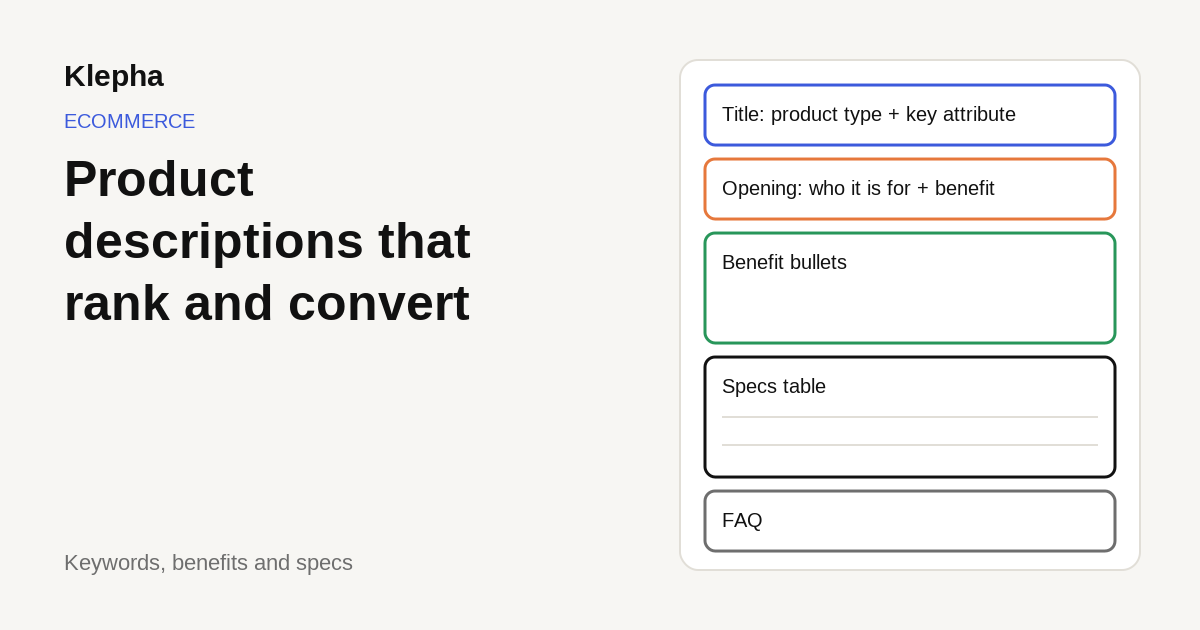
An ecommerce product description that ranks and converts opens with the product name shoppers search for and its main benefit, then gives three to five specific benefit bullets, a specs table with exact facts, and short answers to common buying questions. It must be original, accurate and consistent with your product feed and structured data.
That structure works because the first lines match the query and win the click, the bullets turn features into reasons to buy, and the specs table gives search engines, AI assistants and careful buyers the precise attributes they compare. The rest of this guide shows how to build each part and roll it out across a catalog.
Key takeaways
- Lead with the searched name and the main benefit: the first 160 to 500 characters matter most, which matches Google Merchant Center's own advice.
- Turn features into benefits, then prove them: feature, what it does for the buyer, evidence.
- Put specs in an HTML table: size, material, compatibility and care are what shoppers and machines compare.
- Keep one source of truth: the page, the feed and Product structured data should say the same thing.
- Write original copy for your top products first: copied manufacturer text gives search engines no reason to prefer your page.
- No promotional fluff in feeds: Merchant Center rules exclude prices, shipping, comparisons and all caps from descriptions.
What makes a product description rank and convert?
A product page has to do two jobs. It has to be the best match for a search such as "waterproof hiking boots women wide fit", and it has to persuade the person who lands on it. Those goals rarely conflict. The details that help ranking (the exact product type, material, size, use case) are the same details that help a buyer decide.
Descriptions fail in three predictable ways:
- Generic copy. "High quality, stylish and comfortable" could describe anything, so it matches no specific search and convinces no one.
- Copied text. The manufacturer's paragraph appears on dozens of retailer sites, so your page adds nothing new.
- Missing facts. The buyer cannot find dimensions, compatibility or care instructions, so they leave to check elsewhere.
What structure should you use for a product description?
Use the same skeleton on every product page. It keeps writing fast, makes pages easy to scan, and gives you consistent fields to fill from your product data.
| Block | What goes in it | Length | Main job |
|---|---|---|---|
| Product title (H1) | Brand, product type, key attribute, variant | One line | Match the query |
| Opening line | What it is, who it is for and the main benefit | 1 to 2 sentences | Win the click and the snippet |
| Benefit bullets | Three to five features translated into outcomes | One line each | Persuade |
| Specs table | Dimensions, materials, compatibility, weight, care, what is in the box | As many rows as needed | Answer exact questions |
| Use and care | How to use it, sizing advice, maintenance | Short paragraph | Reduce returns |
| Product FAQ | Real questions from support, reviews and search queries | 3 to 5 answers | Remove doubts, catch long tail searches |
| Reviews | Genuine customer reviews | Varies | Social proof |
The opening line is the most important sentence on the page. Google's Merchant Center guidance for product descriptions says to put the most important details "in the first 160 - 500 characters," because shoppers must click to see the rest. The same logic applies on your own page: many visitors read only the top.
How do you choose and place keywords in product descriptions?
Find the words buyers actually use
- Product type first. Shoppers search "standing desk", not your internal product name. Use the common term in the title and opening line.
- Modifiers second. Material, size, color, use case and audience ("for small spaces", "for beginners") are where purchase intent lives. See our guide to long tail keywords.
- Your own data third. Search Console queries for existing product pages, site search logs and support tickets show the exact phrases customers use.
Place them naturally
- Title tag and H1: product type plus the most important attribute.
- Opening sentence: the same product type, once, in plain language.
- Bullets and specs: modifiers such as material, size and compatibility appear naturally as facts.
- FAQ: question phrasing captures longer searches like "is this desk stable at full height".
Do not repeat the keyword to hit a density target. Google's spam policies list "repeating the same words or phrases so often that it sounds unnatural" as keyword stuffing. If a sentence would sound odd read aloud to a customer, rewrite it. Our guide to meta titles and descriptions covers the search snippet itself.
How do you write benefits that sell?
Use a three step pattern for every bullet: feature, then what it does for the buyer, then a specific detail that makes it believable.
| Feature only | Feature, benefit and proof |
|---|---|
| Merino wool lining | Merino wool lining keeps feet warm without overheating, and resists odor on multi day hikes |
| Dual motors | Dual motors lift up to 120 kg smoothly, so a full monitor setup does not wobble at standing height |
| Stainless steel | 18/8 stainless steel body will not rust or hold flavors, and is dishwasher safe |
The numbers in these examples are illustrations; use your own product's verified figures. A few writing rules help:
- Write for one specific buyer. "For renters who cannot drill into walls" beats "for everyone".
- Lead each bullet with the benefit word the buyer cares about, not with a brand term.
- Prefer numbers to adjectives: "fits laptops up to 16 inches" instead of "spacious".
- Answer the main objection in the copy: noise, size, assembly time, returns.
Do AI shopping answers describe your products correctly?
Klepha's free report shows how ChatGPT, Gemini and Perplexity describe your brand, and which buyer questions you are not answering yet.
Get my free reportHow should you present product specs?
Specs belong in an HTML table, not in a paragraph or an image. A table is easy to scan, readable by assistive technology, and easy for search engines and AI systems to parse. Include the attributes people compare:
- Dimensions and weight, with units
- Materials and finish
- Compatibility, size range or capacity
- Care, warranty and what is included
- Identifiers such as model number and GTIN where you have them
Keep specs consistent everywhere. Google's Merchant Center rules say description information must be "consistent with other details in the data source" and with your landing pages, and Google's guidance on AI features in Search says to make sure structured data matches the visible text on the page. In practice, generate the specs table, the feed attributes and Product structured data from the same product record. Our schema markup guide explains the Product and Offer markup.
Feed rules worth knowing
If you send products to Google Merchant Center, its description attribute allows up to 5,000 characters and comes with rules that differ from what you might put on the page:
- Describe only the product itself, not your store history or other products.
- No promotional text such as price, sale dates, shipping or your company name in the description.
- No comparisons with other products and no capital letters for emphasis.
- Descriptions written with generative AI go in the separate structured_description attribute, labeled as AI generated.
Can you use the manufacturer's description?
You can, but it gives search engines no reason to choose your page over every other store using the same text. Google's spam policies describe thin affiliate pages as those where "product descriptions and reviews are copied directly from the original merchant without any original content or added value." That policy targets affiliate sites, but the principle applies to any retailer: copied text adds nothing.
A practical approach for large catalogs:
- Prioritize. Write original descriptions first for products with the most revenue, search impressions or margin.
- Add what only you know. Sizing notes from returns data, answers from your support team, photos of the product in use, and genuine reviews.
- Handle variants with one page. Color and size variants usually belong on one URL with selectable options, or separate URLs with canonical tags pointing to the main version. See canonical tags and duplicate content.
- Template the long tail. For low volume products, a consistent template filled with accurate specs is better than copied paragraphs.
How do product descriptions affect AI shopping answers?
AI assistants now show product results, so your product data feeds them too. OpenAI's help page on shopping in ChatGPT says it considers "structured metadata from first-party and third-party providers (e.g., price, product description) and other third-party content," and that ChatGPT may generate simplified titles and descriptions from that data. Google says its AI features in Search draw on indexed pages and recommends keeping Merchant Center information up to date.
That changes what good copy looks like. Clear, factual statements such as "fits wrists 140 to 210 mm" are easy for a model to repeat correctly. Vague claims are not. For more on how shopping in ChatGPT works, read ChatGPT shopping in 2026.
What does a finished product description look like?
Here is a fictional example built with the structure above.
Trailline Women's Waterproof Hiking Boot, Wide Fit
A waterproof leather hiking boot in a true wide fit, made for day hikes and wet trails where narrow boots pinch.
- Dry feet in wet conditions: waterproof membrane and sealed seams.
- Room without slipping: wide toe box with a locking lace hook to hold the heel.
- Grip on mud and rock: deep lug rubber outsole.
Specs table: sizes, width, weight per boot, upper material, membrane, outsole, care.
FAQ: Should I size up? Can I resole them? Are they warm enough for snow?
Product description checklist
| Check | Pass when |
|---|---|
| Title and H1 | Contain the common product type and the key attribute |
| Opening line | States what it is, who it is for and the main benefit in two sentences or fewer |
| Bullets | Three to five, each a benefit with a specific detail |
| Specs | In an HTML table with units, matching the feed |
| Originality | Not copied from the manufacturer or another product page |
| FAQ | Answers real customer questions |
| Structured data | Product and Offer markup matches visible text |
| Tone | No keyword stuffing, all caps or unverifiable claims |
If you want help building this into a content process across a catalog, our Blog Ranking service covers content engineering, the expertise page lists the disciplines involved, and our case studies show the approach in practice.
Sources
- Google Merchant Center Help: Description [description] and structured description [structured_description]. Accessed November 24, 2026. Character limits, first 160 to 500 characters advice, consistency, promotional text and generative AI rules.
- Google Search Central: Spam policies for Google web search. Last updated November 23, 2026; accessed November 24, 2026. Keyword stuffing and thin affiliation definitions.
- Google Search Central: AI features and your website. Accessed November 24, 2026. Structured data should match visible text; keep Merchant Center information up to date.
- OpenAI Help Center: Shopping with ChatGPT Search. Accessed November 24, 2026. Factors ChatGPT considers when surfacing products.
Frequently asked questions
How long should an ecommerce product description be?
Long enough to answer what a buyer needs to decide. For most products that means a one or two sentence opening, three to five benefit bullets, a specs table and a few FAQs. Put the most important details first, since Google advises leading with them in the first 160 to 500 characters.
Should every product have a unique description?
Ideally yes, starting with your most important products. Copied manufacturer text appears on many sites and gives search engines no reason to prefer your page. For low volume products, an accurate template filled with real specs is better than copied paragraphs.
Where should keywords go in a product description?
Use the common product type in the title, H1 and opening sentence, and let modifiers such as material, size and use case appear naturally in bullets, specs and FAQs. Avoid repeating phrases unnaturally, which Google treats as keyword stuffing.
Can I use AI to write product descriptions?
You can draft with AI, but check every fact against your product data and add details only you know. If you submit AI generated descriptions to Google Merchant Center, Google requires them in the structured_description attribute labeled as AI generated.
Do product descriptions help in ChatGPT shopping results?
They can. OpenAI says ChatGPT considers structured metadata such as price and product description from first party and third party providers, plus other third party content. Clear, factual descriptions that match your feed are easier for AI systems to describe correctly.