What are Google Connected Apps, and how do they change the path from search to action?
Google's Connected Apps let people link services such as Adobe, Experian, Localiza, Peloton and Calm to Gemini and AI Mode, then get things done inside the conversation. Here is how the platform works, what is live as of November 27, 2026, and what brands should prepare.
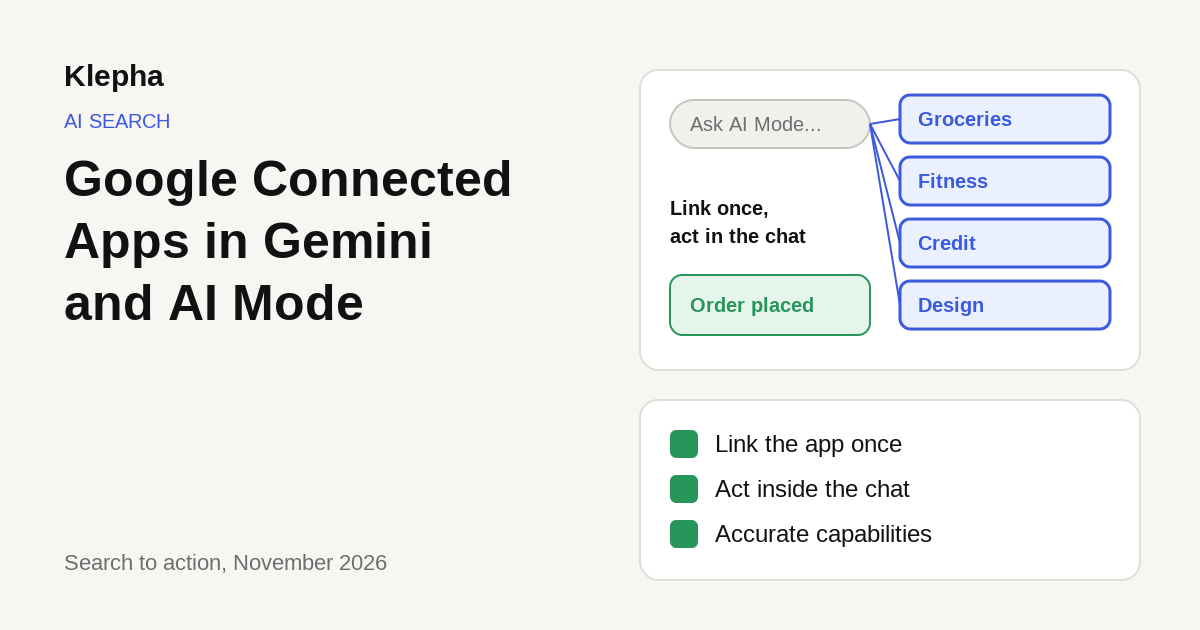
Google Connected Apps are third party services that a user links once to Gemini or to AI Mode in Google Search, so the assistant can read that person's account context and complete real actions, such as building a grocery order, checking a credit rating or starting a workout, without leaving the conversation. On October 28, 2026 Google opened a preview of the Connected Apps Platform, which lets more developers build one integration, using an MCP server or Android's AppFunctions, and publish it to Search, the Gemini app or both.
For brands, the shift is that a search can now end in an action inside Google rather than a click to your website. That does not replace SEO, but it adds a second surface where your product either shows up as the tool that gets the job done or does not show up at all.
Key takeaways
- One integration, two surfaces: the Connected Apps Platform lets developers register an app once and choose whether it goes live in Search, the Gemini app or both.
- Over 50 apps so far: Google says it has launched more than 50 Connected Apps across Search and Gemini, with Adobe, Experian, Localiza and Peloton live in Gemini and Calm announced for both.
- Search is catching up with Gemini: on November 20, 2026 Google added Albertsons, Safeway, Shaw's, Target, Experian and H&R Block to Search in the US, with Angi and Thumbtack to follow.
- Model selection has rules: Google's policy bans overly broad or deceptive capability descriptions written to make the model pick your app over another.
- Defaults matter: AI Mode may default to the last app a user chose for a task, so being the first linked app is an advantage.
- Prepare even without an app: clear product data, accurate content and clean account flows help in AI answers whether or not you build an integration.
What are Google Connected Apps?
Connected Apps are integrations that let Google's AI products work with a service the user already has an account with. Google's developer page describes the goal plainly: the platform lets developers "bring your apps and services directly into Google products like the Gemini app and Search, so users can access their personal live account context and complete real-world actions right in their conversations." A user links the app once, and after that can use it from any supported Google product.
That makes Connected Apps different from the two things marketers already know in AI search:
- AI answers and citations. AI Overviews and AI Mode summarize the web and link to sources. A brand earns visibility by publishing content Google chooses to cite.
- Ads in AI Mode. Paid placements appear inside or next to AI responses and send people to your site.
- Connected Apps. The assistant calls your service directly, with the user's permission, to do something: create a design, add items to a cart, look up a credit score or book a ride.
The first kind rewards information, the second rewards budget, and the third rewards being useful as a tool. A brand can appear in all three, but each needs different work.
Which apps are live, and where?
Google has rolled the feature out in waves, and availability differs between the Gemini app and Search. The table below lists what Google itself has announced, with dates.
| Date | What Google announced | Surface |
|---|---|---|
| October 28, 2026 | Preview of the Connected Apps Platform for developers. More than 50 Connected Apps launched across Search and Gemini. Adobe, Experian, Localiza and Peloton live in Gemini, coming to Search "in the coming weeks". A new Calm integration announced for both. | Gemini app and Search |
| October 31, 2026 (as reported) | Search Engine Journal listed the Connected Apps then shown on Google's Search help page for AI Mode in the US, in English: Instacart, Canva, YouTube Music, Yahoo Fantasy Football and Sleeper Fantasy Football. | AI Mode in Search |
| November 20, 2026 | New US grocery apps in Search and Gemini: Albertsons, Safeway, Shaw's and Target, powered by the Universal Commerce Protocol. Experian rolling out to Search to check a credit rating and shop for a personal loan. H&R Block in Search to calculate taxes and estimate refunds. Angi and Thumbtack coming to Search in the following weeks. | Search and Gemini app (US) |
Two cautions. First, most Search integrations are US and English only so far, and Google says it is opening access "in phases" with more developers, markets and products over the coming months. Second, the partner lists change quickly. Google points users to its help center pages for Search and Gemini for the current list, and you should check those before you plan around a specific competitor being present or absent.
How does the Connected Apps Platform work?
Google's October 28 post and its developer documentation describe a short pipeline:
- Build the integration. Developers connect either a cloud hosted Model Context Protocol (MCP) server or Android MCP through the AppFunctions APIs. According to Google's documentation as summarized by Search Engine Journal, the MCP server route reaches Gemini and Search users on web, Android and iOS, while Android MCP reaches Gemini users on Android.
- Handle sign in. Apps that need an account use OAuth 2.1 so Gemini can act on the user's behalf. Google publishes a separate OAuth implementation guide.
- Register in Google Connected Console. Developers register tools, pick a category for the app (which sets minimum capabilities and cannot be changed later), list at least three capabilities users will see before connecting, and choose countries, languages and Google products.
- Pass review. Google reviews and tests each app before publishing. Apps that require sign in must supply test accounts with sample data, and Google says an app it cannot fully test may be rejected.
- Monitor. Once live, developers can track traffic, latency and error rates, and keep control of their brand identity, including verified logos and authenticated accounts.
The important design choice is MCP. It is an open protocol that other AI assistants also support, so an MCP server built for Google is not wasted work if you later integrate with other assistants. The Google specific work sits mostly in registration, review and policy compliance.
How does the path from search to action change?
For two decades the commercial search journey has looked roughly the same. Connected Apps compress it.
| Step | Classic search journey | Journey with a Connected App |
|---|---|---|
| Intent | User types a query | User asks AI Mode or Gemini for help with a task |
| Choice | User scans results and ads, clicks a site | Assistant routes the task to a linked app, or the user picks from a list of available apps |
| Context | User signs in on your site or app | Account context is already linked through OAuth |
| Action | User completes the task in your interface | Task is completed in the conversation, sometimes with your app's own interface embedded |
| What you measure | Clicks, sessions, conversions on site | App invocations, latency, errors and downstream account activity |
Three consequences follow for marketers:
- Fewer visits for routine tasks. If a customer can reorder groceries or check a score inside Gemini, they have less reason to open your site. That is fine if the order still lands in your system, but it will show up as lower site traffic.
- Competition moves to the routing decision. Instead of competing for position one, apps compete to be the tool the assistant calls. Google's rules for that decision are covered in the next section.
- Existing customers matter more. Linking requires an account. Connected Apps mostly help brands deepen use among people who already chose them, rather than win strangers from a cold query. Discovery still happens through answers, ads and the app list.
See how AI assistants describe your brand today
Before you plan an integration, check where you stand in AI answers. Klepha's free report shows how ChatGPT, Gemini and Perplexity describe your brand and which buyer questions you are missing.
Get my free reportHow does Gemini choose which app to use?
Google has published more about this than many expected. The key points from its Connected Apps policy, MCP server guide and Search help page, as reported by Search Engine Journal on October 31, 2026:
- Server instructions drive routing. Google's MCP guide says models rely on a server's instructions "to recognize when to delegate tasks to your server," and recommends clear instructions so requests route accurately.
- No manipulation of the model. The policy says connected apps must not "deceive or influence the model into performing an adverse action or behavior; for example, using overly broad or deceptive capability descriptions to influence the model into selecting the Connected App over another Connected App." Apps also cannot reference other tools or set rules for when other tools should be used.
- No third party promotion. Ads and promotional material from other companies are not allowed inside the integration. Your own brand information is allowed.
- User defaults. In AI Mode, Google's help page says the system may default to the last app the user used for a task. Users can name a different app in their request, or run a general query and choose from available apps.
- Enforcement. Violations can lead to rejection, suspension, removal or termination of the developer account.
In plain terms: write capability descriptions that are accurate and specific, do not stuff them with every task you might conceivably handle, and earn the habit. If a user picks you once and the experience works, the default may keep you in place.
What should brands prepare for?
Not every business needs a Connected App this quarter. Use the decision table first, then the checklist.
| Your situation | Sensible next step |
|---|---|
| You run a consumer service with logged in accounts and repeat tasks (orders, bookings, workouts, finance checks) | Apply for the preview and scope an MCP server for your two or three most frequent tasks. |
| You are a retailer selling through Google | Prioritize Merchant Center data and the Universal Commerce Protocol, which already powers the grocery Connected Apps and agentic checkout. |
| You are a B2B or SaaS brand | Watch the productivity category, document your public API, and make sure your content answers buyer questions well enough to be recommended in AI answers. |
| You are a local service business | Keep your Business Profile and reviews current, and check whether marketplaces you use (such as Angi or Thumbtack) are integrating, since that may be how you are reached. |
A preparation checklist
- List the jobs customers ask you to do. Pull support tickets, app analytics and site search logs. The most repeated, low risk tasks are the best candidates for an integration.
- Check that an API exists for each job. If the action needs a human in the loop today, it is not ready for an assistant.
- Get authentication right. OAuth 2.1 support, sensible scopes and clear consent screens are prerequisites, and Google will test them with your test accounts.
- Write honest capability descriptions. Treat them like a product listing reviewed by a strict editor. Specific beats broad, both for routing and for policy.
- Plan your brand assets. Verified logos and a consistent app name help users recognize you in the app list.
- Keep your public content strong. People still discover brands through AI answers before they link anything. Our guide to optimizing for ChatGPT, Gemini and Perplexity covers the content side, and our explainer on agentic checkout and UCP covers the commerce side.
- Agree what success means. Decide before launch whether you are aiming for retention, order frequency or new account sign ups, because site traffic will not tell the story.
How should you measure it?
Google says the Connected Console reports traffic, latency and error rates for live apps. That covers the integration's health, not its business value. Pair it with your own data:
- Tag actions by source. Record in your backend which orders, bookings or changes arrive through the Connected App, so you can compare frequency and value with other channels.
- Watch site traffic in context. A drop in visits to account pages may be a sign the integration works. Look at completed tasks, not only sessions.
- Track AI visibility separately. Whether Gemini mentions or recommends you in open questions is a different measure from whether it calls your app. Our guide to tracking AI brand visibility explains how to monitor that over time.
What is still unclear?
- Timelines outside the US. Google has not given dates for most markets.
- Commercial terms. Google's announcements do not describe fees or revenue sharing for Connected Apps, and we found no public pricing.
- Ranking between similar apps. Beyond user defaults and server instructions, Google has not explained how it chooses between two qualified apps for the same task.
- Overlap with ads. Google is testing many ad formats in AI Mode. How ads and Connected Apps will sit together in one response is not documented.
Google Search Advocate John Mueller called Connected Apps "still extremely early" in a LinkedIn comment cited by Search Engine Journal. That is a fair summary. The sensible move for most brands is to understand the mechanics now, fix the foundations that help in every AI surface, and apply for the preview only when you have a task worth handing to an assistant. If you want help deciding, our ChatGPT and AI ranking service, expertise page and case studies show how we approach AI visibility work.
Sources
- Google, The Keyword: Build and manage Connected Apps in one place, by Chips Mistry and Mai Lowe. Published October 28, 2026; accessed November 27, 2026. Platform preview, MCP and AppFunctions, Connected Console, 50+ apps, Adobe, Experian, Localiza, Peloton and Calm.
- Google, The Keyword: Get your year-end tasks done with new Connected Apps. Published November 20, 2026; accessed November 27, 2026. Albertsons, Safeway, Shaw's, Target, Experian in Search, H&R Block, Angi and Thumbtack.
- Google for Developers: Connected Apps Platform. Accessed November 27, 2026. Definition, MCP server and Android MCP paths, OAuth 2.1, Connected Console onboarding.
- Search Engine Journal: Google Opens Connected Apps Preview For AI Mode & Gemini, by Matt G. Southern. Published October 31, 2026; accessed November 27, 2026. Registration requirements, Connected Apps policy quotes, AI Mode defaults and the then current Search app list.
- Model Context Protocol: Official documentation. Accessed November 27, 2026. Background on the open protocol used for Connected Apps.
Frequently asked questions
What are Google Connected Apps?
They are third party services that a user links once to Gemini or AI Mode in Google Search. After linking, the assistant can use the person's account context to complete real tasks, such as building a grocery order or checking a credit rating, inside the conversation.
Which brands are available as Connected Apps?
Google has named Adobe, Experian, Localiza and Peloton as live in Gemini, a new Calm integration for Search and Gemini, and US Search apps including Albertsons, Safeway, Shaw's, Target, Experian and H&R Block, with Angi and Thumbtack announced. Google says it has launched more than 50 Connected Apps in total.
How can a developer build a Connected App?
Developers connect a cloud hosted MCP server or Android MCP through AppFunctions, register and test the app in Google Connected Console, choose whether it goes live in Search, the Gemini app or both, and pass Google's review. Access is in a phased preview.
Can I optimize my app so Gemini picks it over competitors?
Only by being accurate and useful. Google's Connected Apps policy bans overly broad or deceptive capability descriptions meant to influence the model into choosing your app, and AI Mode may default to the last app a user chose for a task.
Do Connected Apps replace SEO?
No. People still discover brands through search results and AI answers, and linking an app requires an account first. Connected Apps add a new surface for completing tasks, so strong content and product data remain necessary.