How do you build an editorial process that shows E-E-A-T?
E-E-A-T is not a checkbox or a single ranking factor. It is the visible result of how you produce content: who writes it, how claims are checked, who reviews it and how you fix mistakes. Here is a lightweight process a small team can run every week.
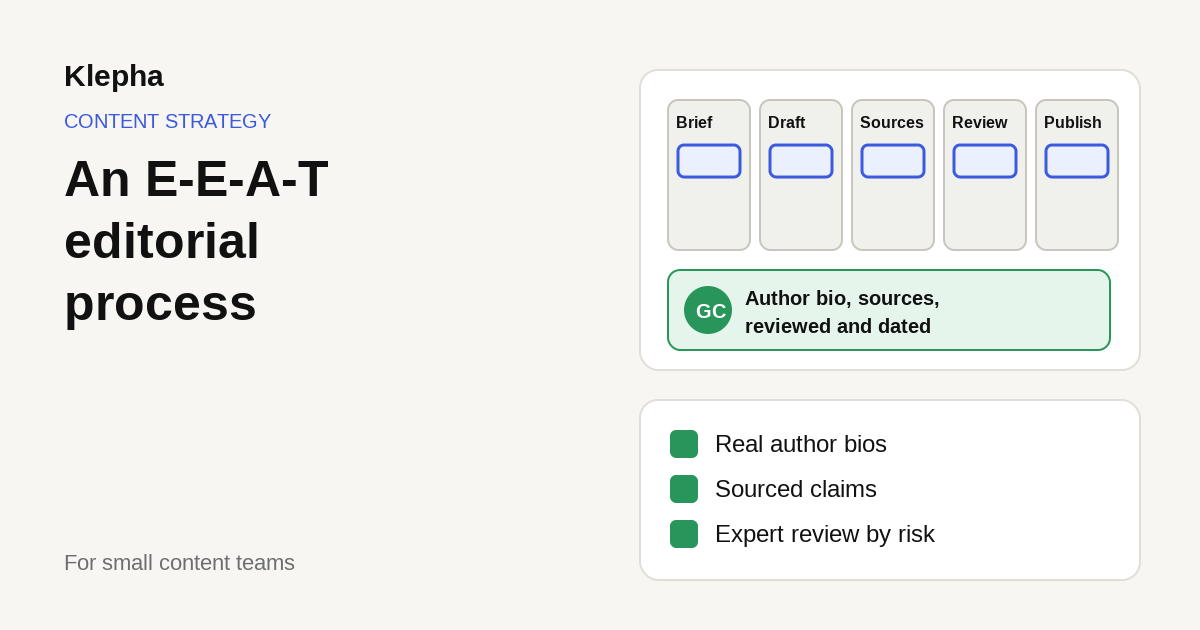
An editorial process that shows E-E-A-T makes four things visible on every page: a real author with relevant experience, sources for every factual claim, review by someone qualified for the topic, and honest dates and corrections. For a small team that means a written author bio standard, a one page sourcing policy, a review step matched to the risk of the topic, and a regular update cycle.
Google says E-E-A-T itself "isn't a specific ranking factor," and that trust is the most important part. So the goal is not to add signals for an algorithm. It is to work in a way that readers can verify, which is also what Google's systems try to identify.
Key takeaways
- Trust comes first: Google calls trust the most important part of E-E-A-T. Experience, expertise and authoritativeness support it.
- Real people only: Google calls fabricated creator profiles, such as AI generated headshots, made up names or false credentials, a form of deception.
- Answer who, how and why: Google's own framework asks who created the content, how it was created and why it exists.
- Match review to risk: topics that affect health, money or safety (YMYL) need qualified review; low risk how-to content can rely on an experienced editor.
- Source every number: link to primary sources with dates, and say when something could not be verified.
- Maintain, do not just publish: scheduled reviews and a visible corrections policy keep old pages trustworthy.
What does E-E-A-T mean in practice?
E-E-A-T stands for experience, expertise, authoritativeness and trustworthiness. In Google's documentation it describes qualities its systems try to identify in helpful content, and the criteria human quality raters use to judge whether Google's results are working. In practice, each letter maps to something a reader can check:
| Quality | Reader's question | What your process should produce |
|---|---|---|
| Experience | Has the writer actually done this? | First hand detail: screenshots, test results, real examples, lessons from doing the work |
| Expertise | Does the writer know the subject? | An author bio with relevant background, and review by a qualified person where needed |
| Authoritativeness | Is this source recognized on the topic? | A focused site, consistent topic coverage, mentions and links from others over time |
| Trustworthiness | Can I rely on this? | Accurate facts, cited sources, honest dates, clear ownership, contact details and corrections |
Authority mostly accumulates outside your control. The other three come straight from how you work, which is why the process matters more than any single page tweak.
What does Google actually say?
Google's page "Creating helpful, reliable, people-first content," last updated October 5, 2026, is the clearest primary source. The key points:
- Trust is central. "Of these aspects, trust is most important. The others contribute to trust, but content doesn't necessarily have to demonstrate all of them."
- Not a single factor. "While E-E-A-T itself isn't a specific ranking factor, using a mix of factors that can identify content with good E-E-A-T is useful."
- Higher bar for YMYL. Google's systems "give even more weight to content that aligns with strong E-E-A-T for topics that could significantly impact the health, financial stability, or safety of people, or the welfare or well-being of society."
- Bylines are encouraged. Google asks whether it is self evident who authored content, whether pages carry a byline where expected, and whether bylines lead to more information about the author. It says it strongly encourages "adding accurate authorship information."
- Fake authors are deception. "Fabricating creator profiles (such as by using AI-generated headshots, made-up names, or false credentials to make content appear as if it was written by human experts) is a form of deception."
- Quality attributes. Raters are trained to evaluate effort, originality, talent or skill, and accuracy of the main content. Google adds that attribution to other sources "doesn't replace the need for original effort."
Google also frames the whole topic as "Who, How, and Why." That is a useful structure for an editorial process, and the rest of this guide follows it. For background on Google's recent wording changes about AI assisted content and authorship, see our article on Google's AI content guidelines.
Who does what on a small team?
You do not need a newsroom. Three roles are enough, and one person can hold more than one, as long as nobody reviews their own work on high risk topics.
| Role | Responsibilities | Typical person on a small team |
|---|---|---|
| Author | Researches, writes, adds first hand examples, lists sources | Subject specialist, founder, practitioner, or a writer working from interviews |
| Editor | Checks structure, clarity, claims against sources, brand and legal rules | Content lead or marketing manager |
| Expert reviewer | Confirms technical accuracy for topics that need it | Internal specialist, customer facing engineer, or an external paid reviewer |
How do you write author bios that build trust?
Author bios are where "Who" becomes visible. Create one author page per real contributor and link every byline to it.
The author bio standard
- Real name and photo. Use the person's actual name and a real photo. Never a stock image or a generated face.
- Role and relevant experience. What they do, for how long, and what they have done that relates to the topics they cover. Specific beats impressive.
- Topics covered. The subjects they write about, so readers can see the match.
- Verifiable links. A professional profile, talks, publications or projects others can check.
- List of articles. The author page should link to everything they have written.
- Structured data. Mark the author up as a
Personwith a stable URL and reference it from each article'sauthorproperty. Our schema markup guide shows the setup.
If a writer has no relevant experience, do not invent it. Either pair them with a reviewer whose credentials you show, or base the piece on interviews with someone who has the experience and credit that person.
Do AI assistants trust your content enough to cite it?
Klepha's free report shows how ChatGPT, Gemini and Perplexity describe your brand and which buyer questions you are not answering yet.
Get my free reportWhat should a sourcing policy include?
A sourcing policy is a one page document every writer follows. It is the "How" behind your accuracy. A workable version:
- Primary sources first. Prefer official documentation, original studies, regulators, company announcements and first hand data over articles that summarize them.
- Every number gets a source. Statistics, prices, dates and quotes link to where they came from, with the date you accessed them for anything that changes.
- Check freshness. For fast moving topics such as product features, prices or policies, verify on the day you publish.
- Say what you could not verify. If a source is inaccessible or a claim is unconfirmed, say so or leave it out. Never fill gaps with guesses.
- Separate fact from opinion. Make it clear when you are recommending something rather than reporting it.
- Disclose relationships. If you recommend a product or company you work with, say so plainly on the page.
- Show sources to readers. End each article with a sources list naming the publisher, title and date.
How does expert review work without an expert on staff?
Match the depth of review to the risk of the topic. Google's own distinction between general topics and YMYL topics is a sensible guide.
| Risk level | Examples | Review standard |
|---|---|---|
| Low | How to write a content brief, how to structure a blog post | Editor checks claims and sources. Author's experience is enough. |
| Medium | Technical SEO fixes, ad platform settings, software comparisons | A practitioner who uses the tool or does the work reviews before publishing. |
| High (YMYL) | Health, legal, tax, financial or safety advice | A qualified professional reviews, and their name, credentials and review date are shown on the page. |
Practical options for small teams
- Internal specialists. Engineers, support leads and account managers often know the product better than marketing. Give them a short review checklist and 20 minutes, not a full rewrite.
- Paid external reviewers. For high risk topics, pay a qualified reviewer per article and credit them with a "Reviewed by" line linked to their profile.
- Interviews. If you cannot get review, interview an expert before writing and quote them accurately with permission.
- Scope down. If you cannot get qualified review for a high risk topic, do not publish advice on it. Cover the parts you can stand behind.
What does the full workflow look like?
| Step | Owner | Output | Time on a small team |
|---|---|---|---|
| 1. Brief | Editor | Search intent, reader, angle, risk level, required reviewer. See our content brief template. | 30 to 60 minutes |
| 2. Research | Author | Primary sources with access dates, first hand examples | 1 to 3 hours |
| 3. Draft | Author | Answer first, self contained sections, tables where data is tabular | 2 to 4 hours |
| 4. Source check | Editor | Every claim matched to a source, unverifiable claims removed | 30 to 60 minutes |
| 5. Expert review | Reviewer | Accuracy confirmed or corrected, reviewer credited if shown | 20 minutes to 1 hour |
| 6. Publish | Editor | Byline, dates, sources section, schema, internal links | 30 minutes |
| 7. Review cycle | Editor | Scheduled recheck date based on how fast the topic changes | Ongoing |
If you use AI tools in drafting or research, put them inside this process rather than around it. A human author still owns the claims, the editor still checks sources, and you disclose AI involvement where readers would reasonably wonder how the content was made, as Google suggests. Our guide to AI assisted SEO writing covers that workflow.
How do you show the process on the page?
A good process that readers cannot see does little for trust. On each article, show:
- Byline linked to the author page, and a "Reviewed by" line when applicable.
- Published and updated dates that reflect real changes. Google warns against changing dates to make pages seem fresh when the content has not substantially changed.
- A sources section with publishers, titles and dates.
- A short "how we made this" note where readers might ask, for example how products were tested or whether AI tools were used.
- Site level pages that explain your editorial standards, corrections policy, ownership and contact details, linked from your footer or about page.
How do you keep content trustworthy over time?
- Set review dates by topic speed. Platform features and prices might need checking every quarter. Evergreen strategy pieces might need a yearly look.
- Publish corrections. When you fix a factual error, say what changed and when. It costs little and signals honesty.
- Consolidate overlapping pages. Two thin articles on the same question confuse readers and search engines. Merge them into one stronger page. Our guide to refreshing old blog posts explains how.
- Retire what you cannot maintain. If nobody can keep a high risk page accurate, update it to a narrower scope or remove it.
E-E-A-T is easiest to show when it is how you already work. If you want help setting up an editorial process that supports both search rankings and AI citations, see our blog ranking service, expertise page and case studies.
Sources
- Google Search Central: Creating helpful, reliable, people-first content. Last updated October 5, 2026; accessed November 27, 2026. E-E-A-T definition, trust, YMYL, Who/How/Why, deceptive authorship, effort, originality, skill and accuracy.
- Google: Search Quality Rater Guidelines. Linked from the page above; accessed November 27, 2026. Criteria raters use to assess E-E-A-T and page quality.
- Google Search Central Blog: Google Search's guidance about AI-generated content. Published February 2023; linked from the page above; accessed November 27, 2026.
- Google Search Central: Spam policies: scaled content abuse. Accessed November 27, 2026. Why automation used mainly to manipulate rankings is a policy violation.
Frequently asked questions
Is E-E-A-T a Google ranking factor?
Google says E-E-A-T itself is not a specific ranking factor. Its systems use a mix of factors that help identify content with good experience, expertise, authoritativeness and trustworthiness, and trust is the most important of the four.
What should an author bio include for E-E-A-T?
A real name and photo, the author's role and relevant experience, the topics they cover, verifiable links such as a professional profile or publications, and a list of their articles. Never use invented names, generated headshots or false credentials.
Do small teams need expert review on every article?
No. Match review to risk. Low risk how-to content can be checked by an experienced editor, while health, legal, financial or safety topics should be reviewed by a qualified professional who is credited on the page.
How should I cite sources to show trust?
Prefer primary sources, link every statistic, price, date and quote to where it came from, note the access date for anything that changes, say when something could not be verified, and list sources at the end of the article.
Should I disclose AI use in my content?
Google suggests AI or automation disclosures where readers might reasonably ask how content was created. Keep a human author responsible for the claims and keep AI tools inside your normal editing and sourcing process.