How do you write a B2B cold email outreach sequence that gets replies?
Good cold email is a small, well researched list, a plain subject line, a short message about the recipient's problem and a few polite follow ups. Here is how to build each part, with templates, a schedule and the deliverability and legal rules that apply.
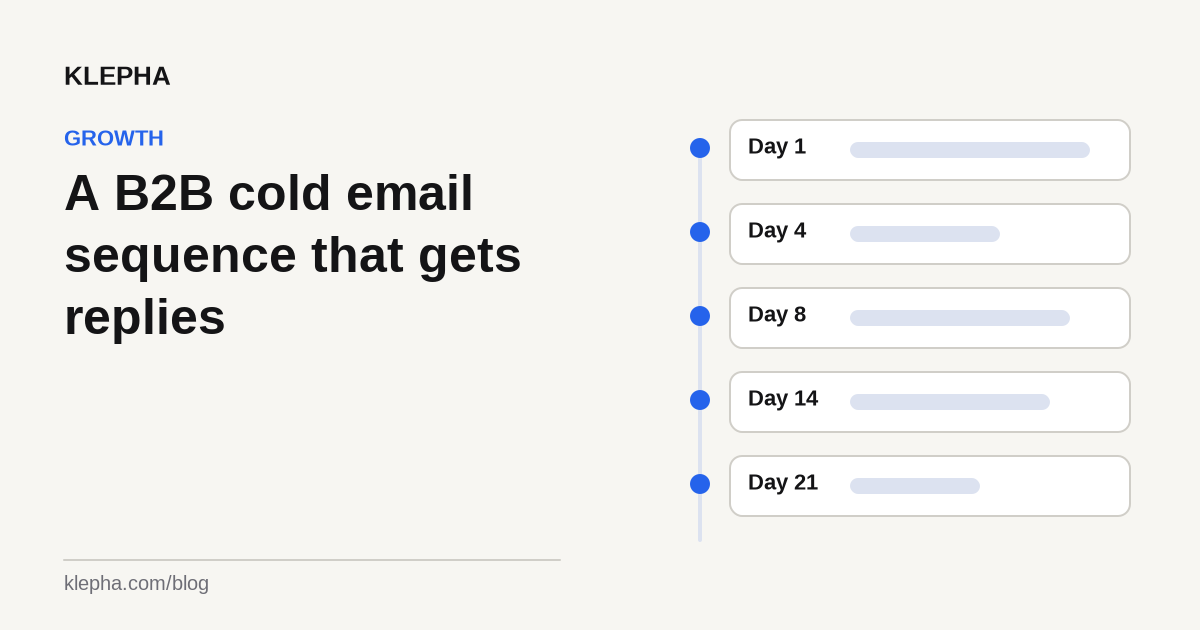
A B2B cold email outreach sequence that gets replies has four parts: a narrow list of accounts and named people who plausibly have the problem you solve, a short plain subject line, a first email of roughly 50 to 120 words about the recipient's situation with one easy question, and three or four polite follow ups spread over about three weeks, each adding something new. Personalisation means a real reason you are writing to this person, not a mail merged first name.
It also has to be sent responsibly. In the US, CAN-SPAM applies to business to business email and requires a working opt out honoured within 10 business days; Gmail requires authenticated mail and spam complaint rates below 0.3%. Small, relevant sends protect both your reputation and your domain.
Key takeaways
- Target first: a list of 50 well chosen people beats 5,000 scraped addresses.
- Subject lines: short, specific, lowercase friendly, never fake "Re:" or "Fwd:".
- First email: one observation about them, one problem, one proof point, one low effort question.
- Follow ups: four to five touches over about three weeks, each with new value, then stop.
- Rules: authenticate your domain, include an opt out and postal address, keep complaints well under Gmail's 0.3% limit.
What makes a B2B cold email sequence work?
Cold email works when it looks and reads like a note from one professional to another about something the recipient already cares about. It fails when it looks like a campaign. Every decision below follows from that one idea.
| Element | What works | What fails |
|---|---|---|
| List | Small, researched, one clear segment per sequence | Bought or scraped lists mixing roles and industries |
| Subject line | Two to six plain words about their world | Clickbait, fake replies, capital letters, emojis |
| Opening | A specific observation about their company or role | "I hope this email finds you well" or a paragraph about you |
| Body | One problem, one proof point, under about 120 words | Feature lists, attachments, several links |
| Call to action | One easy question they can answer in a line | "Book 30 minutes on my calendar" in the first email |
| Follow ups | Three or four, each adding something new | "Just bumping this" repeated until they unsubscribe |
How do you target the right accounts and people?
Targeting decides most of your result before you write a word. A perfect email to the wrong person is still spam to them.
- Write a one paragraph ideal customer profile. Industry, company size, region, the technology or situation that signals need, and what has to be true for them to buy. If you sell SEO services, "B2B SaaS companies with 20 to 200 staff, a blog that has not been updated in six months and a new marketing hire" is a usable profile; "companies that need marketing" is not.
- Pick a trigger. The best cold emails respond to something that changed: a funding round, a new hire, a product launch, a hiring post for a role you could support, a site migration. Triggers give you a natural reason to write.
- Choose one or two roles per account. Write to the person who owns the problem. For a content or SEO offer that is usually the head of marketing or content, not the CEO of a 200 person company.
- Verify every address. Bounces damage sender reputation. Use a verification tool and remove role addresses such as info@ unless that is genuinely the right inbox.
- Segment tightly. One sequence per segment, so the message can be specific. Twenty five people in the same situation are easier to write to than five hundred in different ones.
Do not buy email lists. Gmail's sender guidelines explicitly tell senders not to purchase email addresses from other companies, and bought lists are where most bounces and spam complaints come from.
How do you write cold email subject lines?
The subject line has one job: to look like it is worth opening from someone the recipient does not know. Plain beats clever.
- Keep it short, roughly two to six words, so it is not cut off on mobile.
- Make it about them: their company, their project, their problem. "Acme's pricing page" or "blog traffic after the migration".
- Write like a colleague, in sentence case or lowercase, with no exclamation marks.
- Never fake a thread. Gmail's guidelines say not to start subjects with "Re:" or "Fwd:" unless the message is an actual reply or forward, and US law prohibits deceptive subject lines.
- Match the subject to the body. A subject that promises something the email does not deliver earns a delete at best and a spam report at worst.
How do you write the first email?
Use a four part structure and keep the whole message to something that fits on a phone screen without scrolling.
- Observation (one sentence). Something specific and true about them that shows you looked: "Saw you moved the blog to a new domain last month."
- Problem (one or two sentences). The likely consequence, phrased carefully: "Migrations often lose rankings on older posts for a few weeks, and some never recover without redirects being checked."
- Proof (one sentence). Why you are credible: a relevant result, a client type, or a resource. Only use real, verifiable results.
- Question (one sentence). Low effort to answer: "Worth me sending the three things I would check first?"
Personalisation should be a reason, not a token. Inserting a first name and company name is the minimum, not personalisation. A sentence that could only have been written to this person is what earns a reply. For high value accounts, write that sentence by hand; for larger segments, personalise at the segment level ("teams who just migrated their blog") rather than faking individual research.
Leave out attachments, images and tracking heavy templates. Send plain text or very light HTML from a real person's name, with one link at most. The same principles of clarity apply to every message you send, and our guide to the email welcome sequence covers what to send once someone opts in.
Give prospects something to check before they reply
Cold email works better when your own site answers the questions buyers ask. Klepha's free report shows how Google and AI assistants describe your brand to the people you are emailing.
Get my free reportWhat is a sensible follow up schedule?
Many replies come after the first email, because people are busy, not uninterested. But every follow up should add something, and the sequence should end. This schedule balances persistence and respect:
| Touch | Day | Purpose | Length |
|---|---|---|---|
| Email 1 | Day 1 | Observation, problem, proof, question | 50 to 120 words |
| Email 2 | Day 3 or 4 | Short nudge in the same thread with one extra detail | 30 to 60 words |
| Email 3 | Day 8 | Give value: a useful tip, example or resource | 50 to 100 words |
| Email 4 | Day 14 | Different angle: another problem you solve or a short case | 50 to 100 words |
| Email 5 | Day 21 | Polite close: "I will stop here", with an easy way to reconnect later | 30 to 60 words |
Send during the recipient's working hours, on weekdays. Stop the sequence immediately for anyone who replies, books a call, opts out or bounces. If someone replies "not now", ask when to check back and put them on that date, not back in the sequence.
What does a full B2B cold email sequence look like?
Here is an example sequence for an agency offering SEO support to B2B SaaS companies after a site migration. Adapt the facts; never invent results.
Email 1 (day 1)
Subject: blog after the migration
Hi Sam, saw Acme moved its blog to the main domain last month. After migrations, older posts often lose rankings for a few weeks, and some stay down if redirects or internal links were missed. We run migration checks for SaaS teams and usually find the issues in the first audit. Would it help if I sent the three checks I would start with?
Email 2 (day 4)
Same thread
Hi Sam, one detail I noticed: a few old blog URLs return a 404 instead of redirecting. Happy to send the list if useful.
Email 3 (day 8)
Subject: quick check for migrated posts
Hi Sam, a quick check your team can run without us: in Search Console, compare the last 28 days with the 28 days before the move, filtered to the blog folder, and sort pages by lost clicks. The top ten usually tell you where redirects or content went wrong. Want me to walk through what we would look for?
Email 4 (day 14)
Subject: Acme in AI answers
Hi Sam, separate thought: we also check how assistants like ChatGPT describe a brand after a migration, since they lean on the same pages. If that is on your radar, I can share what we see for Acme's category.
Email 5 (day 21)
Same thread as email 4
Hi Sam, I will stop here so I am not cluttering your inbox. If migration clean up becomes a priority, just reply to this and I will pick it up.
Every email in the sequence also carries a simple opt out line and your business postal address in the signature, as covered below.
What deliverability and legal rules apply to cold email?
Deliverability: Gmail's sender requirements
Google's Email sender guidelines apply to anyone sending to personal Gmail accounts, and the same practices protect delivery to company inboxes. All senders must set up SPF or DKIM, have valid forward and reverse DNS, use TLS, and keep the spam rate reported in Postmaster Tools below 0.3%. Google recommends staying below 0.1%. Senders of more than 5,000 messages a day to Gmail must also set up DMARC, align the From domain and support one click unsubscribe for marketing messages.
- Use a separate sending domain or subdomain for outreach so problems do not affect your main company email, and authenticate it with SPF, DKIM and DMARC.
- Increase volume slowly. Google advises starting with low volume and avoiding sudden spikes.
- Do not rely on open rates. Google states it does not track open rates and cannot verify the accuracy of open rates reported by third parties. Judge sequences on replies and meetings.
- Be honest with yourself about consent. Gmail's guidelines advise sending only to people who want your messages. Cold outreach is in tension with that, which is why it has to stay small, relevant and easy to stop.
Legal: the rules differ by country
This is general information, not legal advice; check the rules for every country you email.
- United States (CAN-SPAM). The FTC states the law makes no exception for business to business email. Commercial emails must not use false header information or deceptive subject lines, must include a valid physical postal address and a clear way to opt out, and opt out requests must be honoured within 10 business days.
- United Kingdom (PECR and UK GDPR). The ICO's guidance says the PECR rule on electronic mail marketing does not apply to corporate subscribers, but sole traders and some partnerships are treated as individuals and need specific consent. Data protection law still applies to personal data such as a named work email.
- EU and other markets. Rules vary by country and are often stricter for emails to identifiable individuals. Check local guidance before including a market in a sequence.
How do you measure and improve a cold email sequence?
Track a small set of numbers per sequence and segment:
- Bounce rate: should be very low if addresses were verified. A high rate means a list problem.
- Reply rate and positive reply rate: the real measures of relevance. Count "not interested" separately from "tell me more".
- Meetings or qualified conversations: the outcome that matters.
- Opt outs and spam complaints: watch Postmaster Tools for your sending domain and stop a sequence that drives complaints.
Change one thing at a time: the segment, the problem statement, the proof point or the question. The same discipline applies to ads and landing pages; see how to A/B test ads and landing pages. Outreach is also only one stage of demand generation; our guide to building a marketing funnel shows where it fits beside search, content and paid channels, and calculating CAC and LTV tells you what a meeting is worth. For how we combine outreach with search and AI visibility, see our expertise, our solutions and our case studies.
Sources
- Gmail Help: Email sender guidelines. Accessed November 21, 2026. Requirements for all senders and for senders of 5,000 or more messages a day, spam rate thresholds of 0.3% and recommended 0.1%, one click unsubscribe, guidance against purchased lists and fake Re: or Fwd: subjects, and the note that Google does not track open rates.
- US Federal Trade Commission: CAN-SPAM Act: A Compliance Guide for Business. Checked November 21, 2026 via search excerpts (the page blocked automated reading). No exception for business to business email; opt out requests honoured within 10 business days.
- UK Information Commissioner's Office: Business-to-business marketing and Electronic mail marketing. Checked November 21, 2026 via search excerpts. PECR email rule does not apply to corporate subscribers; sole traders and some partnerships are treated as individuals.
Frequently asked questions
How many emails should a B2B cold email sequence have?
Four to five emails over about three weeks is a sensible default: a first email, a short nudge after three or four days, a value email around day eight, a different angle around day fourteen and a polite closing email around day twenty one. Stop immediately for anyone who replies, opts out or bounces.
How long should a cold email be?
Short enough to read on a phone without scrolling. Aim for roughly 50 to 120 words in the first email and less in follow ups, with one observation, one problem, one proof point and one easy question.
What makes a good cold email subject line?
A short, plain subject of about two to six words that is about the recipient's company or problem and matches the body. Avoid clickbait, capital letters and fake Re: or Fwd: prefixes, which Gmail's guidelines and US law both discourage.
Is B2B cold email legal?
It depends on the country. In the US, CAN-SPAM applies to business to business email and requires honest headers and subjects, a postal address and an opt out honoured within 10 business days. In the UK, the PECR email rule does not apply to corporate subscribers, but sole traders need consent. This is general information, not legal advice.
How do I keep cold emails out of spam?
Send from an authenticated domain with SPF, DKIM and DMARC, verify addresses to avoid bounces, keep volumes low and increase them slowly, write plain relevant messages, include an easy opt out, and keep spam complaints well below Gmail's 0.3% limit, ideally under 0.1%.
Should I track open rates for cold email?
Use them cautiously at most. Google says it does not track open rates and cannot verify open rates reported by third parties. Replies, positive replies and meetings booked are better measures of whether a sequence works.