How does AppsFlyer's Apple Ads bid agent work, and how do you keep control?
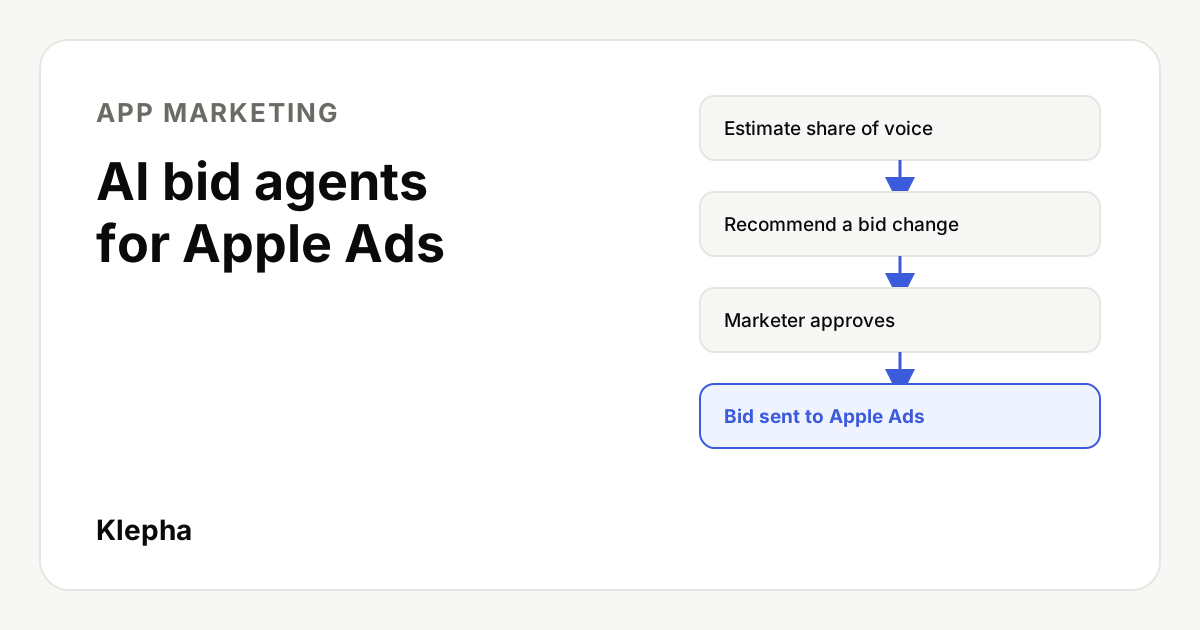
AppsFlyer's Apple Ads Share of Voice Agent, announced November 11 to 12, 2026 and in closed beta, estimates share of voice per keyword and country, recommends a bid change when you are off target, and sends that bid to Apple Ads only after you approve it. AppsFlyer's help center says you can apply, edit or reject each recommendation. Keep control by setting targets and bid limits first, limiting who can approve, and logging every change.
For years, mobile measurement tools told app marketers what happened after an ad was seen. In November 2026, AppsFlyer started testing an agent that also changes what you bid on Apple Ads, once you say yes. It is a small product in closed beta, but it shows where app marketing tools are heading: from dashboards that report to agents that act.
This article covers what AppsFlyer announced, how the approval flow works according to its documentation, what has not been disclosed, and the guardrails any app team should set before letting an AI agent touch bids, budgets or keywords.
Key takeaways
- What it does: estimates share of voice per keyword and country, recommends a bid change when you are off target, and applies it in Apple Ads after approval.
- Status: closed beta, through AppsFlyer customer success managers. No public pricing.
- Control: AppsFlyer's help center describes Apply, edit then Apply, or Reject for each recommendation.
- Unknowns: how share of voice is estimated, which Apple interface is used, and how it treats Maximize Conversions campaigns.
- Your job: set targets, bid limits and approvers before the agent starts, and log every change.
What did AppsFlyer announce?
AppsFlyer announced an expanded Agent Hub and new MCP tools in a release distributed by Business Wire on November 12, 2026 (PPC Land covered it on November 11). The Apple Ads part reads, in AppsFlyer's words:
"This is the first AppsFlyer agent that not only recommends - but takes actions (with your approval). It estimates share of voice per keyword and geo, recommends a bid change when you are off target, and executes bid change to Apple Ads directly from AppsFlyer. You retain full control, as updates are only applied upon your approval. In closed beta, available through your CSM."
The same release added:
| Feature | What AppsFlyer says it does | Takes action? |
|---|---|---|
| Apple Ads Share of Voice Agent | Recommends and applies keyword bid changes in Apple Ads after approval | Yes, after approval |
| Create an Agent | Builds a custom agent from a written workflow; delivers analysis to Slack or email on a schedule; can run root cause analysis and recommend next steps | No, recommends |
| Protect360 data via MCP | Lets your own AI tools query fraud data | No |
| Creative performance data via MCP | Exposes creative level spend, reach, conversion, retention and revenue cohorts | No |
| OneLink creation via MCP | Turns a plain language description into a configured OneLink; "nothing is created until the marketer approves it" | Yes, after approval |
| Partner integration settings via MCP | Surfaces attribution windows, postback rules and event mappings to diagnose setup issues | No, read only as described |
AppsFlyer is a mobile measurement partner: it attributes app installs and in-app events to the ad campaigns that drove them.
How does the approval flow work?
AppsFlyer's help center article on Agent Hub (marked beta) adds detail the release did not:
- Recommendations land in the Activity tab. For each Apple Ads bid recommendation you can click Apply to send the recommended bid, edit the bid and then apply it, or click Reject.
- Nothing changes until you act. The help center says no agent takes actions on its own.
- Connection requirements. To apply bid changes directly, Apple Ads must be connected with read and write permissions, using a non-agency account in Cost Settings.
- Roles. Admin, Marketing manager, Team manager and Marketing lead roles have full access to Agent Hub by default; other roles need the AI Tools capability enabled in User Management.
That last point is a control you own. If several people hold those roles, several people can approve bid changes. Decide who should.
What is share of voice, and why does it drive bids?
Share of voice is your portion of all advertising visibility in a category over a period, expressed as a percentage. On App Store search, it roughly means how often your ad shows for a keyword compared with how often it could have shown. An agent built on share of voice works like this:
- You (or the tool) set a target share for a keyword in a country.
- The agent estimates your current share.
- If you are below target, it recommends raising the bid; if far above, it may recommend lowering it.
- After approval, it sends the new bid to Apple Ads.
AppsFlyer has not published how it estimates share of voice, who sets the target, or how large a change it may propose at once. PPC Land notes that Apple's newer Ads Platform API includes impression share insights, but AppsFlyer has not said whether it uses them.
What has AppsFlyer not disclosed?
- Method. How share of voice is estimated and from which data.
- Interface. Which Apple API carries the bids. PPC Land reports Apple's documentation says the Campaign Management API will be sunset on January 26, 2027, replaced by the Platform API.
- Campaign types. PPC Land reports Apple's documentation says advertisers cannot add or manage keyword bids in Maximize Conversions campaigns. How the agent treats those campaigns is not stated.
- Limits and audit trail. Whether there is a cap on bid change size or a log of who approved what.
- Commercials. Pricing, plan eligibility, beta size and general availability date.
None of these are reasons to avoid the tool. They are questions to ask your customer success manager before you join the beta.
People also ask AI which app to download
Paid placement is one channel; AI assistants are another. A free Klepha report shows whether ChatGPT, Gemini and Perplexity recommend your app or a competitor.
Get my free reportHow do you keep control of budgets and keywords with an AI bid agent?
These guardrails apply to AppsFlyer's agent and to any AI tool that can change live campaigns.
| Guardrail | What to set | Why |
|---|---|---|
| Business target first | Target cost per install or cost per paying user, based on unit economics | Share of voice is a means, not the goal; buying visibility you cannot afford is easy |
| Keyword scope | Which keywords and countries the agent may touch; exclude brand terms you manage by hand if needed | Keeps experiments away from your most sensitive spend |
| Bid change limit | A written maximum change per step (for example a percentage) and a maximum bid per keyword | Prevents a single approval from doubling costs |
| Named approvers | One or two people, not every admin | Clear accountability |
| Budget caps in Apple Ads | Daily and campaign budgets set in Apple Ads itself | A hard ceiling no outside tool can exceed |
| Change log | Date, keyword, old bid, new bid, approver, reason | Lets you link results to decisions and undo mistakes |
| Review cadence | Weekly check of cost, installs and downstream value per keyword | Catches cases where higher visibility did not pay |
Set your cost targets from real numbers. Our guide to calculating CAC and LTV shows how to work out what an install is worth before you decide what to bid for it.
How should a team start with AI bid recommendations?
- Shadow mode first. For two to four weeks, read recommendations without applying them, and note what you would have done.
- Apply on a small scope. Start with a handful of non brand keywords in one country.
- Edit before applying. The help center describes an edit option; use it to keep changes within your limit.
- Compare against a holdout. Keep similar keywords under manual management and compare cost per install and retention.
- Expand only on evidence. Widen scope when results hold for several weeks, not after one good day.
Paid search ads only work if the product page converts the tap. Before you raise bids, check your listing with our ASO audit guide, and keep your rating healthy by responding to negative app reviews.
If you want help connecting app growth with search and AI visibility, see our solutions, the disciplines on our expertise page, and our case studies.
Sources
- AppsFlyer via Business Wire, "AppsFlyer Expands Agentic AI and MCP Tools to Empower Marketers with Trusted Automation", November 12, 2026, accessed November 14, 2026. financialcontent.com
- AppsFlyer Knowledge Base, "[Beta] Agent Hub overview", accessed November 14, 2026. support.appsflyer.com
- PPC Land, "AppsFlyer tests agent that changes Apple Ads bids once marketers approve", November 11, 2026, accessed November 14, 2026 (for Apple API and Maximize Conversions context). ppc.land
Frequently asked questions
Does the AppsFlyer agent change Apple Ads bids automatically?
Not without approval. AppsFlyer says updates are only applied upon your approval. Its help center says recommendations appear in the Activity tab, where you can click Apply to send the recommended bid, edit it and then apply, or reject it.
Who can get the Apple Ads Share of Voice Agent?
It is in closed beta and available through your AppsFlyer customer success manager, according to the November 2026 release. AppsFlyer's help center says applying bids requires connecting Apple Ads with read and write permissions and a non-agency account in Cost Settings.
What is share of voice in Apple Ads?
In advertising, share of voice is your portion of all visibility in a category over a period. AppsFlyer says its agent estimates share of voice per keyword and geography, but it has not published how the estimate is calculated.
Does the agent work with Apple's Maximize Conversions campaigns?
AppsFlyer has not said. PPC Land notes that Apple's documentation says advertisers cannot add or manage keyword bids in Maximize Conversions campaigns, so a keyword bid agent would appear to apply to campaigns that still use manual keyword bids.
How much does the AppsFlyer agent cost?
AppsFlyer did not publish pricing or plan details for the new tools in its November 2026 release. Ask your customer success manager before you plan around it.
Should small app teams use AI bid agents?
They can help if you already have clear targets and enough data. Start with recommendations only, compare them with your own decisions for a few weeks, and approve changes in small steps with a written limit on bid size.