How can I monitor my website’s SEO and AI performance in one place?
Two channels, one report — but not one number. Here is the reporting structure that survives contact with an executive audience and still tells you what to fix.
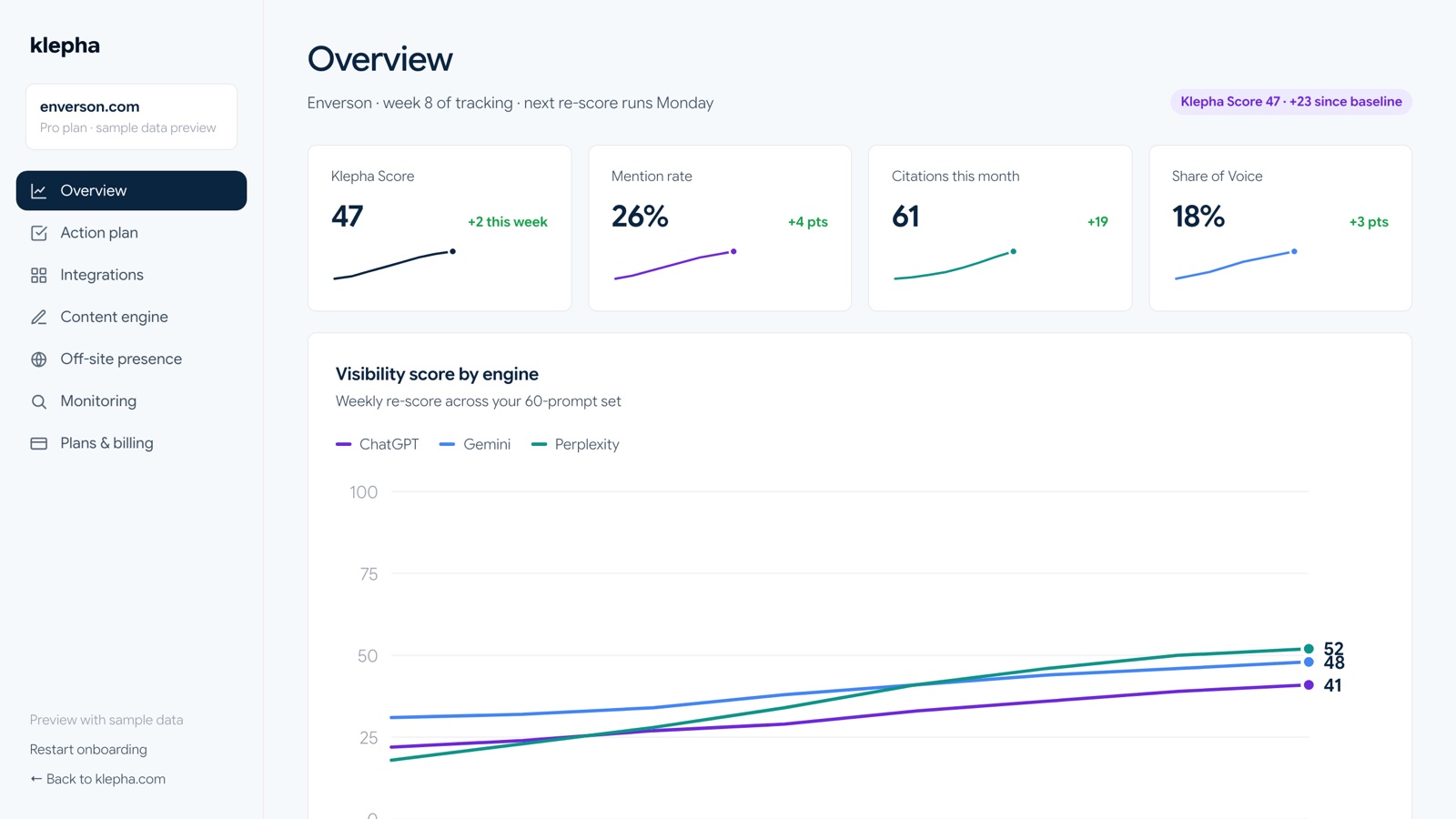
Two channels, one report. The temptation is one number, and that is the mistake that makes the whole exercise useless.
The five numbers
1. Queries in the top ten. A count, trended monthly. The clearest proxy for organic visibility and unusually hard to game, because it moves only when something meaningful happens. Better than average position, which mixes a page going from 90 to 40 with one going from 4 to 3.
2. Non-branded organic clicks. Branded traffic reflects marketing generally; non-branded reflects search specifically. Split them with a regex filter on your brand terms and report only the second here.
3. Share of voice in AI answers. Across a fixed prompt set, what proportion of named brands are you, against two named competitors? This is the most legible AI number for an audience outside the team, because it is immediately comparable.
4. AI referral sessions, with conversion rate alongside. Configured as its own analytics channel covering the assistant referrer domains. Small volume, usually high quality, and invisible unless you set it up deliberately.
5. Factual errors. A count of incorrect claims assistants make about you — wrong pricing, missing features, stale positioning. Frequently the most urgent line on the report and the one nobody thinks to include.
Why not one score
Three reasons a blended index fails, and they compound.
Different response times. Title rewrites show in one to three weeks. Corroboration work takes one to two quarters. A composite averages a fast-moving number with a slow-moving one, producing a line that is mostly noise from the fast component.
Different variance. Search Console data is stable. AI answers vary between identical runs by design, since generating text involves sampling. Blending a stable measure with a noisy one contaminates the whole index.
It hides the actionable finding. The useful information is almost always in the divergence — rankings up and AI visibility flat is a specific diagnosis with a specific fix. A composite that stays level while those two move in opposite directions reports nothing at all.
Report the two channels adjacently, never merged. The gap between them is where every finding lives.
Assembling it
Four sources, configured once.
Search Console for numbers one and two. Export monthly to your own storage — Search Console retains sixteen months, and anything older is gone permanently, which makes a year-over-year comparison in month eighteen impossible unless you started archiving in month one.
A prompt-tracking process for numbers three and five. A fixed set of twenty to sixty buyer questions, run against ChatGPT, Gemini and Perplexity, several times each, with the answers stored. Manual is viable for a baseline and collapses under weekly repetition.
Analytics for number four, with a channel group covering chatgpt.com, perplexity.ai, gemini.google.com, claude.ai and copilot.microsoft.com.
A dated change log. Not a metric, and the thing that makes the metrics interpretable. Five lines a month recording deploys, migrations, content updates and known algorithm updates turns “why did this move?” from an investigation into a lookup.
Both halves in one report
Klepha reports Search Console data alongside prompt-level AI visibility, with every answer stored so numbers trace back to evidence.
Run my free scanThe weekly fifteen minutes
Three questions, no report, no meeting.
- Has anything dropped out of the top ten that was in it last week?
- Has anything entered the 8–20 band that was not there before? That is an opportunity rather than a problem.
- Has CTR fallen anywhere with stable position? Usually means the results page changed around you rather than anything on your side.
Add a fourth if you are running an active AI programme: did anything appear in the AI scan that has not appeared before — a new competitor being named, or a new factual error.
Anything more elaborate becomes a ritual nobody sustains past a month.
The monthly report
One page. The five numbers, each with the previous month and the same month last year, and one sentence of context each.
Then three lines of narrative: what moved, what caused it according to the change log, and what is being worked on next. Resist the urge to explain every fluctuation — most month-to-month movement is variance, and a report that assigns a cause to noise trains people to distrust the causes you assign to real changes.
Two things to leave out. Rankings for a handpicked keyword set, which is the metric most vulnerable to selection bias, and once a stakeholder notices the list changes when results are awkward, every other number loses credibility with it. And any single AI scan presented as a result, since answers vary between runs and a stakeholder who learns a number moved eight points because of sampling will discount the whole report.
Reading the combinations
The value of adjacent reporting is that the combinations are diagnostic.
Rankings up, AI visibility flat. Almost always the mechanical requirements — content only rendering after JavaScript, or blocked crawlers. Those gate AI entirely while costing rankings nothing, which is exactly why this combination appears.
AI visibility up, rankings flat. Corroboration is working. Third-party sources now describe you consistently, which assistants weight heavily and Google weights less directly. Expect rankings to follow slowly as the resulting links accumulate.
Both flat, clicks down. Check AI Overview presence on your top queries. Position holding while clicks fall is the signature of an overview absorbing the click, and no amount of ranking work fixes it.
Both up, conversions flat. You are winning the wrong queries. Segment by intent — growth concentrated in informational traffic will not move pipeline.
Errors rising. Something stale is propagating. Trace it through the citation list to its source and correct there, not just on your own site.
Reporting to different audiences
The same five numbers need three different framings depending on who is reading.
For the team. All five, plus the change log, plus the raw answers behind any AI number that moved. The detail is the point — this is the working document that decides next month’s tasks.
For a marketing lead. Three numbers: queries in the top ten, non-branded clicks, and share of voice against two named competitors. One sentence each on what moved and why. The AI number is best presented as a comparison rather than an absolute, because there is no benchmark to compare an absolute against.
For an executive audience. One number they already care about — pipeline or conversions from organic — plus one screenshot of an assistant recommending competitors and not you. That screenshot does more to secure a budget than any chart, because it is the actual product rather than a derived metric.
What to do when the two channels disagree
The most common awkward month is one where organic clicks fall and AI share of voice rises. Both numbers are correct and the instinct is to lead with the one that looks better.
Lead with the fall, explain it, then report the rise. If clicks fell because AI Overviews now appear on a set of queries where your position is unchanged, that is a specific, evidenced explanation rather than an excuse — and it is considerably more credible delivered proactively than extracted under questioning.
The reverse case, rankings up and AI visibility flat, deserves the same treatment. It almost always means a mechanical AI issue is unfixed, which is a named problem with a named owner rather than a mystery.
The credibility rules
Two habits protect the report from the scrutiny it will eventually receive.
State the limitations in the report itself. AI Overview clicks arrive as ordinary Google organic. Missing referrers land in direct. Answers vary between runs. A number presented with its caveats survives challenge; the same number presented as complete does not.
Never change the keyword or prompt set to improve the numbers. It is the fastest way to lose credibility permanently, and it will be noticed. Add to a clearly-labelled second cohort instead, and keep the original comparable.
One tool or several
Several works. One is better, for a reason that is not convenience.
The interesting findings live at the join between the two datasets. A page that ranks first and is never cited is only visible when both numbers sit in the same view. A competitor who ranks below you and is named ahead of you is only visible when the two are compared directly. Split across two tools, those findings require someone to deliberately go looking, and nobody does that every month.
Whatever you use, insist on one property: the ability to open the raw answer behind any AI number. Generated responses vary between runs, so a score you cannot trace back to a stored response is a claim rather than a measurement — and in a report that has to survive scrutiny, that distinction is the whole basis of trusting the data.
Sources
- Pew Research Center — approximately 68,000 real search queries; clicks fell from 15% to 8% of visits when an AI summary was present.
- Google Search Console documentation — sixteen-month data retention and average position methodology.
- Ahrefs — CTR impact of AI Overviews; approximately 58% decline for top-ranking pages (February 2026).
Frequently asked questions
How can I monitor my website’s SEO and AI performance in one place?
Report five numbers side by side: queries in the top ten, non-branded organic clicks, share of voice in AI answers against named competitors, AI referral sessions, and the count of factual errors assistants state about you. Report them separately rather than blending them, because the channels move at different speeds and a composite cannot be attributed.
Should I combine SEO and AI metrics into one score?
No. The two channels respond to different work on different timelines, so a blended index moves for reasons nobody can attribute and hides the finding that matters — which channel is underperforming and why. Report them adjacently rather than merged.
What tools do I need to monitor both?
Search Console for the organic half, an analytics platform with a properly configured AI referral channel, and something that runs prompts against the assistants on a schedule and stores the answers. That last part is the only one that requires a purchase, and free scans exist to establish whether it is worth one.
How often should I review both channels?
Fifteen minutes weekly for anomalies and a proper report monthly. Weekly is enough to catch a problem early; anything more frequent produces noise-driven decisions, because both channels have substantial short-term variance for reasons unrelated to your work.
What does it mean if rankings improve but AI visibility does not?
Usually that the mechanical AI requirements are unmet — content only rendering after JavaScript, or blocked crawlers — since those gate AI visibility entirely while costing rankings nothing. If those check out, the gap is corroboration: your pages are fine and the wider web does not describe you consistently.
What if AI visibility improves but traffic does not?
That is expected rather than a failure. AI search mostly produces shortlist entries rather than sessions, and Pew Research found clicks fell from 15% to 8% of visits when an AI summary was present. Judge AI visibility on share of voice against competitors, and treat referral traffic as a secondary benefit.