Gemini 4 Hydrogen is now the default model in Google AI Mode. What does it change for citations?
On November 12, 2026, Google made Gemini 4 Hydrogen the default model in AI Mode for all users worldwide, and Google Search VP Robby Stein said it also answers the hardest questions in AI Overviews. Google says Hydrogen improves query fan-out and connects people to "a broader range of helpful links," but it published no figures, and the switch landed two days into the November 2026 core update, so any change in your AI citations this month has two possible causes.
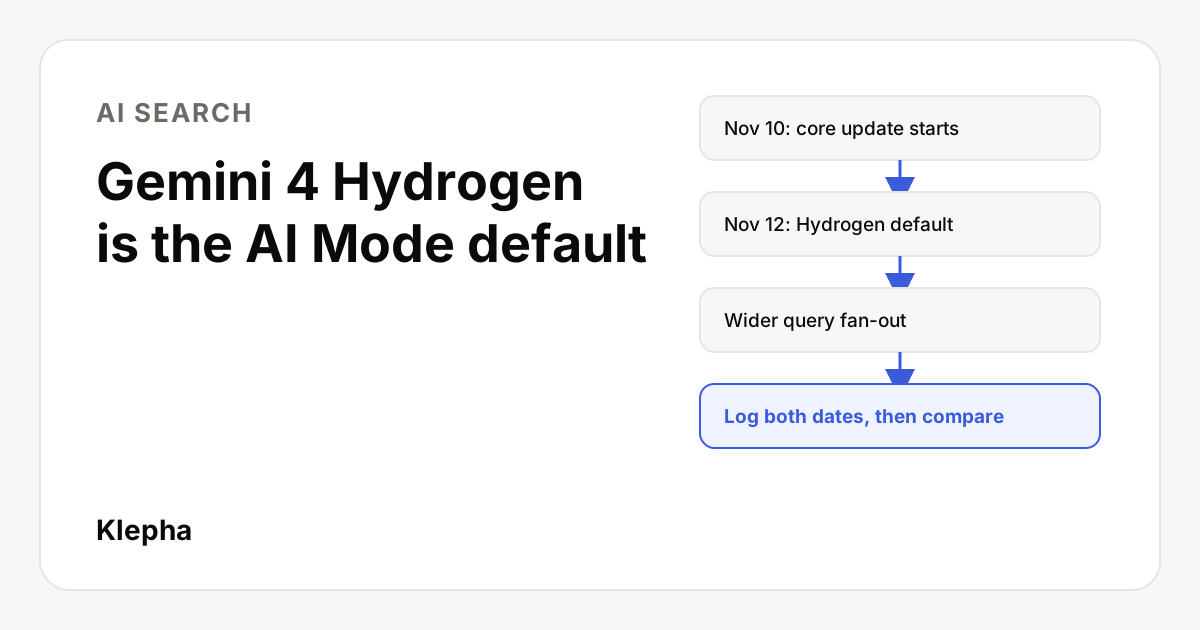
Gemini 4 Hydrogen is the model Google introduced on November 12, 2026 as fast, efficient and "bringing cutting-edge intelligence to everyone." The same day, Google said Hydrogen is "now available globally in Google Search for all users," and Search Engine Journal confirmed it became the default model in AI Mode, two days into the November core update.
For brands that track how often AI Mode cites them, this is the first Gemini 4 model that every searcher gets by default. That makes it more important for visibility than Gemini 4 Carbon, which we covered two days earlier and which stays limited to paid subscribers. This guide separates what Google confirmed from what it did not, explains what better query fan-out could mean for your citations, and shows how to read AI Mode tracking data for November without blaming the wrong change.
Key takeaways
- Default for everyone since November 12, 2026. Google's Search post says Hydrogen is available globally in Search for all users; Search Engine Journal reports it is the AI Mode default.
- Also used in AI Overviews, partly. Robby Stein said Hydrogen handles "your hardest questions" in AI Overviews. Google has not defined which questions count.
- Google claims more links, without numbers. Improved query fan-out should connect people to "a broader range of helpful links," but no counts were published.
- Two changes overlap. The November 2026 core update started on November 10 and was still rolling out on November 13. Annotate both dates.
- Measure before you rewrite. Compare citations before November 10, between November 10 and 12, and after November 12, prompt by prompt.
What is Gemini 4 Hydrogen?
Hydrogen is the fast, general purpose member of Google's Gemini 4 family. In its November 12 announcement, Google DeepMind's Koray Kavukcuoglu described it as built "with speed and efficiency for everyday coding and agentic workflows." Google positions it next to two heavier models: Gemini 4 Carbon and Gemini 4 Argon, which Google says "excel at deep, long-horizon reasoning on your hardest problems," while "Hydrogen is built for rapid execution across diverse agentic workflows."
Unlike Carbon, Hydrogen is not limited to paid tiers. Google lists it for all tiers of Google AI Studio, the Gemini API, Gemini for business, the Gemini app and Google Search. For developers, Google quotes a flat API price of $1.50 per million input tokens and $7.50 per million output tokens across its 1 million token context window. That pricing matters for teams building on the API, not for searchers.
Google also reports that Hydrogen slightly outscores Argon on the Artificial Analysis Intelligence Index at its default thinking level, 51 against 50. That is a general model benchmark chosen and reported by Google. It says nothing about AI Mode answers or which websites get cited.
Where does Hydrogen run in Google Search?
Google's Search post, also by Robby Stein, calls this "the biggest model upgrade to Search yet." Here is what each source confirms, as of November 13, 2026.
| Surface | Model situation | Source |
|---|---|---|
| AI Mode, default answers | Gemini 4 Hydrogen for all users, worldwide | Google Search post; Search Engine Journal |
| AI Mode, model menu | "Everyday help (4 Hydrogen)" and "Most complex work (4 Carbon)"; Carbon for Ultra subscribers with daily limits | Stein's screenshots via Search Engine Journal; AI Mode help page |
| AI Overviews | Hydrogen for "your hardest questions"; the rest not specified | Robby Stein on X, via Search Engine Journal |
| Previous AI Mode default | Gemini 3.5 Flash since Google I/O in May; Google did not say what Hydrogen replaced | Search Engine Journal |
Two gaps are worth noting. Google has not said which AI Overview queries count as "hardest," so you cannot yet tell how much of your AI Overview tracking reflects Hydrogen. And Google's Search post does not mention AI Overviews at all; that detail comes from Stein's thread.
What does Google say changes in answers?
Google lists four improvements in the Search post. In plain terms:
- Better understanding of intent. Search should handle questions "with multiple parts, hard-to-understand typos, or highly specific requests," with "deeper instruction following and tool calling."
- Improved query fan-out and linking. Hydrogen runs "simultaneous queries across all the relevant subtopics," which Google says connects people "to a broader range of helpful links than before" and to "sites you previously might not have discovered."
- More visual responses. More images, structured responses, comparison tables and custom tools.
- Richer language understanding across all languages AI Mode supports.
The second point is the one that touches publishers directly. Query fan-out is the technique where AI Mode breaks a question into subtopics, searches each one, and assembles an answer from the results. More thorough fan-out means more searches behind each answer, which in principle means more pages that can be retrieved and cited. Stein's thread repeats that the fan-out improvements show more links to the web. Neither he nor the Search post gives a count of links, sites or clicks.
Could Hydrogen change which sites AI Mode cites?
Probably, because it is the default for everyone and Google says linking changed. But the direction for any single site is unknown, and nobody outside Google has published before and after data yet. Here is what can reasonably be inferred, labelled as inference:
- Subtopic coverage should matter more. If AI Mode searches every relevant subtopic of a question, a page that answers one specific sub-question clearly has more chances to be pulled in, even if it does not rank for the head term. This is the same logic behind our guide on how LLMs choose sources.
- Specific, constraint-heavy questions favor explicit facts. Google says Hydrogen follows "highly specific requests" more precisely. A buyer who asks for a tool with a certain price, integration and language can only be pointed to your page if those facts are stated in plain text.
- Structured answers reward structured data on the page. More comparison tables in answers means more demand for clean, comparable facts. Pages with honest HTML tables of plans, specs or limits are easier to draw from than pages that bury them in images.
- Long tail sites may gain exposure. Google's phrase "sites you previously might not have discovered" suggests a wider spread of sources. If true, concentrated citation shares for big publishers could thin out, but that is Google's framing, not measured data.
None of this is a reason to rewrite your site this week. It is a reason to check whether your pages answer the sub-questions buyers actually ask, which we cover in how to rank in Google AI Overviews and what content ranks in AI answers.
Why does the November core update complicate the picture?
Google's Search Status Dashboard shows the November 2026 core update started on November 10 at 10:06 Pacific time, applies globally and to all languages, and "may take up to 2 weeks to complete." On November 13 it was still listed as rolling out. Hydrogen became the AI Mode default on November 12, inside that window.
That overlap matters because AI Mode builds answers from web results. A core update can move which pages rank for the fan-out queries, and a model change can move which of those results get selected and cited. If your AI Mode citations rise or fall between November 10 and late November, either change could be responsible, or both. Our guide to the 2026 core updates explains why it pays to wait until a rollout completes before acting.
| Date (2026) | Event | What to log |
|---|---|---|
| October 13 | Gemini 4 Argon added to AI Mode as an option for AI Pro and Ultra subscribers | Optional model, small audience |
| November 10 | November 2026 core update starts; Gemini 4 Carbon rolls out to Ultra subscribers in AI Mode | Annotation A |
| November 12 | Gemini 4 Hydrogen becomes the AI Mode default for all users | Annotation B |
| Core update end date | Not yet announced as of November 13 | Annotation C when Google posts it |
How should you read AI Mode tracking data this month?
Treat November as three periods, not one. Search Engine Journal's advice is the right starting point: log both dates so you can compare data before and after each change instead of reading the month as a single shift. In practice:
- Annotate November 10 and November 12 in every report that includes AI Mode or AI Overview data, including your rank tracker, analytics and any AI visibility tool.
- Split your prompt tracking into three windows: before November 10, November 10 to 11, and from November 12. The middle window is short, so treat it as a sanity check, not a baseline.
- Compare the same prompts. Use a fixed set of buyer questions and compare which domains are cited, how many sources appear per answer, and whether your brand is named. A change in the number of links per answer is the most direct test of Google's "broader range of links" claim.
- Separate head terms from specific questions. If Hydrogen helps with "highly specific requests," long, multi-constraint prompts should change more than short ones. If both shift equally, the core update is the more likely cause.
- Check classic rankings for the same topics. If your blue link rankings moved for the fan-out queries behind a prompt, the core update is in play. If rankings held but citations changed, the model is the likelier driver.
- Wait for the rollout to finish. Analyze a full week after Google marks the core update complete before drawing conclusions or changing pages.
Get a baseline before the next model change
A free Klepha report shows how ChatGPT, Gemini and Perplexity describe your brand for the questions buyers ask, and which sources they cite instead of you.
Get my free reportWhat should you check in Search Console and analytics?
Google said there will be more links, so the honest test is your own referral data. AI Mode clicks are reported inside Google Search traffic, so look at patterns rather than a dedicated channel:
- Pages gaining impressions for long, question-style queries after November 12, which can signal more fan-out exposure.
- Landing pages that rarely received organic traffic but now do, especially deep pages that answer narrow sub-questions.
- Click-through rate on informational queries, compared week over week and against the same weeks last year to account for seasonality.
If you track AI answers directly, record the number of cited sources per answer as well as whether you are one of them. A brand can lose share of citations even while total links per answer go up, and that is invisible if you only record yes or no. Our guide on how to track AI brand visibility covers a simple logging setup, and Klepha's ChatGPT Ranking service applies the same method across assistants.
What should site owners do now?
- Do nothing drastic during the core update. Large edits made now are hard to evaluate later.
- List the sub-questions behind your money queries. For each important buyer question, write down the three to five subtopics AI Mode would likely search. Check whether you have a clear, self-contained answer for each.
- Make key facts explicit. Prices, limits, supported platforms, locations and comparisons should be in plain HTML text and tables, not only in images, PDFs or scripts.
- Keep pages fast and crawlable. Fan-out is still search. If Googlebot cannot render your content, a better model cannot cite it.
- Revisit in December with clean before and after windows, then decide what to change.
If you want help building that kind of evidence base, our expertise page explains how we approach generative engine optimization, and our case studies show how we measure it without promising placements no one can guarantee.
What is still unconfirmed?
| Claim | Status as of November 13, 2026 |
|---|---|
| Hydrogen is the default AI Mode model for all users | Confirmed (Google Search post, Search Engine Journal) |
| Hydrogen answers some AI Overview questions | Confirmed by Robby Stein for "hardest questions"; scope undefined |
| AI Mode now shows more links | Google's claim; no counts published |
| Specific sites gain or lose citations | Unknown; no public data yet |
| Which model Hydrogen replaced | Not stated by Google |
Sources
- Google (Robby Stein), "Google Search gets a major upgrade with Gemini 4 Hydrogen", November 12, 2026, accessed November 13, 2026. blog.google
- Google (Koray Kavukcuoglu), "Introducing Gemini 4 Hydrogen", November 12, 2026, accessed November 13, 2026. blog.google
- Search Engine Journal (Matt G. Southern), "Google Makes Gemini 4 Hydrogen The Default Model In AI Mode", November 12, 2026, including Robby Stein's X thread and screenshots. searchenginejournal.com
- Google Search Status Dashboard, "November 2026 core update", incident started November 10, 2026, accessed November 13, 2026. status.search.google.com
- Google Search Help, AI Mode help page (model options), as cited by Search Engine Journal on November 12, 2026. support.google.com
Frequently asked questions
What is Gemini 4 Hydrogen?
Gemini 4 Hydrogen is a Google model released on November 12, 2026 and built for speed and efficiency. Google offers it in the Gemini app, Google Search, AI Studio and the Gemini API, and positions it below Gemini 4 Carbon and Argon, which handle longer, deeper reasoning.
Is Gemini 4 Hydrogen the default in Google AI Mode?
Yes. Since November 12, 2026, Hydrogen is the default AI Mode model for all users worldwide. Google AI Ultra subscribers can still choose Gemini 4 Carbon from the model menu for complex work.
Does Gemini 4 Hydrogen power AI Overviews?
Partly. Robby Stein of Google said Hydrogen is used for the hardest questions in AI Overviews, but Google has not said which questions count as hardest or which model answers the rest.
Will Hydrogen send more traffic to websites?
Google says improved query fan-out connects people to a broader range of helpful links than before, but it published no figures. Check your own referral and Search Console data before assuming a gain or a loss.
How do I separate the Hydrogen change from the November core update?
Annotate November 10, when the core update began, and November 12, when Hydrogen became the default. Compare a fixed prompt set across those windows, check whether classic rankings also moved, and wait a week after the core update completes before acting.
Should I change my content because of Gemini 4 Hydrogen?
Not specifically. Make sure each important page answers the sub-questions buyers ask, states prices, limits and comparisons in plain text, and is easy to crawl. That helps with any model that uses query fan-out.