What happened to clicks after Google AI Overviews launched in France, and what can other sites learn?
Google launched AI Overviews and AI Mode in France on July 22, 2026, and Search Console data shared by SEO consultant Glenn Gabe shows some sites losing roughly half of their daily Google clicks overnight, with one YMYL site falling about 69%, while impressions stayed flat. But two of the five sites he showed kept stable clicks, so the impact depends on the queries a site depends on, not on being in France.
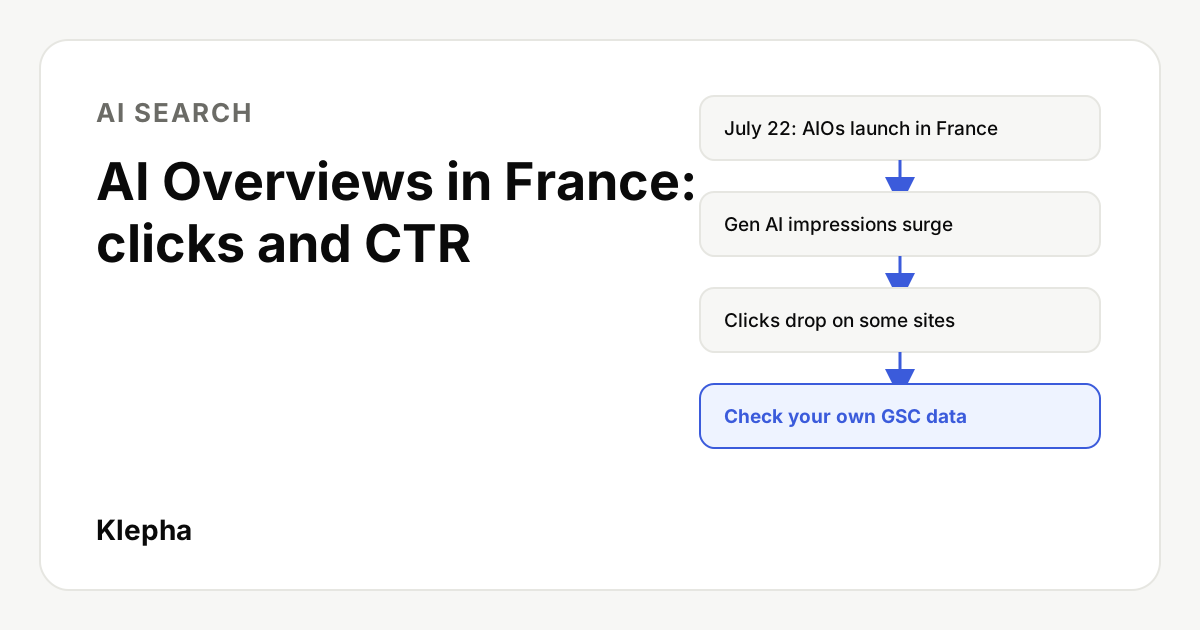
The French rollout is unusual because it has a clean start date. Google switched on AI Overviews, AI Mode, Search Live and its new search box in France on a single day, July 22, 2026, and Search Console now has generative AI reporting. That combination let Gabe line up the moment AI Overviews appeared against clicks, impressions, click-through rate and average position, site by site. Search Engine Land summarized his findings on November 9, 2026.
This guide walks through the five cases, explains which kinds of sites lost the most, flags the measurement traps in the data, and turns it into a checklist you can run on your own Search Console property, whether or not you have French traffic.
Key takeaways
- Clean date: AI Overviews and AI Mode launched in France on July 22, 2026, which makes before and after comparisons unusually clear.
- Big losses for some: one site fell from about 750 to 400 daily clicks (about 47%) with stable impressions; CTR dropped from 2% to 1.1%.
- YMYL hit hardest in the sample: one YMYL site fell from about 80 to 25 daily clicks; another saw CTR drop from 1.2% to 0.4%, with a second drop around August 13.
- Not everyone lost: two of five sites kept stable clicks despite surging generative AI impressions.
- Position data wobbles: average position moved on July 22 even for stable sites, likely because of how collapsed and expanded AI Overviews are counted.
What did the France analysis find?
Gabe filtered Search Console's Performance reports to France, first checking the generative AI report for the surge in AI impressions, then switching to the Web Search report with the same country filter to see clicks, impressions, CTR and average position. He shared five sites. All five saw generative AI impressions jump on July 22. What happened to clicks differed sharply.
| Case | Type of site | Clicks | CTR | Impressions |
|---|---|---|---|---|
| 1 | Not specified | About 750 to 400 per day (about 47% lower) | 2% to 1.1% | Stable |
| 2 | YMYL | About 80 to 25 per day (about 69% lower), second drop around August 10 | Stable, because impressions also fell | Dropped about a week before the rollout |
| 3 | YMYL | Double drop: July 22, then around August 13 | 1.2% to 0.4% (about 67% lower) | Stable until early September |
| 4 | Not specified | Stable; summer dip recovered by early September | Strong throughout | Relatively stable |
| 5 | Not specified | Mostly stable | Relatively stable | Relatively stable |
Percentages for cases 1 and 2 are Search Engine Land's calculations from Gabe's daily figures. These are five sites chosen by one consultant, not a representative sample, and the timing alone does not prove AI Overviews caused every decline. Search Engine Land notes both limits.
Which sites lost the most?
In Gabe's sample, the heaviest losses were on sites where clicks fell while impressions held. That pattern means the site still ranked but searchers stopped clicking, which is what you would expect if an AI Overview answered the question on the results page.
YMYL ("Your Money or Your Life") sites, which cover health, finance and similar topics, stood out for a second reason: a double drop. Several YMYL sites lost clicks on July 22 and again a few weeks later. Gabe's interpretation is that Google first held back AI Overviews on sensitive queries and then expanded them: "I believe this was Google rolling out AIOs for additional query types after the initial rollout testing." That is his reading, not a Google statement, but the pattern repeated across several YMYL sites he monitors.
The sites that held steady are just as instructive. Both had large increases in generative AI impressions, so AI Overviews were showing for their queries, yet clicks did not fall. Gabe does not identify the query mix, but the likely difference is intent: queries where people still need to visit a site (to buy, compare, log in, or read in depth) are less exposed than quick factual questions.
Why do some sites lose clicks and others do not?
Based on this data and what earlier studies show, four factors decide how exposed a site is:
- Query intent. Informational, answerable questions are most exposed. Navigational and branded queries keep higher CTRs, a point Gabe makes directly: "Branded and navigational queries will yield higher CTRs than non-branded queries."
- Whether the AI Overview is collapsed or expanded. Gabe notes that Google began showing some AI Overviews expanded by default in late August, which takes more space and pushes classic results down.
- Topic sensitivity. YMYL topics appear to have received AI Overviews in a second wave in France, so the timing of losses differs.
- Whether you are cited. Being a cited source inside the AI Overview does not guarantee clicks, but it keeps your brand visible when blue link clicks fall.
These factors match what we found when reviewing the published CTR studies in the AI Overviews engagement drop, measured: the average decline is less useful than the decline for your own query mix.
What measurement traps does the France data reveal?
The analysis also shows how easy it is to misread Search Console after an AI rollout.
- Average position wobbles. Position changed on July 22 for almost every site Gabe analyzed, including stable ones. His explanation: a citation inside a collapsed AI Overview only earns an impression when someone expands it, while the same site's blue link registers at a lower position. Do not treat a position swing as a ranking change without checking clicks and the live results page.
- CTR can hide a drop. In case 2, CTR looked stable because impressions fell at the same time as clicks. Always read clicks and impressions together.
- Seasonality can mask losses. Gabe warns that a site with a normal autumn surge may look flat when it is actually down against last year. Compare year over year.
- Unrelated drops overlap. One site's impressions fell a week before the rollout, in other countries too. Check other markets before blaming AI Overviews.
See whether AI answers mention you
Search Console shows what Google sends you. A free Klepha report shows how ChatGPT, Gemini and Perplexity describe your brand and which sources they cite instead.
Get my free reportHow can you check your own site?
Gabe's steps work for any country where AI features launched on a known date. Adapted into a checklist:
- Filter by country. In Search Console, open the generative AI report and filter to the country. Gabe notes the filter carries over to the other reports, which saves time.
- Find the launch date in the generative AI impressions chart, then switch to Web Search and compare clicks, impressions, CTR and position before and after.
- Sort queries by lost clicks. Open the queries that fell most and look at the live results page. Is there an AI Overview? Is it expanded? Are you cited?
- Find the queries without AI Overviews. Gabe calls this "very important for your content team": these are where classic SEO still drives the most clicks.
- Segment by intent. Separate branded, navigational, commercial and informational queries. Read each segment's change on its own.
- Compare year over year to strip out seasonality.
- Report it. Gabe recommends telling stakeholders what you see so traffic targets reflect the new results page.
If you are not sure where your traffic loss started, our guide on why website traffic drops covers how to separate algorithm updates, technical problems and AI features.
Does the France data apply to other countries?
Partly. France is useful because the start date is clean, not because French searchers behave differently. The mechanisms Gabe describes, stable impressions with falling clicks, position wobble from collapsed AI Overviews, and later waves for sensitive topics, are features of how AI Overviews and Search Console work, so similar patterns are plausible wherever AI Overviews launch or expand.
What does not transfer is the size of the effect. Query mix, language, competition and how often Google expands AI Overviews by default all differ by market and by site. A site that lost little in France might lose more in a market where its queries are more informational, and the reverse. Gabe himself suggests using France to "better understand the impact that might have occurred in other countries," which is the right framing: a clear reference point, not a forecast.
If you operate in several markets, run the same analysis per country with the country filter, and compare against each market's launch or expansion date where you know it.
What should other sites learn from France?
Three lessons travel well beyond France:
- Expect uneven impact. Some sites lose half their clicks and some lose almost nothing. Plan from your own data, not from averages.
- Shift effort toward queries that still earn clicks and toward citations. Strengthen pages for commercial and comparison queries, and make informational pages easy to cite with direct answers, clear structure and named sources. Our guide on how to increase AI citations covers the page patterns that get selected.
- Measure AI visibility directly. When clicks fall but impressions hold, the question becomes whether AI answers mention you. That needs prompt tracking alongside Search Console, which is what our Blog Ranking and ChatGPT Ranking services are built around.
Nothing here guarantees recovery. What the France data does show is that the sites best placed to adapt are the ones that know which queries they depend on. Our case studies show how we set up that measurement for in-house projects, and our expertise page describes the method.
Sources
- Glenn Gabe (GSQi), "The Impact of Google AI Overviews rolling out in France: The clearest evidence of impact to clicks and click-through rate yet [GSC Data]", November 9, 2026, accessed November 13, 2026. gsqi.com
- Search Engine Land (Danny Goodwin), "Google AI Overviews in France: Big click losses, but not for everyone", November 9, 2026. searchengineland.com
- Rajan Patel (Google), announcement of AI Overviews, AI Mode, Search Live and the new search box launching in France, July 22, 2026, as embedded in Gabe's analysis. x.com
Frequently asked questions
When did Google AI Overviews launch in France?
Google launched AI Overviews, AI Mode, Search Live and its new search box in France on July 22, 2026, according to Google's Rajan Patel.
How much traffic did French sites lose to AI Overviews?
It varied. In Glenn Gabe's Search Console examples, one site fell from about 750 to 400 daily clicks, a YMYL site fell from about 80 to 25, and another YMYL site saw CTR fall from 1.2% to 0.4%. Two of the five sites kept stable clicks.
Which sites were hit hardest?
In this sample, sites whose clicks fell while impressions stayed flat, and YMYL sites in health or finance, which also saw a second drop a few weeks after launch. The sample is small, so check your own data.
Why did average position change after the rollout?
Gabe suggests citations in collapsed AI Overviews only register impressions when expanded, while the same site's blue link records a lower position. That makes average position swing even when rankings have not really changed.
How do I check AI Overviews impact in Search Console?
Filter the generative AI report to the country, find the launch date, then compare clicks, impressions, CTR and position in the Web Search report. Review the queries that lost clicks on the live results page and compare year over year.